Dismantling science and economic analysis at the US Environmental Protection Agency creates new challenges—but also provides an opportunity to reenvision the role of science and economics in policy design.
Air-quality regulations in the United States have largely been an environmental and economic success story. Americans have the largest, most robust economy in the world—and at the same time, some of the best air quality. But recent deregulation by the Trump administration and the 119th US Congress have slowed or reversed this pattern, prompting large portions of the general public, and environmental economists like us, to ask: What can we do to prevent the loss of these earlier successes and reintroduce data-driven decisions into good policy design?
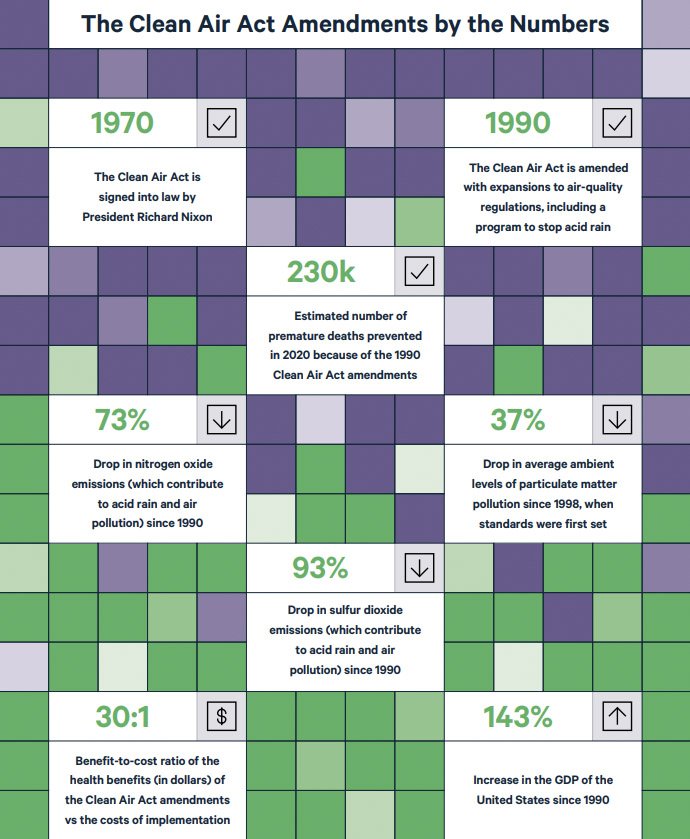
Air-quality policies over the past five decades have followed from what is arguably the most effective environmental legislation in the United States: the Clean Air Act of 1970 and its amendments in 1977 and 1990. More recently, greenhouse gas emissions have started to fall, in part due to the endangerment finding (a federal decision that enabled agencies to enact regulations with the understanding that greenhouse gases are air pollutants) and the passage of the Inflation Reduction Act of 2021 (the most significant nationwide climate policy in US history). Ultimately, the past 30 years have seen steady reductions in air pollutants, even while the US economy doubled in size.
Science and economics played important roles in all aspects of these regulatory successes. Scientific evaluation of national ambient air-quality standards has supported a robust standard-setting process that has continued to advance public health protections, including the recent tightening of the annual standards that regulate particulate matter pollution (from 12 micrograms to 9 micrograms per cubic meter), which reflects stronger scientific evidence of adverse health effects at levels below the previous standard. Likewise, regulatory impact analyses (RIAs) for proposed rulemakings at the US Environmental Protection Agency (EPA) have provided the public with information on the economic benefits and costs of different regulatory alternatives and have demonstrated the large net benefits that could be achieved through regulations on the power sector, vehicles, and industrial sources.
The benefits of regulating air pollution far outweigh the costs, as documented by a range of economic and epidemiological assessments across federal agencies and academic institutions. The most recent report published by EPA on the benefits and costs of the Clean Air Act amendments estimates that the benefits of the amendments in 2020 include the prevention of 230,000 premature deaths, millions of asthma attacks, and other negative health effects, valued at $2 trillion. These benefits compare with $65 billion in costs—a ratio of 30 to 1.
In spite of these clear net benefits, recent actions by the Trump administration and the 119th US Congress have slowed or reversed this pattern. Since January 20, 2025, the policy and regulatory foundations supporting environmental protections have changed dramatically.
Two Trump administration decisions do the most to threaten the success of evidence-based environmental regulation: the decision to not quantify the health benefits of regulations, and the elimination of EPA’s independent Office of Research and Development (ORD).
In a recent blog post, we addressed EPA’s decision earlier this year to stop quantifying the health benefits of regulating air pollution, reducing the usefulness of EPA’s regulatory impact analyses. Benefit-cost analysis, the most common economic tool for regulatory decisionmaking, is not a perfect measure of social welfare. But the beauty of a well-designed benefit-cost analysis is that it forces a transparent consideration of all underlying assumptions, data, and uncertainties. We showed that the Trump EPA’s decision to not quantify health benefits is not consistent with science, best practices in economics, or the federal government’s own guidelines on benefit-cost analysis. The decision was made as EPA was moving forward with a broader deregulatory program that questioned the health benefits of regulations and emphasized cost savings.
Credit: James Round
The most far-reaching environmental legislation in decades, the Inflation Reduction Act, was largely dismantled with the budget reconciliation bill that President Donald Trump signed on July 4, 2025. More recently, EPA rolled back standards for vehicle emissions, standards for vehicle efficiency, and greenhouse gas standards for electric utilities. Wind projects have been canceled at great taxpayer expense, coal plant retirements have been reversed, air-pollution standards have been threatened and disrupted, and some electricity generators that support data centers have been given a pass on air-quality standards. Benefit-cost analyses accompanying major deregulatory actions have been stripped of their health impacts, their emissions reductions and monetary benefits forgone (including climate benefits), making standard benefit-cost analysis impossible and distorting the understood impacts of regulatory repeals. EPA has also undergone structural changes, perhaps most egregiously through the elimination of the agency’s ORD.
In short, the current administration has upended the environmental and energy-policy landscape and challenged how economic theories and practice are implemented across the federal government. Deregulatory actions by the Trump administration and the 119th US Congress have disrupted a decades-long trajectory of both improving the environment and benefiting the economy, which prompts environmental economists like us to ask: What happens next?
Out of the Ashes: Can Environmental Economics Reach New Heights in a Future Policy Landscape?
The Clean Air Act is far-reaching and addresses air pollution by setting standards for national ambient air quality, technology related to toxic air pollution, and fuels and engines; establishing the Acid Rain Program to control sulfur dioxide and nitrogen oxides from power plants; and requiring permitting for emissions sources. These laws laid the foundations for regulations that have brought cleaner air across the nation. They made space for innovative, economically sound policies like market incentive programs. With recent regulations rolled back, gone are the forces that have kept the United States moving toward cleaner air, and air quality has the potential to worsen as a result.
The more recently recognized challenges of responding to climate change—decarbonizing to address greenhouse gas emissions and adapting to climate-related risks—are driving new policies and regulations. But actions to reduce greenhouse gas emissions are proceeding at a much slower pace than for traditional air pollutants. Because they were not directly regulated until after the 2009 endangerment finding, greenhouse gases have persisted compared to other air pollutants (dropping less than 2 percent from 1990 levels). Following the implementation of emissions regulations on vehicles and power plants and provisions in the 2021 Inflation Reduction Act, greenhouse gas emissions started to fall and were on a trajectory toward substantial reductions over the next 30 years. That progress has now been stalled, at least at the federal level, due to the rescission of the EPA endangerment finding and the repeal of greenhouse gas regulations.
Through recent actions, EPA has taken the practice of RIAs backward and undermined their future validity. Since the January 2026 decision to not quantify air-quality benefits, EPA has published RIAs for multiple proposed and final deregulatory rules. These recent rules include the National Emissions Standards for Coal- and Oil-Fired Electric Utility Steam Generating Units, the repeal of the 2024 amendments to the Mercury and Air Toxics Standards, the Large Municipal Waste Combustors: New Source Performance Standards and Emissions Guidelines, and the repeal of the endangerment finding and related vehicle standards.
None of these analyses include quantified or monetized health impacts for particulate matter and ozone, and report on only half of the equation: the cost. This incomplete approach by EPA has led to the questionable conclusion that rolling back regulations has a positive impact on society.
Credit: ZHMURCHAK / Shutterstock
Although the short-term prospects for improving air quality and reducing greenhouse gases remain dim at best, we see an opportunity created by the current chaos to rethink both the economic and scientific enterprise that undergirds environmental regulations.
Reforms of a relatively well-functioning system are hard to do—“If it ain’t broke, don’t fix it!” often being the operative approach. But when the system becomes as broken as it is now, the bias toward the status quo weakens. With this opportunity, we suggest rethinking how science and economics can be even more effective in advancing environmental protection, safeguarding public health, and addressing the challenges of climate change, than before the current rollback.
Let’s Make Better Use of Economics to Improve Environmental Decisions
Environmental economics brings two main tools to the table: benefit-cost analysis and effective policy design. Benefit-cost analysis helps gauge whether society is better off with a new rule or not, and effective policy design accounts for the behavior of polluters in response to new policies. These tools often work together in comparing the net benefits of alternative policy designs.
The recent retreat from comprehensive regulatory analysis creates information gaps that need to be filled by organizations like Resources for the Future, to make sure the public can access estimates of both the benefits and costs of federal rulemakings—including the health benefits surrendered through deregulation. And regulatory analysis should be part of the regular policy process. Broad reform to establish a new regulatory framework that improves on past practice requires many statutory and rule changes. We focus on some of the key categories of change here.
Rethink the Relationships Between Economics, Policies, and Regulations
Current environmental policy and regulatory design mostly treat economics as an afterthought: a retrospective exercise to justify a decision already made. As we think about economics informing future policies and regulations, opportunities will arise to improve how economics is carried out and incorporated into the decisionmaking processes of the legislative and executive branches.
In looking ahead to a renewed interest in environmental progress, opportunities to move economics to the forefront likely will include identifying the highest-value uses of economics to drive policy design, optimize regulatory programs, and create an iterative policy process that applies lessons in real time and can improve regulatory outcomes. Economists and policymakers can explore new possibilities for building policies and regulations that are efficient by design, rather than just checking the box for benefit-cost analysis to meet executive orders.
Some critical questions: What are the highest-value-added opportunities for economics to improve policies, regulations, and regulatory outcomes? How can we restore high-quality RIAs and enhance their relevance?
Economists and policymakers can explore new possibilities for building policies and regulations that are efficient by design, rather than just checking the box for benefit-cost analysis to meet executive orders.
A key step is developing the underlying rationale to champion the up-front role of economics in policy design, embedding economic theory and mechanisms into the statutory language that drives regulations.
Also, recent developments serve as a call for closer collaborations between economists and lawyers, to make sure that innovative economic designs are explicitly authorized in legislation. The Supreme Court’s decision in Loper Bright Enterprises v. Raimondo (which dismantled the Chevron deference, a mechanism that allowed expert agencies to interpret ambiguous statutes), and the Supreme Court’s invocation of the major questions doctrine to overturn the Clean Power Plan, have challenged EPA’s use of market programs to address carbon emissions. Economists can no longer rely on the court’s deference to agency experts. Economic logic must be legally bulletproof, and in some cases, the role of economic analyses must be specifically articulated in legislation.
In the same vein, legislators can no longer assume that agencies will be able to interpret vague or unclear legislative text. If they wish to see a specific market-based mechanism implemented in a regulation, they need to remove ambiguity from legislative language. And with the endangerment finding now in the hands of the courts, legislators likely must specifically authorize EPA to tackle major environmental challenges such as climate change through the regulation of pollutants emitted by sources across economic sectors, such as greenhouse gases.
Promote a New Paradigm for Policy Design
Establishing iterative policy processes, which bake in evaluation and learning, can lead to more effective and efficient policies over time. Benefit-cost analysis can help model policy implementation ahead of enactment. Using analysis as a precursor to policy implementation can help identify opportunities to optimize outcomes—and help address anticipated negative consequences. Formalizing milestones at which economic parameters of regulations are adjusted, based on real-world implementation and observed data, will ground policies in the realities of markets, human behavior, and constraints.
Pre-implementation assessments also can evaluate the potential frictions that may occur when scaling up policies (e.g., competition for scarce funds), or translation of policies from one place to another (e.g., from larger, better resourced communities to smaller, less resourced communities).
Rethink Regulatory Impact Analysis
RIAs have been a cornerstone of environmental economics for decades. RIAs have, until recently, included assessments of how a regulation impacts emissions, environmental quality, compliance costs, health and environmental benefits, markets, employment, and environmental justice. RIAs typically report the net benefits for a preferred regulatory option and its alternatives.
RIAs generally have been conducted to support proposed or final rulemakings, rather than used earlier in the process to help identify potentially welfare-improving regulatory options. More specific requirements could be established via executive orders or legislation to require economic analysis in the planning stages and advance notice of proposed rulemaking, with the information used as a factor when selecting among regulatory alternatives.
To the extent that standardized economic-analysis tools can be developed and maintained (such as EPA’s Environmental Benefits Mapping and Analysis Program), benefit-cost analyses could be conducted in much less time and at lower cost, making RIAs more feasible for inclusion in the early stages of regulatory development.
Identify Opportunities for Expanding the Use of Economics
It’s time for a convening of economists, policymakers, lawyers, and regulatory analysts to identify the barriers to, and opportunities for, expanding the use of economics to inform environmental policies and regulations. Key goals of such a convening would be to identify specific actions that could increase the uptake of ideas from the economics research community into local, state, and federal policies and programs. A truly interdisciplinary group could address the question, “How do we design economically efficient regulations that can survive strict judicial scrutiny in a post-Chevron world?”
This type of collaboration will explore various creative solutions to current conundrums. A multidisciplinary group should consider how to incorporate multi-objective thinking into regulatory design; for example, ensuring that a policy efficiently achieves goals for both affordability and environmental health. A group of experts like this could identify “ready-to-go” economic ideas that could be tested with local and state agencies. They could create a stress-testing platform through which economists and lawyers can jointly work through policy designs to determine where legal or implementation issues might derail success.
Engage State and Local Governments as Learning Laboratories
While federal use of economics is struggling, state and local governments are trying new approaches. For example, Washington State and California have implemented cap-and-invest programs to address carbon dioxide emissions. The Regional Greenhouse Gas Initiative, operational since 2009, has resulted in emissions reductions of 50 percent across member states. Washington, DC, has implemented a stormwater-trading program to reduce flood risks. Vermont has a climate superfund program that requires fossil fuel companies to pay for climate damages. These programs can serve as proof of concept and present opportunities for research to determine how well these efforts are working, why they succeed, and whether they can be applied elsewhere or at different scales.
While federal use of economics is struggling, state and local governments are trying new approaches.

Credit: James Round
As noted above, economists working together with policymakers, lawyers, and regulatory analysts could identify “ready-to-go” economic ideas that could be tested with local or state programs. Interdisciplinary groups also could evaluate the state and local capacity for implementing policies. This “learning laboratory” concept can be accelerated by providing model statutory language for use by local, state, and federal legislators to implement market-based and other economics-informed policies.
Local and state governments also can benefit from the availability of modular economic-analysis tools, building from EPA’s successful Environmental Benefits Mapping and Analysis Program, which has enabled local and state agencies to assess the benefits of air-quality programs. Tools like these can reduce the time and resource burdens of conducting robust benefit-cost analyses.
Restore and Strengthen the US Environmental Protection Agency’s Independent Office of Research and Development
Independent science offices are critical components of federal policymaking and policy implementation. In particular, a strong science office at EPA is critical to supporting the RIAs that facilitate well-designed environmental policies.
Changes to EPA’s scientific research infrastructure, including the elimination of ORD and the loss of ORD’s national research programs, along with the exodus of hundreds of experienced agency scientists, will reduce the availability of new scientific data and analyses that are essential to informed, accurate policy decisions.
One of us, Bryan Hubbell, recently served as National Program Director for the Air, Climate, and Energy Research Program at EPA, and knows firsthand the importance of strategic research planning. The movement away from national research programs and lack of long-term strategic research planning will make it difficult to maintain a broad, forward-looking research program. For example, long-term scientific programs related to wildfire smoke, low-cost air-quality sensors, and so-called forever chemicals were critical in making sure that EPA was out in front of these emerging environmental challenges, even when regulatory programs had not begun to address these problems. And the politicization of research topics, such as the prohibition of research related to environmental justice and equity, and the movement away from research on climate change and cumulative impacts, will mean that the agency is less prepared to develop policies that can address these challenges.

Credit: James Round
Over the past decade, ORD began shifting toward solutions-driven research, a strategy meant to provide transdisciplinary approaches to meet the needs of stakeholders at all governance levels. A reconstituted ORD could lean into this concept. In practice, this approach means less narrowly focused research and more emphasis on delivering integrated sets of research that directly inform solutions for stakeholders.
To better address the focus on integrated solutions, a reconstituted ORD could be designed with a more flexible approach toward hiring the scientific expertise that can build effective solutions-driven research teams. Expanded authority for hiring under Title 42 of the Code of Federal Regulations would allow for term employment of national experts at appropriate salaries that provide flexibility for bringing in highly trained experts. Coupled with the ability to form and disband teams as needed to address specific topics (e.g., forever chemicals or wildfire smoke), this approach to hiring, supplemented with the accompanying necessary appropriations, would enable ORD to be responsive to agency needs and to conduct anticipatory research when an emerging issue is identified through horizon scanning. Staff could shift within the organization as scientific questions evolve, keeping the process of scientific inquiry fresh. Like blood cells in the human body, circulating researchers could go where they are needed, bringing new ideas and new energy to address the most pressing needs.
It’s time for a convening of economists, policymakers, lawyers, and regulatory analysts to identify the barriers to, and opportunities for, expanding the use of economics to inform environmental policies and regulations.
The use of the Intergovernmental Personnel Act Mobility Program also could be expanded to regularly bring in staff, including economists, from state agencies that cover the environment and public health. These staff understand the on-the-ground challenges faced by the agencies that implement federal regulations and policies—and when they return to their home agencies, these staff likewise could bring awareness of the scientific resources that ORD can provide. Teams of ORD staff assigned reciprocally to program and regional offices would expose these people to direct experience with the policy-development process and help everyone identify new opportunities for scientific research that can improve policy analysis and design.
Internships, fellowships, and postdoctoral fellowships also could be enhanced to increase training opportunities and create a pipeline of scientific expertise to produce policy-relevant science and analysis.
Hope for the Future
While the current policymaking landscape for a healthy environment and clean energy seems somewhat daunting, building on the past is possible for the future.
Implementation of the Clean Air Act was a huge success, as confirmed through objectively evaluating the outcomes. Since 1990, sulfur dioxide emissions have dropped by 93 percent, nitrogen oxide emissions by 73 percent, and direct emissions of particulate matter by 28 percent. Since the first standard was set at 15 micrograms per cubic meter in 1998, average levels of fine particles in the United States have fallen by 37 percent, from 13.5 micrograms to 8.5 micrograms per cubic meter (below the current standard of 9 micrograms). And the United States has achieved these benefits at relatively low costs even while maintaining robust economic growth: since 2000, GDP in the United States has risen 95 percent.
Economics brings a strong set of theories, ideas, models, and tools to improve the effectiveness of policies and regulations.
The ratio of benefits to costs of clean-air regulations continues to be large. For the recent tightening of particulate-matter standards, EPA projects as much as $77 in human health benefits for every $1 spent on emissions reductions. The successful cap-and-trade program that addressed acid rain is another model for market-based solutions that have led to continued reductions in pollutant emissions while allowing industry the flexibility to reach those reductions at a lower cost. This is a remarkable achievement and has had direct impacts on the health and life expectancy of hundreds of millions of people across the United States.
We have the opportunity to do even better—and we need to be prepared to meet that opportunity. Part of that preparation will involve bringing economic ideas more directly into the design of policies and regulations that can achieve environmental improvements at the highest net benefits to society. Along with this goal is the recognition that cities, states, and the federal government need to be partners in designing and implementing effective policies and regulations.
Economics brings a strong set of theories, ideas, models, and tools to improve the effectiveness of policies and regulations. By embracing an expanded role for these resources, we could witness a flourishing of environmental policies that achieve environmental and health benefits, grow the economy, and reduce inequities in exposure to environmental pollution simultaneously. The past 30 years of demonstrably effective environmental regulations—which have produced clean air to breathe while maintaining robust economic and productivity growth—have shown that we can cultivate (and have already been able to achieve) both a healthy environment and a thriving economy at the same time.

Editor’s Note: This article was updated on October 7, 2026, to reflect that the US Environmental Protection Agency finalized its repeal of greenhouse gas standards for electric utilities. A previous version of this digital article (and the printed version of the magazine) was published before the deregulation was finalized and thus states that the administration proposed the repeal of the standards—that proposal now has gone into effect.
A version of this article appeared in print in the Fall 2026 issue of Resources magazine.