An analysis of new vehicle sales in the United States explores how demand for electric, hybrid, and gasoline-powered vehicles has changed since the start of the war with Iran.
The war in Iran began in late February this year, and almost immediately, rising global oil prices drove gasoline prices up from $3.00 per gallon to about $4.50 per gallon. Prices for other petroleum products rose similarly, costing the typical US household hundreds of dollars. Even if the United States and Iran uphold an agreement to end the war, analysts expect oil and gasoline prices to remain above prewar levels through the end of the year.
Recent events have also generated speculation about whether high or volatile gasoline prices could revive plug-in electric vehicle (EV) sales. (EVs include both all-electric vehicles and plug-in hybrids.) High gasoline prices may have caused some households to cut back driving to reduce their gasoline expenditures, but many households may find it hard to reduce driving. On the other hand, households considering new vehicle purchases may have greater flexibility to reduce their gasoline consumption by purchasing EVs instead of gasoline-powered vehicles. Higher gasoline prices raise fuel costs for gasoline vehicles and leave EV driving costs largely unaffected. EV sales fell sharply following the end of Inflation Reduction Act (IRA) EV subsidies in late 2025, but might higher gasoline prices help revive EV sales?
Based on our analysis of new vehicle sales in the United States, the answer seems to be that EV sales have increased slightly since February, although the main story is the accelerating demand for conventional, non-plug-in hybrids. However, we’ll argue that the long-term future of the EV market in the United States may be positive.
How Have World Events Affected Electric Vehicle Market Share?
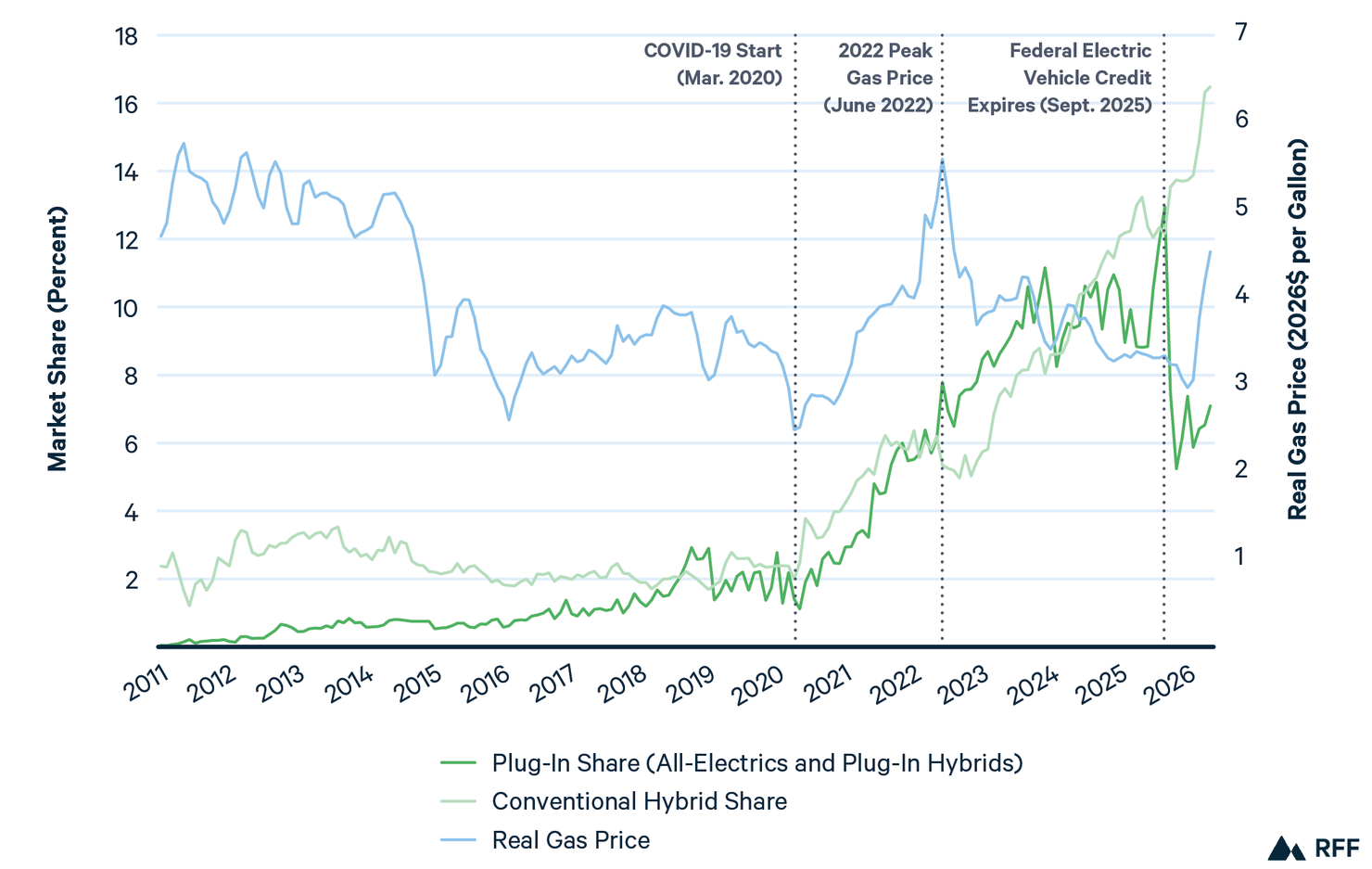
First, some context: A vehicle’s market share tells us its proportion of total sales during a given period. Figure 1 shows that, in the United States, the share of EVs in total vehicle sales increased from 2 percent in 2019 to 9 percent just four years later. The market share then leveled off in 2024, when the federal government still offered the IRA subsidies, before dropping to about 6 percent just prior to the war. High up-front purchase prices for EVs, lack of public charging or high charging costs, and concerns about all-electric range may also have dampened EV demand growth.
Figure 1. Gasoline Prices Compared to Light-Duty Electric Vehicle and Conventional Hybrid Market Share, 2011–2026
Source: Argonne National Laboratory (sales); Energy Information Administration (gas, deflated to 2026$ via the US Bureau of Labor Statistics Consumer Price Index for All Urban Consumers)
From 2019 through 2023, the market share of conventional hybrid vehicles increased at a similar rate to EVs, but in late 2024, the paths diverged. The market share for conventional hybrids continued growing to about 14 percent of new vehicle sales in February 2026.
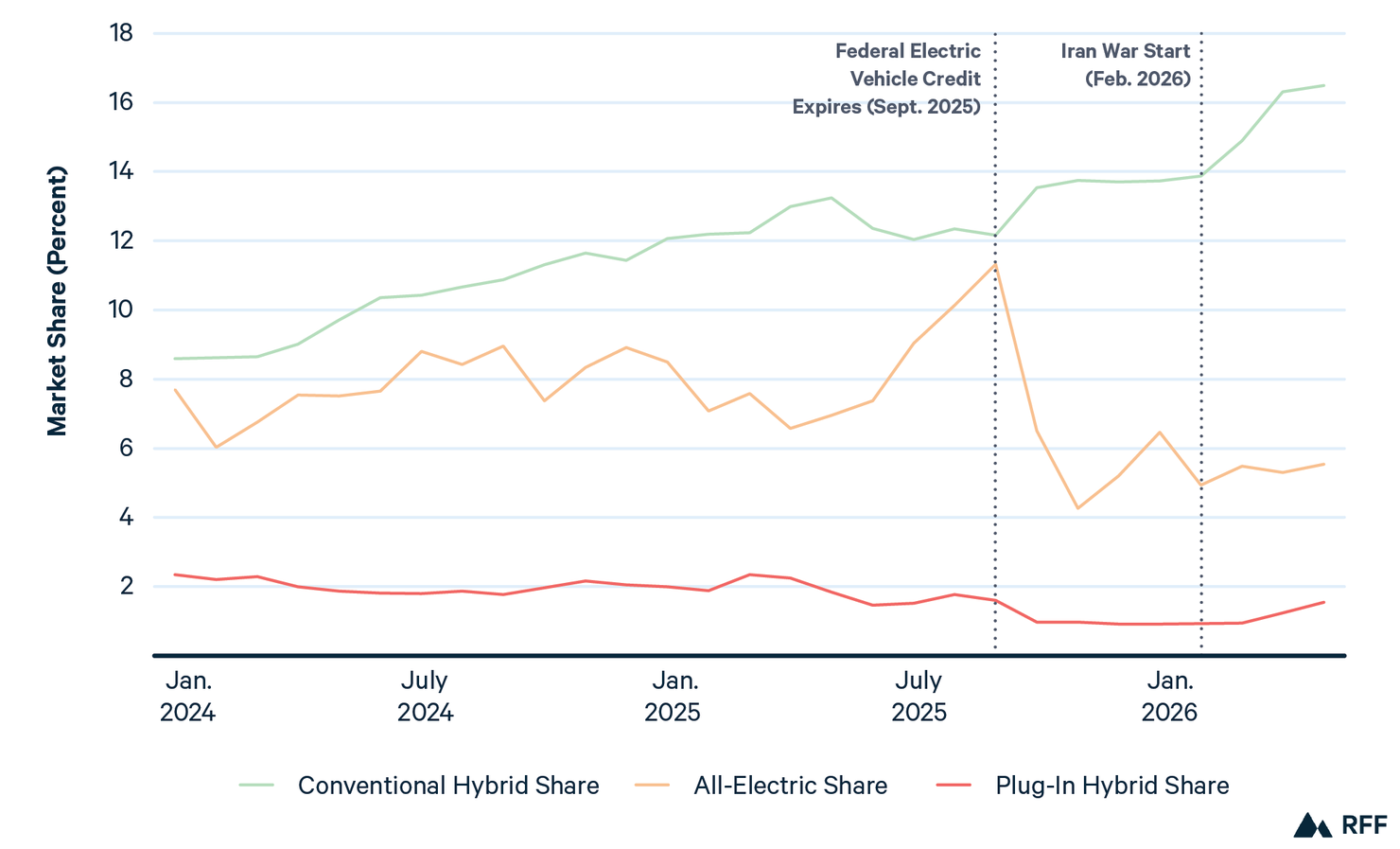
Zooming in on recent months in Figure 2, we can see more clearly the implications of the IRA subsidies and gasoline prices for market shares of EVs and conventional hybrids. The figure below separates EVs into all-electrics and plug-in hybrids. The IRA subsidies expired in September 2025, and the September market share of all-electrics reached an all-time high close to 12 percent, as consumers hurried to make their purchases and claim the subsidies. After the subsidies expired, the market share of all-electrics dropped to about 6 percent in the first two months of 2026, prior to the war. Since the war began, the all-electric market share has been no higher than it was prior to the war.
Figure 2. Plug-In Hybrid, Conventional Hybrid, and All-Electric Market Share of US Light-Duty Vehicle Sales, 2024–2026
Source: Argonne National Laboratory, Light-Duty Electric Drive Vehicles Monthly Sales Updates. Not seasonally adjusted.
Figure 2 also shows that market shares of plug-in hybrids and conventional hybrids followed different trajectories than all-electrics. Plug-in hybrid market shares did not increase prior to the expiration of the IRA subsidies, indicating that IRA subsidies affected all-electrics more than plug-in hybrids. However, the plug-in hybrid market share has nearly doubled, from 0.8 to 1.5 percent, since the start of the war (albeit still making up a much smaller share of purchases than all-electrics and conventional hybrids), contrasting with the flat market share for all-electrics during the same period.
The market share for conventional hybrids dropped a bit prior to the subsidy expiration, which may reflect some households choosing subsidized EVs over conventional hybrids. After subsidy expiration, the market share of conventional hybrids recovered and then grew from 14 percent to 17 percent during the first three months of the war.
How Have High Gas Prices Affected Electric Vehicle Sales?
Until now, we’ve discussed market shares rather than sales to account for seasonal patterns of vehicle buying. We can also quantify the additional sales of conventional hybrids and EVs that the market shares imply.
Based on data from the Argonne National Laboratory, we calculate that the market share for gasoline vehicles fell from 80 to 76 percent between February and May 2026. The lower market share implies that 56,000 households bought hybrids or EVs instead of gasoline vehicles during this period. Of those 56,000 households that did not choose gasoline vehicles, 38,000 chose conventional hybrids and 18,000 chose EVs. In other words, these households were more than twice as likely to choose conventional hybrids than EVs. Moreover, nearly all those choosing EVs instead of gasoline vehicles got plug-in hybrids rather than all-electrics. The situation may be different elsewhere, such as Europe, where EV sales appear to have increased somewhat more than in the United States.
Why Were Households More Likely to Choose Plug-In Hybrids Over All-Electric Vehicles?
One possible explanation for households choosing plug-in hybrids over all-electric vehicles when gas prices rose in March 2026 is that households had different expectations about gasoline prices. For households expecting to drive their new vehicles for many years, the advantage of buying an all-electric vehicle over a plug-in hybrid or gasoline vehicle depends on how long they expect gasoline prices to remain high.
If you think gasoline prices will quickly fall back to prewar levels, an all-electric EV won’t save much on fuel. Consequently, households who think the period of high gasoline prices will be short-lived may opt for plug-in hybrids, whereas households who think prices will remain high or volatile for a long time may choose all-electric EVs. So, maybe we saw plug-in hybrid sales increasing more than all-electric and gasoline vehicle sales because more households expected temporary, rather than long-term, price increases. Data on consumer expectations isn’t yet available.
Nearly all those choosing EVs instead of gasoline vehicles got plug-in hybrids rather than all-electrics.
Another possible explanation is that households strongly considering all-electric EVs may focus more on up-front purchase price and other vehicle attributes besides fuel costs, such as charging convenience and performance, when buying a car. Households considering gasoline vehicles, conventional hybrids, or plug-in hybrids, which outnumber households considering all-electric EVs, may pay more attention to refueling costs, which means that we see a bump in sales for these vehicles while all-electric EV sales remain flat. Similar to the first possibility, we’ll need to wait for more information from consumer surveys to check this story.
The second explanation is potentially good news for future EV sales. Lately, in some parts of the country, electricity demand and prices have been growing faster than historical rates. Although higher electricity prices could dampen enthusiasm for EVs, the relative lack of responsiveness to gasoline prices indicates that potential EV buyers may not be paying much attention to relative fueling costs, in which case higher electricity prices may not harm EV sales all that much.
The second explanation also implies that, although many potential EV buyers may have switched to conventional hybrids when the IRA subsidies expired, those consumers may switch back to EVs if future innovation reduces battery and vehicle prices or improves vehicle quality, even if gasoline prices remain low. Maybe the United States isn’t yet at the point where driving costs are important for potential EV buyers. As EV quality continues to improve, and if battery costs continue to decrease, US consumers may turn their attention to the lower driving costs of EVs, much as they do in other countries that have larger EV markets.