
This credit would reduce road funding, raise gasoline and diesel prices, and deliver small and expensive carbon emissions reductions.
In California, road construction, maintenance, and repairs are funded primarily through excise taxes on gasoline and diesel. Governor Gavin Newsom’s latest budget includes a proposal that would diminish this dedicated source of revenue. It would allow fuel suppliers to reduce their diesel excise tax liability by selling sustainable aviation fuel (SAF).
Deciphering the implications of this proposal is tricky because SAF is closely related to renewable diesel, the main biofuel substitute for petroleum diesel that now comprises 70 percent of diesel in California. Moreover, the proposed tax credit would exist in a complex web of regulations and tax credits at the federal level, in California, and in other states.
The Newsom administration estimates the SAF tax credit would reduce diesel excise tax receipts by about 10 percent ($165 million). We have analyzed this proposal in the broader context of national and state biofuel policies.
Based on our analysis, we project three outcomes:
- The tax credit will incentivize much more SAF than projected by the administration.
- That increase in SAF comes at a cost: diesel excise tax receipts decrease by at least 20 percent and as much as 75 percent within a few years, and the prices of gasoline and diesel increase by 10–15 cents because of interactions with existing policies.
- Because the SAF largely would come from diverting biofuels from surface transport to aviation, the net reductions in carbon emissions would be small and expensive.
Phillips 66 Refinery in Rodeo, California
Where Would Sustainable Aviation Fuel Come From?
The easiest and most immediate way to scale up SAF production involves using the hydroprocessed esters and fatty acids (HEFA) process to convert vegetable oils and waste fats into fuel. Refiners in the United States currently produce three billion gallons of renewable diesel per year using this process. At least six of these refineries are already equipped to produce SAF alongside renewable diesel if given a sufficient financial incentive, including the Phillips 66 refinery in Rodeo, California.
Figure 1. Locations of Facilities That Produce Sustainable Aviation Fuel Using the Hydroprocessed Esters and Fatty Acids Process
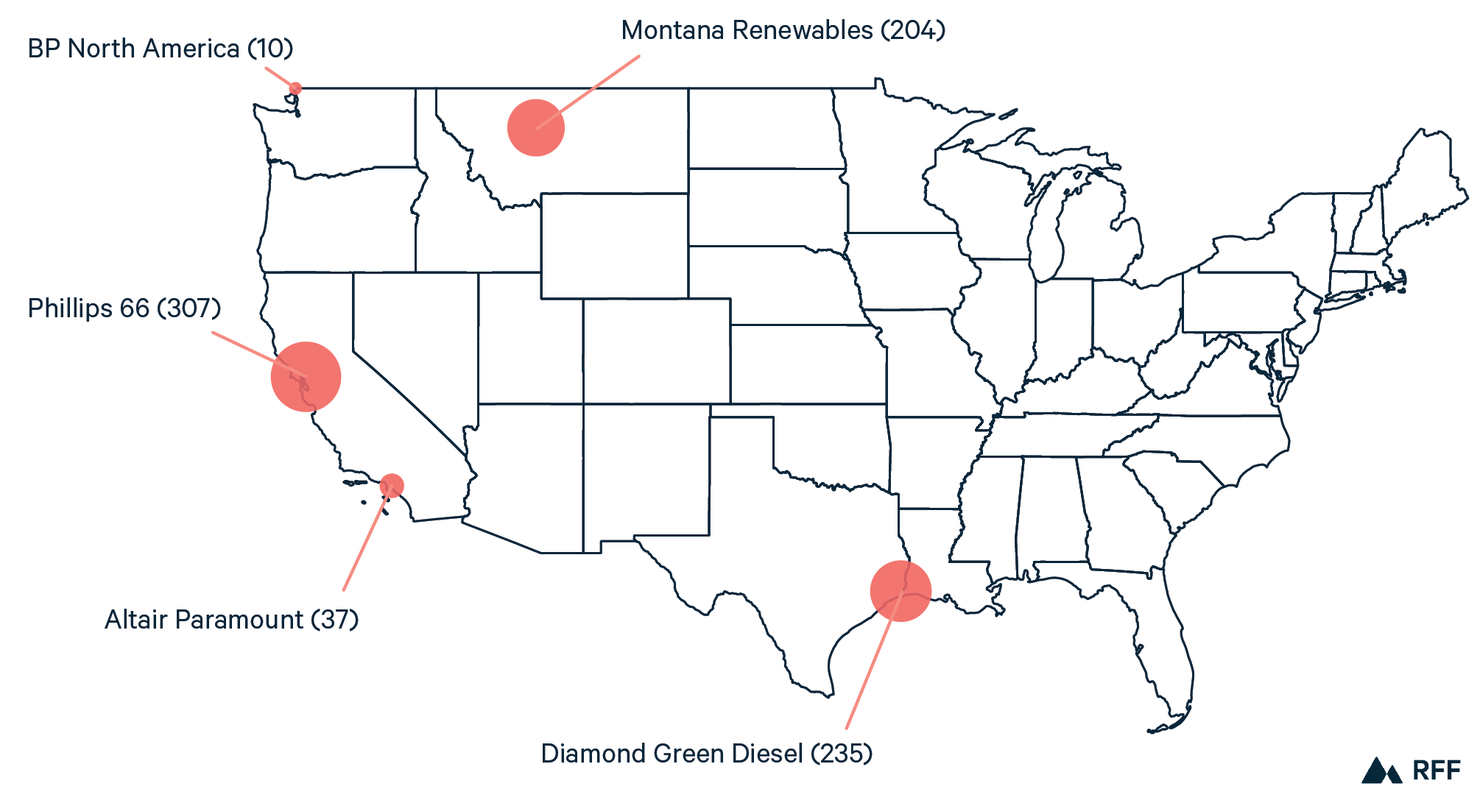
Note: Numbers represent capacity in millions of gallons per year. Not shown is the Par Pacific facility in Kapolei, Hawaii, which has 41 million gallons of capacity.
Source: farmdoc daily, January 2025
As we wrote last fall, current policies will yield very little SAF because it costs at least three times as much to produce as petroleum jet fuel. Although SAF currently earns substantial incentives, including credits in the federal renewable fuel standard, low carbon fuel standard credits from California, and federal tax credits, SAF does not receive enough to make up for its higher production cost relative to fossil jet fuel. At the same time, renewable diesel costs somewhat less to produce than SAF, benefits from a more favorable subsidy stack, and faces a smaller price gap with petroleum diesel, while also competing with SAF for feedstocks and production capacity.
SAF produced at a carbon intensity at least 50 percent below that of jet fuel would be eligible for California’s proposed tax credit, which is $1 per gallon of SAF, plus 2 cents per gallon for each additional percentage point of reduction beyond this 50 percent threshold, up to a maximum $2 per gallon. Based on the California Air Resources Board’s existing carbon intensity models, the tax credit would apply to SAF produced from waste oils and fats such as used cooking oil, tallow, and distiller’s corn oil. Crop-based oils such as soybean or canola oil would not qualify, which is a good thing given that increasing demand for these oils causes substantial carbon losses through tropical deforestation.
The other viable way to produce SAF is alcohol-to-jet (ATJ), which involves refining ethanol or isobutanol made from corn or sugarcane into jet fuel. Although cost estimates vary, this production process is widely understood to be more expensive and nascent relative to HEFA SAF. LanzaJet owns the only ATJ plant currently operating in the United States. In addition, the California Air Resources Board’s existing carbon intensity models imply that ATJ would face an additional hurdle to claiming the tax credit because it would likely need to integrate carbon capture and storage to meet the 50 percent reduction threshold.
If the six current HEFA refineries that are equipped for SAF were to produce at maximum capacity, they would crank out 834 million gallons of SAF per year. At $1.25 per gallon, that is $1.04 billion in tax credits, or 65 percent of diesel excise tax receipts. Adding ATJ SAF would generate even more tax credits, as would more renewable diesel facilities retooling to produce SAF.
What Is the Likely Effect of the California Tax Credit for Sustainable Aviation Fuel?
This question cannot be answered without accounting for all the complex interactions created by existing fuel policies. In a recent working paper, we developed a detailed model to do just that. In late February, we added the proposed California tax credit to the model.
We consider two policy scenarios, reflecting different potential costs of producing ATJ. The lower-cost scenario uses estimated production costs provided by industry analysts, and it implies that ATJ with carbon capture and storage is competitive with HEFA for SAF production. However, given that ATJ technology has yet to prove itself viable at scale, we also present a higher-cost scenario in which the marginal cost of ATJ production is 25 percent higher. We view the higher-cost scenario as a conservative projection for 2030.
Under the lower-cost scenario, we find an increase in both HEFA SAF and ATJ SAF, totaling close to one billion gallons annually and split between the two technologies. Some, but not all, of the SAF production comes out of renewable diesel, which decreases by 700 million gallons. The higher-cost scenario generates a quarter of a billion gallons of SAF annually, almost all of which is from HEFA. We plot these outcomes in the figure below.
Figure 2. Quantity of Biofuels Used in Diesel and Aviation in California
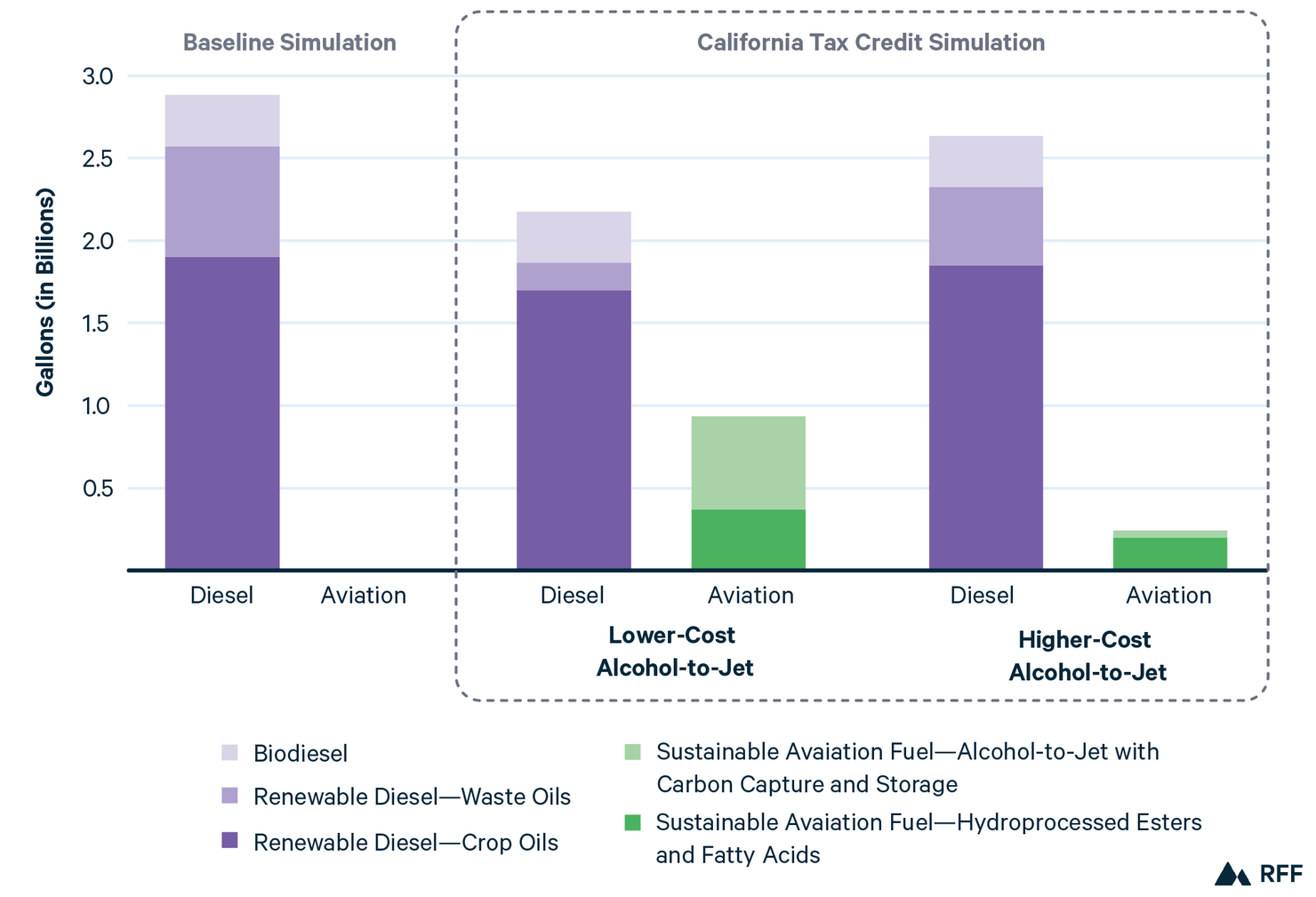
The two SAF technologies (HEFA with waste oils and ATJ with carbon capture and storage) generate tax credits of about $1.25 per gallon. Thus, our two scenarios imply potential tax credits between $300 million and $1.2 billion annually, or between 20 percent and 75 percent of diesel excise tax receipts.
How Would the Sustainable Aviation Fuel Proposal Change Fuel Prices?
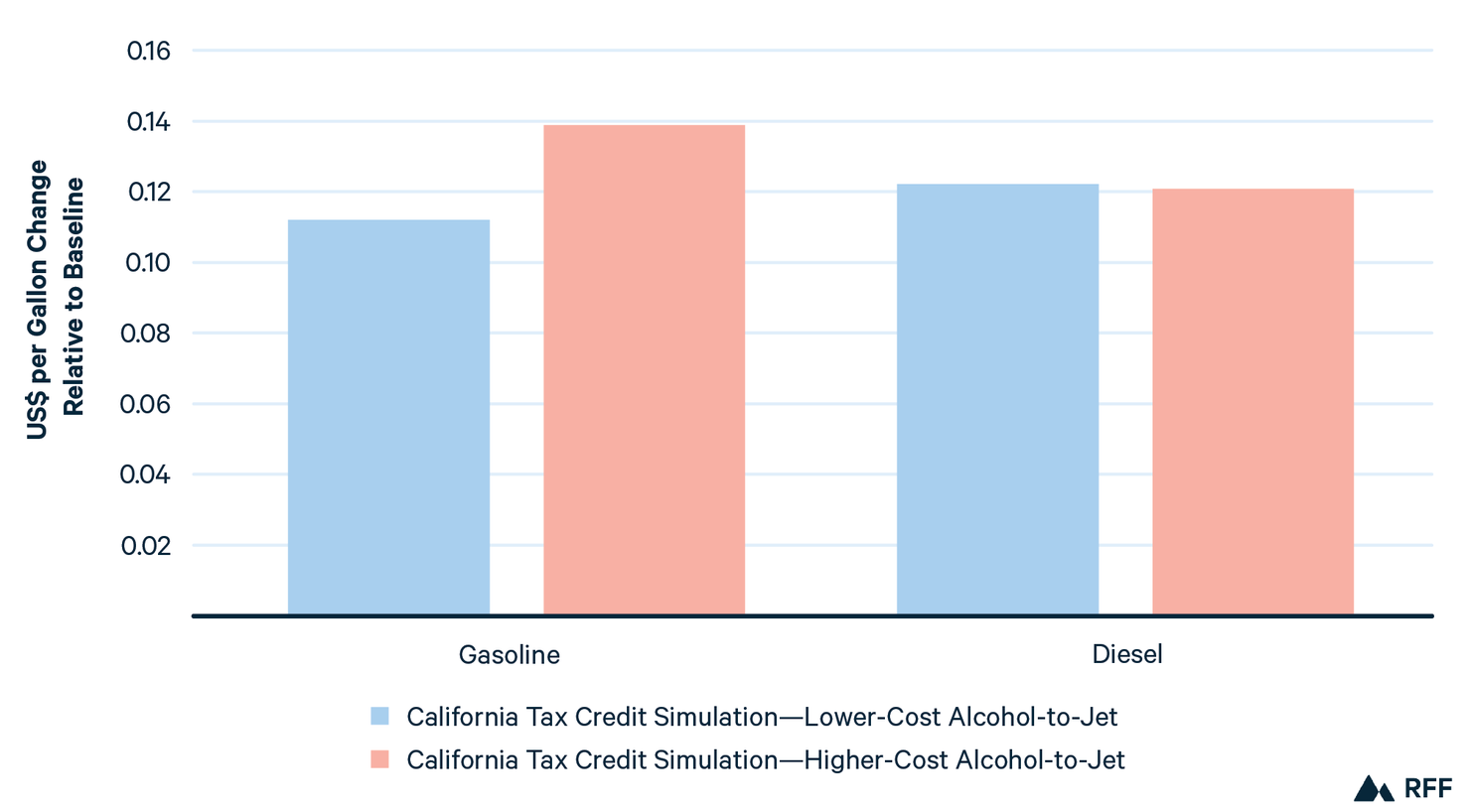
As a result of this policy, we estimate that both gasoline and diesel prices would rise in California. Gasoline prices would increase by 11–14 cents and diesel prices by 12 cents. Californians use about 13 billion gallons of gasoline and 4 billion gallons of diesel per year, so these price increases imply that annual costs to consumers would rise by between $1.9 billion and $2.3 billion.
Fuel prices rise because of complex interactions between the tax credit and existing policies. In particular, California’s low carbon fuel standard requires that every gallon of fossil gasoline and diesel be matched by some amount of cleaner (i.e., lower carbon intensity) fuel such as renewable diesel or SAF.
When California fuel suppliers reduce renewable diesel in favor of SAF, the lost renewable diesel has to be backfilled with fossil diesel to meet road transportation fuel demand. But more fossil diesel means that more low-carbon fuel has to enter the system to meet the goal specified by the low carbon fuel standard. This is why the tax credits cause a smaller decline in renewable diesel than the increase in SAF, as shown above in Figure 2. The additional required low-carbon fuels raise costs.
Figure 3. Change in Wholesale Fuel Prices
How Much Emissions Reduction, and at What Cost?
Carbon emissions decrease because the SAF is produced using relatively low-carbon processes compared to crop-based renewable diesel. In the lower-cost ATJ scenario, annual US carbon dioxide emissions fall by 2.1 million metric tons (MMT) relative to current policy, which is the equivalent of taking 1.5 percent of California’s gasoline-powered cars off the road. This net reduction, however, obscures substantial leakage: California emissions would decline by 3.6 MMT, and emissions in the rest of the United States would increase by 1.5 MMT as lower fuel prices in other states spur consumption there. The net reductions cost $997 per ton, which is about five times the social cost of carbon.
The higher-cost ATJ scenario sees smaller emissions reductions because less SAF enters the system. The emissions reduction is 0.5 MMT, or the equivalent of taking 0.4 percent of California’s gasoline-powered cars off the road. Again, there is substantial leakage, with California emissions declining by 2.0 MMT and rest-of-the-US emissions increasing by 1.5 MMT. The average abatement cost in this scenario is exorbitant at $2,768 per ton.
Figure 4. Average Cost of Reducing Carbon Dioxide Emissions
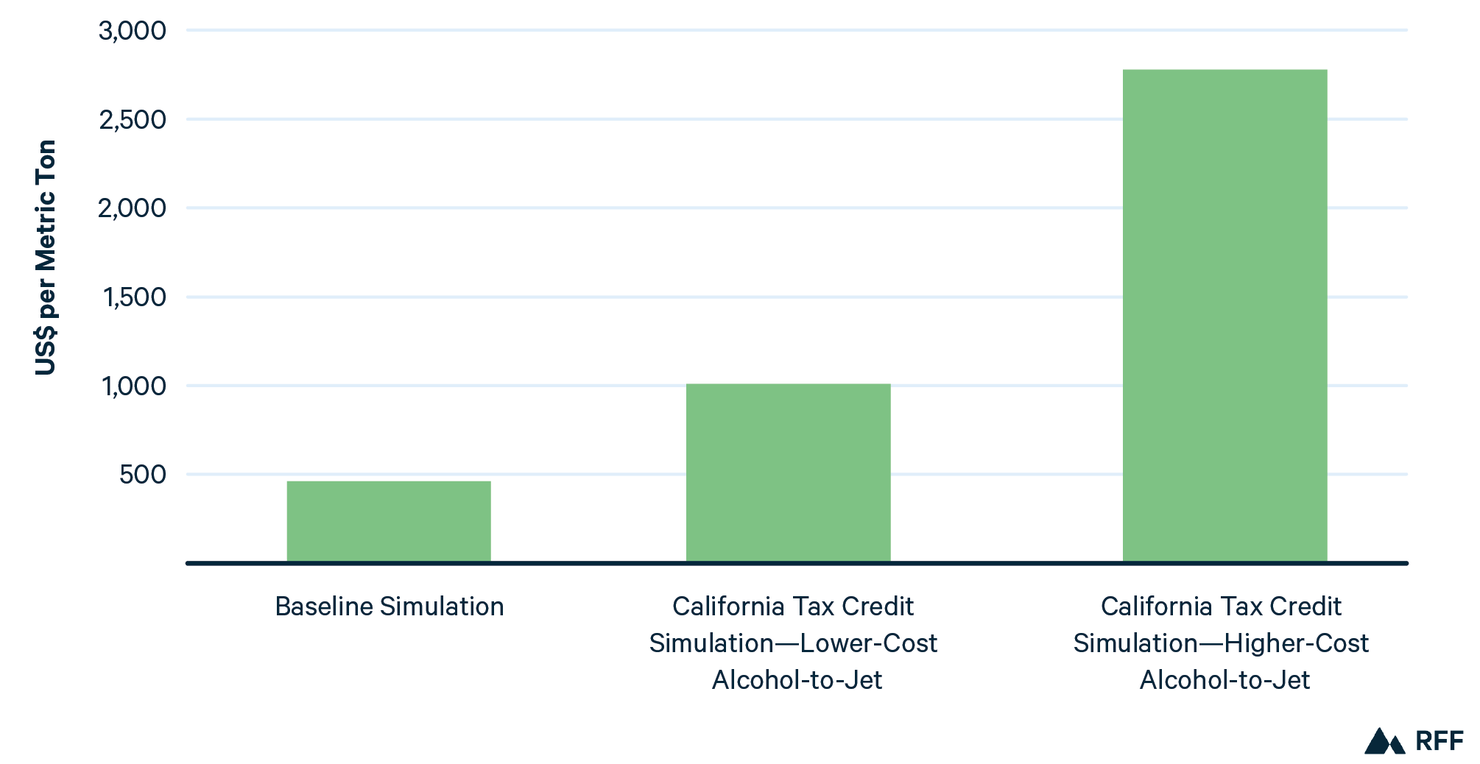
Note: The baseline simulation shows all reductions under the current biofuel policy. Additional reductions from SAF tax credits are represented in the bars showing the California tax credit simulation.
Potential Complications
First, can all the tax credits be claimed? Firms that sell wholesale diesel pay the diesel excise tax. If those firms sell SAF, then they can claim credits against their excise tax liability (e.g., Phillips 66 sells both SAF and diesel). If the firms selling SAF don’t have (much) excise tax liability, then they may not be able to claim all of the credit (e.g., LanzaJet). If enough money is on the line, we would expect firms to engage in some financial engineering to align tax liabilities with available credits (e.g., mergers or joint ventures).
Second, what about the state’s cap-and-invest program? As discussed in our October working paper, accounting methods and emissions covered by California’s low carbon fuel standard and cap-and-invest program differ, so in some cases, the additional fossil diesel consumed in California might be offset by a decrease in emissions in non-transportation sectors. The magnitude of these effects is relatively small.
A Series of Unintended Consequences
Any expansion of biofuels into SAF will conflict with the regulations and tax credits that currently incentivize their use in surface transportation. These policy interactions make trying to do something that seems simple, like incentivizing SAF, hard to do without unintended consequences.
We predict that the proposed tax credit would increase SAF adoption more than expected and generate some additional emissions reductions, but at a high cost through lost road funding and higher fuel prices. If incentivizing SAF were to spur future cost reductions through new technologies, then it may be worth paying a high price, but there is limited evidence for significant cost declines in the biofuels sector so far.
Decarbonizing aviation will be challenging. Current batteries are too heavy and hydrogen takes up too much space, which leaves liquid fuels as the dominant energy source for the next few decades. However, promoting SAF only makes sense if it creates a clear path to future cost reductions and carefully manages the unintended consequences.
This blog post is a lightly edited version of the original article, which was published by the Energy Institute at Haas.