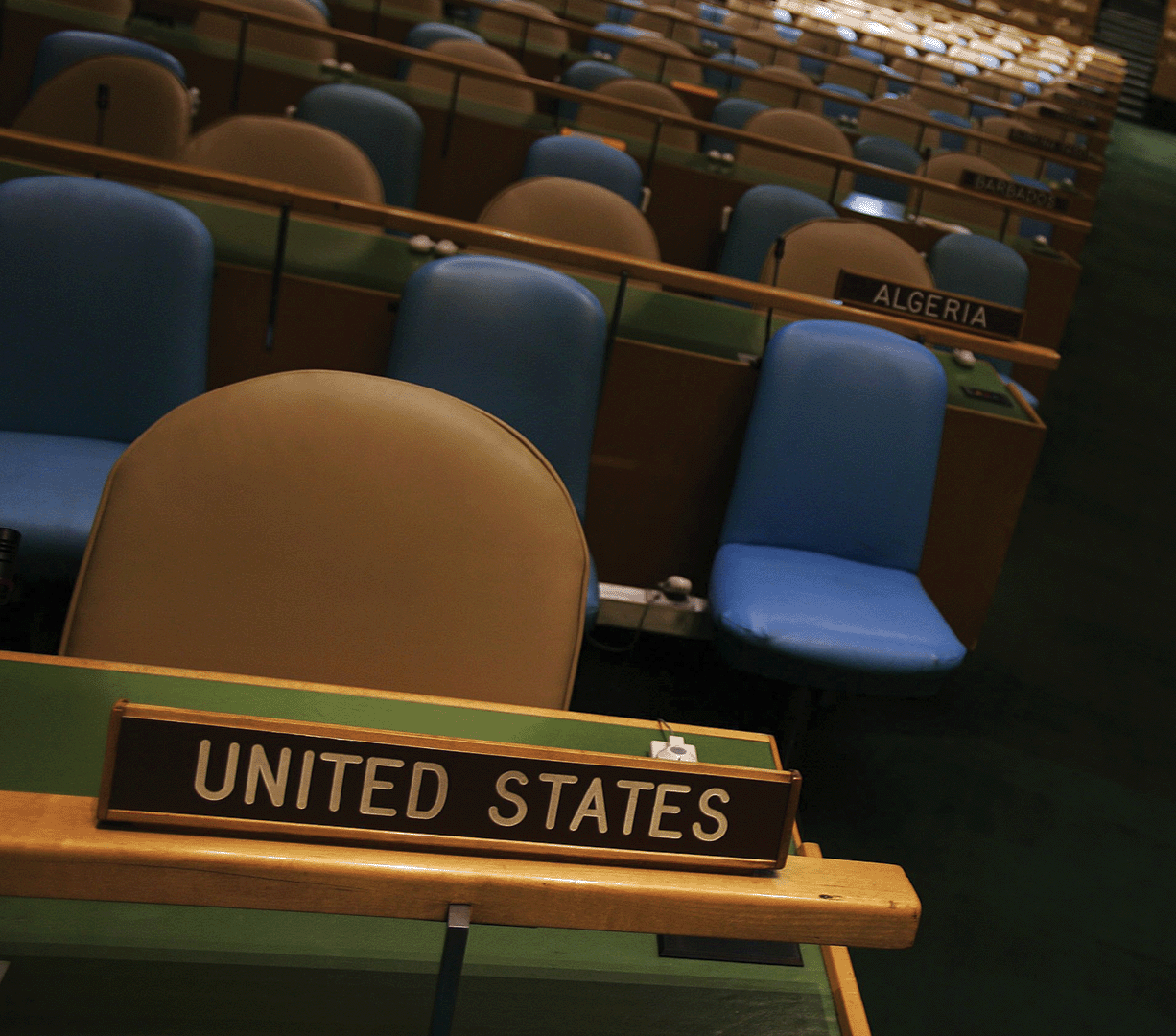
If the United States pulls out of climate treaties—most recently its intended withdrawal from the UN Framework Convention on Climate Change and the Intergovernmental Panel on Climate Change—Then uncertainty over US commitment to climate action will persist for the foreseeable future.
The Trump administration announced in January 2026 the US intent to withdraw from the United Nations Framework Convention on Climate Change (UNFCCC) and the Intergovernmental Panel on Climate Change (IPCC)—the two core entities of the international climate policy architecture—along with dozens of other multilateral bodies relevant to climate action. What are the implications of US withdrawal for the UNFCCC, IPCC, and global climate policy?
Some organizations that the US will leave have indirect relevance for climate policy. They include the International Renewable Energy Agency, a renewable-energy counterpart to the International Energy Agency; the United Nations Conference on Trade and Development, which focuses on the role of clean energy and other aspects of trade and development; and the International Trade Centre, which can support small businesses with policies such as carbon border measures.
The IPCC and UNFCCC are more fundamental to global climate policy. IPCC withdrawal can be reversed easily in the future. But for now, the United States will no longer be able to shape the influential “summaries for policymakers” that accompany IPCC reports. UNFCCC withdrawal, however, may be lasting—and have lasting effects on global climate policy.
International Climate Policy Without the United States
The UNFCCC is the foundational international treaty for international climate policy, which sets out key objectives and principles that have shaped subsequent agreements such as the Paris Agreement. Among these fundamental goals and principles is the key objective for the UNFCCC to achieve “stabilization of greenhouse gas concentrations in the atmosphere at a level that would prevent dangerous anthropogenic interference with the climate system.” The 102nd US Congress ratified the UNFCCC in 1992 (as is required for all treaties that the United States accedes to) making the UNFCCC part of the Law of the Land. The US withdrawal raises domestic legal questions, although as a matter of international law, the United States could easily rejoin by notifying the UN secretary-general. Given possible litigation of either withdrawal or reentry, the status of the United States within the UNFCCC may remain uncertain beyond the current presidential term.
The United States would be the only country (i.e., member of the United Nations) in the world to not be part of the UNFCCC, unless other countries decide to withdraw, too. However, the US withdrawal from the Paris Agreement has not led to any other countries following suit. In the short term, not much would change alongside the UNFCCC withdrawal, since the United States already stopped funding and participating in UNFCCC meetings, such as the recent 30th Conference of the Parties (COP30) in Brazil. Without being a party to the UNFCCC, official US participation in any UNFCCC meeting or negotiation would no longer be possible.

Credit: 4kclips / Shutterstock
Because of the free-rider problem inherent to climate change, the international community will keenly watch US capability and interest in reengaging with climate policy. Domestic climate change mitigation is useful only if other countries move in the same direction, since the benefits of reducing greenhouse gas emissions are shared by all countries. A long-lasting absence of the United States from global climate governance institutions could affect other countries’ propensities to engage in these same institutions—or reduce other countries’ willingness to adopt more ambitious policies in line with the Paris Agreement. The proposed rescission of the US Environmental Protection Agency’s endangerment finding in 2025 (culminating in the repeal announcement this week) likewise was a decision that could affect the ability of the United States to mitigate greenhouse gas emissions, with potential knock-on effects that could mute enthusiasm for climate action around the world.
Climate Policy Closer to Home
US domestic climate policy does not depend on US participation in the UNFCCC. But credibly committing to (and communicating) US intentions for future climate policy would be even more important if the United States remains outside of the UNFCCC and therefore no longer participates in the international meetings that coordinate and track climate policy. Other international forums, such as the Group of 20, may gain relevance in climate policy if the United States (perhaps under different leadership) wants to engage with climate policy while its UNFCCC status is contested.
Well-coordinated, successful outcomes are unlikely to arise if most countries of the world meet in UNFCCC venues and iterate on climate-policy strategies among themselves—while the most economically powerful country remains outside the international architecture of climate policy. Absent the United States, decisions made at the UNFCCC and at COPs could reflect different interests that follow a new balance of power in the negotiations.
Historically, the United States has played a major role as a power broker on contentious topics such as climate finance, carbon markets, transparency, and language surrounding fossil fuels. Decisions made in the absence of the United States can make US reengagement less attractive if the United States considers these decisions contrary to its interests.
The coordination problem also could affect US climate policy decisions. If emissions reductions in the rest of the world lag behind expectations, US decisionmakers could be more skeptical of pursuing further climate action domestically. Ensuring that all countries move in the same direction—albeit at different speeds—is the main rationale for international climate policy institutions like the UNFCCC and Paris Agreement. A world without a united forum for decisionmaking for global climate policy will be less capable of overcoming the free-rider problem.
The Broader Outlook for Climate Policy
Uncertainty regarding the US commitment to climate action may be a given for the foreseeable future.
Globally, plurilateral initiatives with “coalitions of the willing” that jointly pursue certain climate strategies may become more important, as this approach does not depend as much on global consensus. Initiatives launched at COP30 on carbon pricing and climate and trade are examples and could be an option for the United States if the country chooses to reengage with international climate policy.
Other initiatives targeting the pernicious challenge of decarbonizing trade-exposed industrial sectors also might become more attractive in a fractious world of global governance, where perceptions about the threats posed by climate change, climate action, and energy and economic security diverge among nations. Such arrangements need not replace nor make irrelevant the UNFCCC and Paris Agreement, but rather could support implementation actions toward their ultimate goal: ensuring that atmospheric greenhouse gas stabilization and climate change no longer threaten human security and prosperity.

For more timely insights about developments in environmental and energy policy, browse the If/Then series.