
Several online flight-booking platforms display estimates of each flight’s carbon dioxide emissions. A new working paper examines whether emissions information shifts travelers’ booking choices—and what these responses may mean for aviation policy.
If you have searched for a flight online recently, you may have noticed an estimate of the carbon dioxide emissions displayed next to each itinerary, alongside the fare, travel time, and number of stops. A growing number of booking platforms have added similar emissions disclosures over the past several years, giving travelers estimates of the carbon footprint of their options.
Whether this information affects travelers’ booking decisions is the question at the center of a new working paper. We use data from the US domestic airline market to examine whether emissions disclosure has shifted how travelers choose among flights—and what the size of any response implies about how much flyers value lower-emissions travel.
We find evidence that emissions disclosure changes behavior—and the effect is economically meaningful.
Why Emissions Disclosure Matters for Aviation
Studies estimate that aviation accounted for roughly 3.5 percent of human-caused global warming between 2000 and 2018, driven by carbon dioxide emissions and factors such as contrails. Demand for air travel has expanded rapidly over recent decades—aviation’s share of global carbon dioxide emissions has grown substantially since the mid-twentieth century (Figure 1), and demand for flights is projected to double from current levels by midcentury. These trajectories make aviation one of the fastest-growing sources of climate impact.
Figure 1. Share of Global Carbon Dioxide Emissions from Aviation (1940–2021)
Since the COVID-19 pandemic, carbon dioxide emissions from aviation have rebounded. By 2023, levels reached more than 90 percent of their 2019 pre-pandemic peak.
The most promising long-run solutions—new aircraft technologies, sustainable fuels, and operational improvements—require significant investment, infrastructure, and time to scale. Emissions disclosure is different. Displaying an emissions estimate in an online flight search works through existing platforms, reaches travelers at the moment they are comparing options, and is comparatively inexpensive to implement. Its potential as a climate policy tool, however, depends entirely on whether travelers respond to emissions disclosure. Our paper provides evidence that they do.
A Natural Experiment in Flight Search
In April 2019, Skyscanner became the first major flight-comparison website to display emissions estimates. Other platforms followed Skyscanner’s lead; by the end of our study period in 2022, seven websites had adopted emissions disclosure (Figure 2). Travelers book through many different flight-comparison platforms, and reliance on these platforms varies across US states. So, when the emissions disclosure rolled out, the extent to which travelers encountered emissions estimates varied across both time and geography. We use the variation in consumers’ exposure to emissions information across geography and over time to identify the effect of emissions disclosure on consumer choices.
Figure 2: Timeline of Disclosure Rollout across the Seven Websites
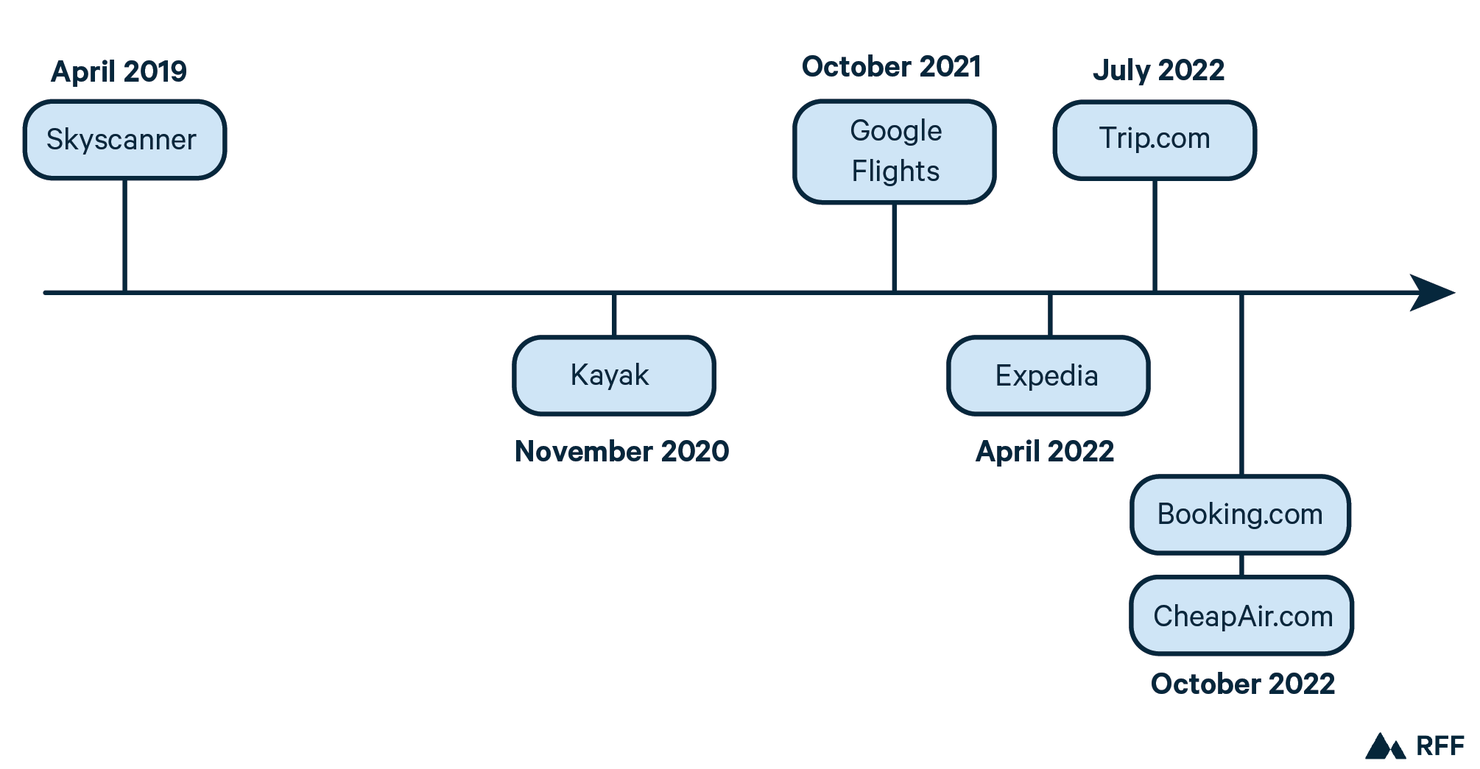
If emissions disclosures were effective during our study period, lower-emissions itineraries should have gained market share relative to higher-emissions itineraries, especially in states where websites that disclose this information are popular. We tested whether this pattern holds using detailed data on actual flight bookings between large US metro areas from 2018 to 2022. Our model estimates allow us to compare behavior across two periods: the period before April 2019, when no flight-comparison platform displayed emissions, and the years that followed, during which seven platforms rolled out the disclosure at different times.
To isolate the effect of emissions information from other factors shaping demand, we controlled for factors such as fares, number of layovers, and aircraft type. To calculate emissions for each itinerary, we replicated the Travel Impact Model—an open-source methodology used by several major flight-purchase platforms.
Emissions Disclosure Changes Behavior
We find that emissions disclosure increases travelers’ sensitivity to differences in carbon dioxide emissions when choosing among flights. Before April 2019, a traveler’s choice between a higher- and lower-emissions itinerary on the same route was less sensitive to the emissions gap—some baseline sensitivity existed, reflecting consumers’ ability to infer emissions from observable flight attributes. After disclosures started, that responsiveness increased measurably and consistently. In our main analysis, consumers became roughly 22 percent more responsive to emissions, and the effect holds across a range of model specifications.
[Disclosure’s] potential as a climate policy tool depends entirely on whether travelers respond to emissions disclosure. Our paper provides evidence that they do.
To put this response in dollar terms, we translate the demand shift into an implied willingness to pay—the fare premium that consumers appear willing to accept in exchange for a lower-emissions itinerary. In our main analysis, implied willingness to pay for emissions reductions was higher in the post-disclosure period than the pre-disclosure period by about $33 per ton of carbon dioxide. The average one-way itinerary in our sample was associated with about half a ton of carbon dioxide. For a hypothetical emissions reduction of half a ton of carbon dioxide, our willingness-to-pay estimate implies a roughly $15 increase in what consumers were willing to pay for the lower-emissions option. These are model-derived estimates, but across specifications, the results consistently point to a consumer response that is economically meaningful.
A Tool Worth Taking Seriously
Greater demand for flights with lower emissions does not, on its own, reduce aviation emissions in the short run. However, if enough travelers consistently favor lower-emissions options, that shift in demand could eventually affect which aircraft configurations, routes, and operational practices are commercially attractive.
Our findings also create scope for a different kind of incentive. If consumers respond to emissions differences, airlines that invest in lower-emissions options may be able to recover some costs through pricing. But that channel depends on the credibility of underlying estimates: consumers need to see emissions estimates that reflect real efforts toward climate change mitigation. Current booking-platform estimates typically do not account for the use of sustainable aviation fuels, for example.
Emissions disclosure is not a substitute for fuel standards, carbon pricing, or direct regulation. But our findings suggest that disclosure can shift consumer behavior in ways that are detectable and economically meaningful. The open question is whether the information infrastructure behind carbon dioxide estimates can keep pace with the role that emissions disclosure increasingly is taking on. Realizing the potential of such disclosures would require sustained coordination among airlines, booking platforms, and regulators—together, these entities would need to improve data sharing, standardize accounting methods, and develop credible verification systems so that the information travelers see better reflects differences in the climate impact of flights.