
New analysis shows that Virginia policymakers could use the proceeds from the Regional Greenhouse Gas Initiative’s allowance market to reduce electricity prices for residential customers.
Virginia’s re-entry into the Regional Greenhouse Gas Initiative (RGGI) presents an opportunity for a significant expansion of carbon pricing—the economist’s favorite tool for addressing environmental externalities. While recent volatility in the program’s cost to emitters has raised concerns about electricity affordability, new analysis shows that, if Virginia policymakers act decisively to direct enormous auction revenues (soon coming their way) back to residential electricity consumers, lawmakers can craft a policy that simultaneously reduces carbon dioxide emissions and associated local air pollutants, protects investments in flood preparedness and energy efficiency for low-income households, and reduces electricity bills for every Virginia household by about 8 percent starting next year (or about $12 per month for the typical Virginia household) at no cost to state coffers.
How Can the Regional Greenhouse Gas Initiative Influence Electricity Prices in Virginia?
Virginia is re-entering RGGI (pronounced “Reggie”) on July 1, 2026, after leaving the program at the end of 2023. RGGI is an interstate cap-and-trade program covering carbon dioxide emissions from electric power plants in 10 eastern US states—11, counting Virginia.
How Do Cap-and-Trade Programs Work?
A cap on carbon dioxide emissions is one way a state can address the challenge of climate change. These systems, often called cap-and-trade programs or cap-and-invest systems, are flexible environmental policies that leverage the powers of competitive markets to identify the lowest-cost ways to meet environmental goals.
In such market-based approaches, an environmental regulator creates a finite number of emissions allowances corresponding to the fixed number of permitted tons of pollution. The regulator then typically sells those allowances at auction to polluting companies, which in RGGI’s case are fossil fuel–fired power plants. These auctions, alongside secondary allowance markets, leave the price of allowances to be determined by the market, yielding the desired emissions reductions at the lowest possible cost.
The price of RGGI emissions allowances rose in recent months to over $45 per short ton of carbon dioxide in secondary markets before settling at $35 in the official quarterly auction on June 3. By comparison, when Virginia participated in RGGI between 2021 and 2023, allowance prices ranged from $8 to $15 per ton. While allowance prices incentivize polluters to reduce emissions, these prices also increase the cost of delivering electricity, which has raised concerns among policymakers about electricity affordability.
The price of allowances is a measure of the cost of reducing carbon pollution and is paid by emitting power plants. That price is then passed on to all electricity users, including households, industry, and commercial customers (like data centers), in the form of higher electricity prices. But that price also determines the proceeds raised for the Commonwealth of Virginia. Allowance revenues represent a sizable resource for policymakers that can be used for various purposes.
One purpose could be to cut household electricity bills. In fact, when policymakers use cap-and-trade revenues to reduce residential electricity prices, higher allowance prices can lead to lower electricity bills. If the revenues from allowance auctions are used for rebates, a cap-and-trade program can reduce household electric bills relative to a world without the program, inverting the frequently perceived tension between environmental goals and household energy affordability. This finding reinforces results from previous research showing that carbon pricing in the power sector can create analogous cost savings for households in states without existing carbon prices, and in California, which has an economy-wide cap-and-trade program.
When policymakers use cap-and-trade revenues to reduce residential electricity prices, higher allowance prices can lead to lower electricity bills.
By analyzing data that we share in a new interactive Virginia RGGI Affordability data tool, we show that taking most of the revenues raised for Virginia in the RGGI allowance auctions and using those revenues to reduce residential electricity prices can reduce the price of electricity for every Virginia household by an average of about 14 percent, or about $23 per month—which exceeds the anticipated 7 percent price increase from the direct effect of allowance prices on costs to Virginia utilities. In the aggregate, rejoining RGGI can reduce every Virginia household’s electricity price by an average of 8 percent on net, representing about $12 in net savings on a typical household’s monthly bill.
What Will Virginia’s Re-entry Mean for the Allowance Markets?
The opportunity to use auction revenues to achieve affordability goals is emerging forcefully in the RGGI states, which have had a price on carbon dioxide emissions in the electricity sector since 2009. Over that time frame, emissions in RGGI states have fallen 43 percent compared to a 2006–2008 baseline, faster than the emissions reductions across the United States as a whole.
Every state in RGGI has an apportioned budget of emissions allowances, which are sold at auction to carbon-emitting power plants. Based on the expected base budget and supplemental allowances which could come into the market, we expect 29.5 million total allowances in Virginia’s allowance budget at prevailing allowance prices. At today’s $35-per-ton allowance price, that allowance budget could bring in over $1 billion annually to the commonwealth.

Credit: PTAP Aerial / Shutterstock
RGGI allowance prices have risen over the years for many reasons, including rising emissions driven by electricity demand associated with data centers; federal assaults on clean energy development in RGGI states; and most recently, Virginia’s announcement to rejoin RGGI with an allowance budget that is anticipated to be smaller than its emissions, which will introduce a net increase in demand for allowances in the market.
The allowances Virginia will bring into RGGI account for less than the state’s power-sector emissions of more than 30 million tons in 2025, when the state did not have a price on emissions. Given expected strong growth in electricity demand, if generators in the state do not cut emissions, Virginia’s re-entry into RGGI could add several million tons of net allowance demand to the RGGI allowance market. Simple economics tells us that as demand rises, so do prices. Indeed, prices already have started rising in anticipation.
How—and Why—Would Auction Revenue Be Returned to Virginians?
Previously, Virginia directed RGGI auction proceeds to two main priorities. The Clean Energy and Community Flood Preparedness Act allocated 50 percent of anticipated auction revenues for a low-income energy-efficiency program (Housing Innovations in Energy Efficiency), 45 percent for a flood-resilience program (the Community Flood Preparedness Fund), and the remaining 5 percent for related administrative expenses. Virginia policymakers negotiated that allocation in 2020, when the policymakers could have reasonably anticipated that it would collect approximately $200 million in revenues at a time when allowance prices of less than $10 per ton prevailed.
In the current policy environment, energy affordability has surfaced as a top priority for policymakers. In our analysis, we protect the funding levels for programs and administrative expenses identified in 2020, keeping them fully funded by setting aside for them $275 million per year—equal to the average annual revenues generated for those programs during Virginia’s past participation in RGGI. Our interactive data tool lets users vary this budget set-aside and visualize the impacts of different choices on household electricity prices. We then assume the remaining allowance value is rebated to all Virginia residential electricity consumers through a uniform reduction in electricity prices.
At current RGGI allowance prices, this rebate yields estimated price reductions of more than 2 cents per kilowatt-hour (kWh), equivalent to approximately 14 percent of the average residential electricity price and equivalent to a $23 monthly savings on a typical bill for a household consuming 1,000 kWh per month. This price reduction more than offsets the direct “carbon cost” of RGGI—the cost of purchasing allowances that is passed on to Virginia ratepayers—of slightly more than 1 cent per kWh, equivalent to nearly 7 percent of average residential prices and about $11 per month on a typical bill. The net effect is an estimated 8 percent reduction in residential electricity prices in Virginia, or about $12 in net monthly savings.
In addition to benefiting Virginians directly, rebates also improve economic efficiency. Borenstein and Bushnell note in their 2022 paper that in many parts of the United States, electricity is overpriced relative to its social costs. This divergence is because utilities typically recover fixed costs through variable, per-kilowatt-hour charges, resulting in retail prices of electricity well above the cost of generating it. Rebates that reduce electricity prices help mitigate that inefficiency. Rebates also have environmental benefits, because lower electricity prices provide greater incentives to electrify home heating, cooking, and transportation. Those economic-efficiency and environmental points are further emphasized by the fact that alternatives to electrification typically entail using more fossil fuels like gasoline, natural gas, and heating oil.
Understanding Policy Pathways with the New Affordability Data Tool
The Virginia RGGI Affordability interactive data tool shows how factors vary with the key inputs, which are uncertain and/or up for debate by policymakers. The RGGI allowance price determined in the market is particularly uncertain, implying that the funds available to improve affordability for Virginia households also are uncertain. However, what is clear from the data tool is that the higher the allowance price, the greater the potential benefit for households.
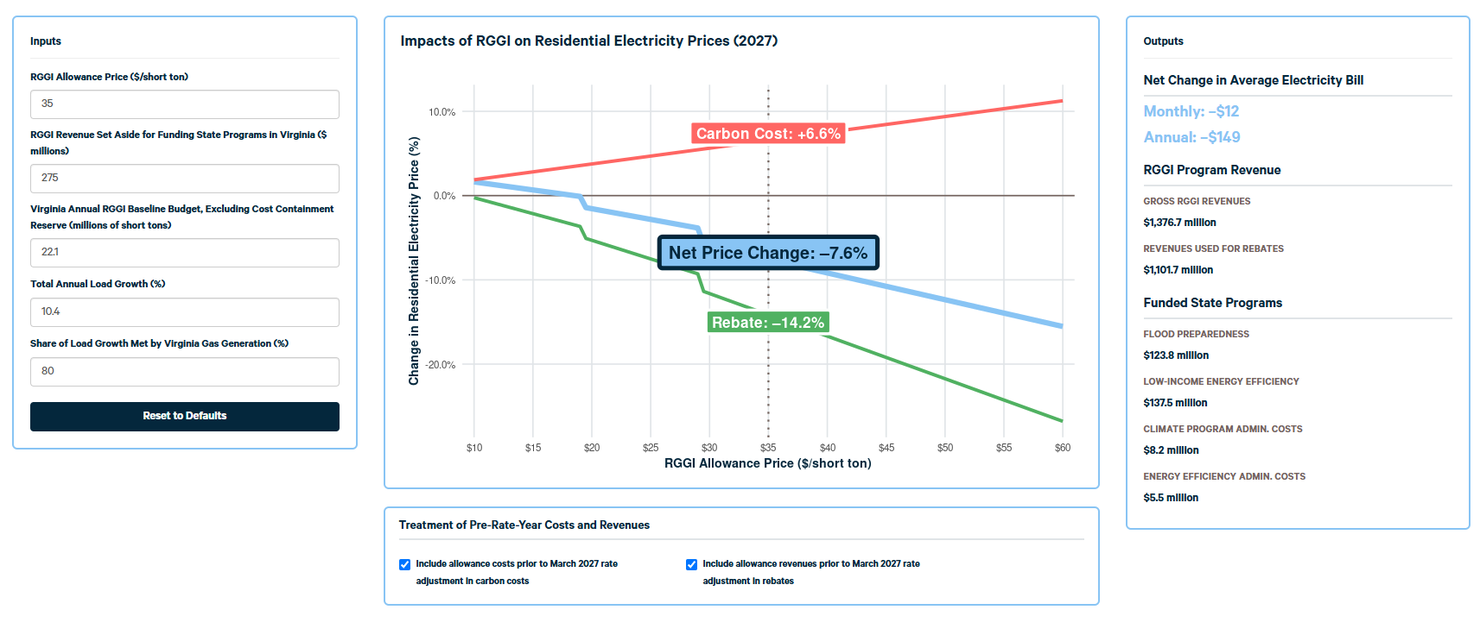
A screenshot from the Virginia RGGI Affordability data tool.
Other inputs in the data tool influence the rebates. These inputs include the budget set aside for the low-income energy-efficiency program and flood preparedness (higher values for these programs leave less funds available for rebates), Virginia’s allowance budget (higher values produce more revenues for rebates), and assumptions about overall growth in Virginia’s electricity load and carbon dioxide emissions (which have only small effects on rebate values).
Net reductions in residential electricity prices are typically possible with allowance prices above $20 per ton of carbon dioxide, so long as the combined revenues set aside for the Housing Innovations in Energy Efficiency program and the Community Flood Preparedness Fund are less than $200 million–$300 million. Otherwise, funds available for rebates may be insufficient to fully offset RGGI-related costs that emitters pass to consumers through higher electricity prices.
What is clear from the data tool is that the higher the allowance price, the greater the potential benefit for households.
Our analysis and data tool are designed for the particular circumstance in which Virginia finds itself as the state re-enters RGGI. But in principle, the idea of using cap-and-trade allowance revenue to bring down residential electricity prices is relevant to other states, as well. For example, New Jersey is striking a similar path of using RGGI funds to provide consumers rate relief. But Virginia is especially well situated to ensure that new sources of large commercial load, like data centers, cover the costs they impose on the electricity grid and the environment. The RGGI pricing mechanism, coupled with substantial rebates to all of Virginia’s residential electricity customers, would be an especially virtuous way to ensure that data centers and polluting entities cover the costs of their emissions while directly reducing every Virginia household’s electricity bill.

The authors appreciate excellent research assistance from Emma DeAngeli, a research associate at RFF.
Artificial intelligence (AI) was used in the creation of this data tool. Claude AI software generated the script based on a human-generated quantitative analysis, and Claude was used to make further modifications to the design and functionality of the tool.