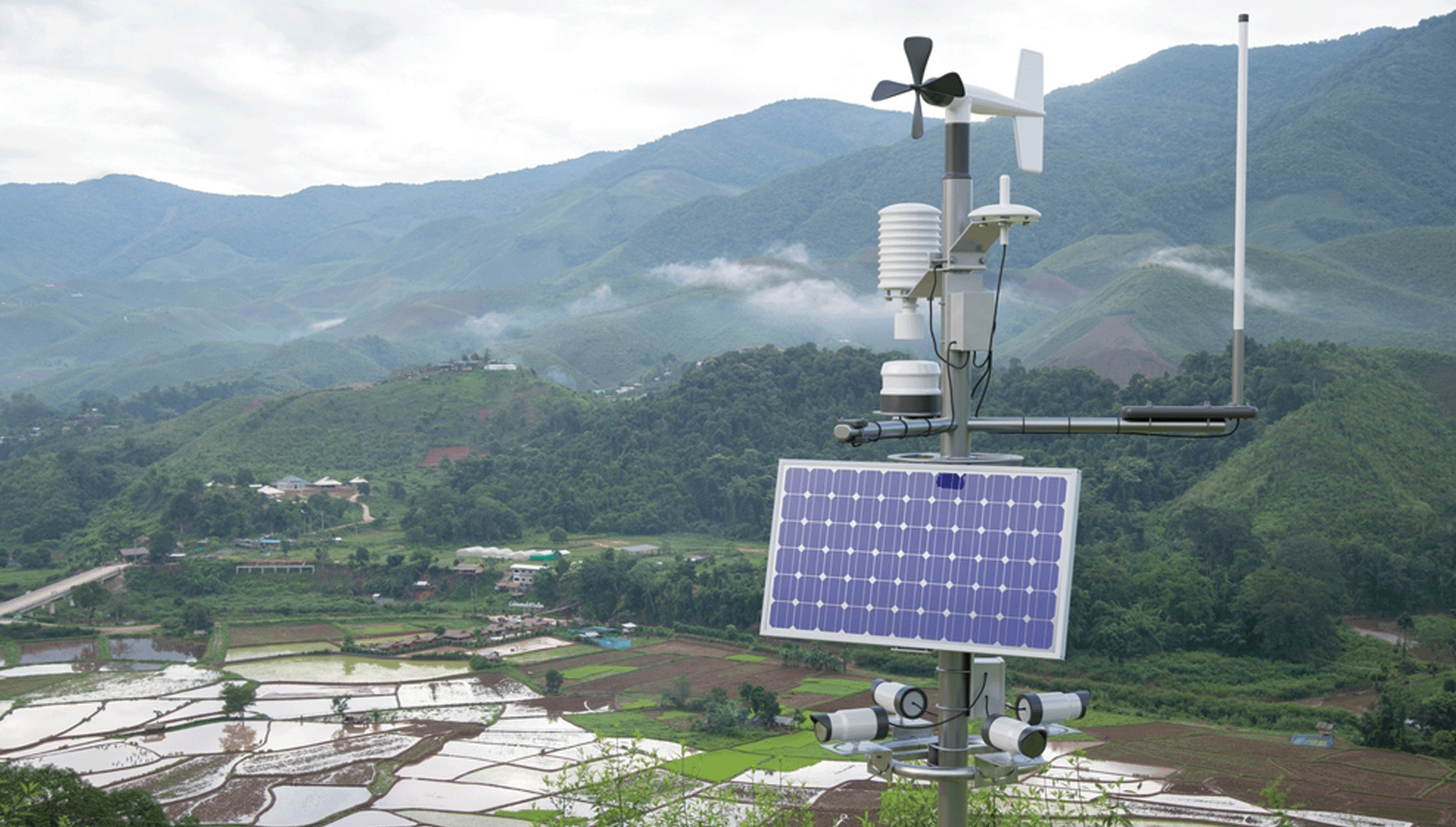

This week, host Margaret Walls investigates the world of weather forecasting with Jeffrey Shrader, an associate professor at Columbia University whose recent research examines inequalities in forecast accuracy among countries across the globe. While the accuracy of weather forecasts has improved steadily over the past few decades, low-income countries experience notably less reliability in their local and regional weather predictions. Shrader explains how factors such as topography and proximity to the tropics impact the ability to get a read on the weather, while lack of investment in weather-observing infrastructure exacerbates such inequalities. In the course of breaking down his findings, Shrader gives an overview of the public-private partnership behind US weather forecasting (including how the context and outcomes may be poised to shift with recent policy proposals) as well as the changes that national and global leaders can implement to improve the complex weather forecasting system.
Listen to the Podcast
Audio edited by Rosario Añon Suarez
Notable Quotes
- Stark disparities in forecast accuracy among countries: “Low-income countries, on average, have temperature forecasts that are substantially less accurate than temperature forecasts for high-income countries. That’s true, also, for precipitation forecasts. One-day-ahead forecasts 20 years ago in high-income countries are as accurate as one-day-ahead forecasts in low-income countries today.” (5:31)
- Geography and infrastructure create a twofold problem: “You have much less weather-observing infrastructure in the tropics, and in general across low-income countries. It’s harder to forecast in these low-income countries, and we’re making the problem worse because there’s not as much weather-observing infrastructure in place to create as accurate a forecast as we could make.” (11:13)
- Weather predictions have significant indirect benefits: “Accurate forecasts help reduce mortality from temperature. They help people avoid hot temperatures that might be deadly for them. They help mobilize public health resources. And so, forecasts are a tool that can make public health efforts more effective.” (15:37)
Top of the Stack
- “Global Inequalities in Weather Forecasts” by Manuel Linsenmeier and Jeffrey Shrader
- “Weather Forecasts Become More Important for Reducing Mortality as the Climate Warms” by Jeffrey G. Shrader, Stephan Thies, Laura Bakkensen, Manuel Linsenmeier, and Derek Lemoine
- “On the Impossibility of Informationally Efficient Markets” by Sanford J. Grossman and Joseph E. Stiglitz
- Princess Mononoke film
- All the World by Liz Garton Scanlon
- Balanced Weather blog from Alan Gerard
- Balanced Weather substack from Alan Gerard
The Full Transcript
Margaret Walls: Hello, and welcome to Resources Radio, a weekly podcast from Resources for the Future (RFF). I’m your host, Margaret Walls.
I’m wondering today how many of our listeners check their local weather forecasts at some point. Did you open your phone, click on the weather app? I do that a lot myself. Did you hear forecasts from your local radio station on the drive to work? Are you like me: you have a tennis match tonight, and you’re wondering if it will be rained out? Well, on today’s show, we’re going to talk about weather forecasts, why they matter—not just for tennis matches—and how accuracy differs a lot depending on where you live.
My guest today is Dr. Jeffrey Shrader. Jeff is an environmental economist, an associate professor in the School of International and Public Affairs at Columbia University, and he’s an expert on weather forecasts. He studies how forecasts affect various kinds of human behavior and decisions around climate adaptation. He’s extremely knowledgeable about forecast data, and he’s thought hard about how we measure the economic benefits and costs of forecasting.
I’m really excited to have Jeff on the show today. I’ve been a fan of his work for a while, but he’s got a recent paper which is going to be the focus of our conversation. He’s just published it in the journal Nature Communications. It’s co-authored with Manuel Linsenmeier, and it’s entitled “Global Inequalities in Weather Forecasts.” The paper shows the differences in forecast accuracy across various countries, and it discusses the implications of these differences. It’s fascinating and important research. I’m also going to ask Jeff toward the end to go a little bit beyond the paper and talk about some recent US policy around weather forecasting. So, we have lots to discuss. Stay with us.
Hello, Jeff. Welcome to Resources Radio. Thanks for coming on the show.
Jeff Shrader: Hi, thanks for having me. Thanks for that very generous introduction.
Margaret Walls: Yeah, I’m excited to have you here. So Jeff, we start with a get-to-know-you question. Tell us a little bit about yourself, what inspired you to become an environmental economist, and especially how you came to focus a lot of your research—not all of it, but a lot of it—on these issues related to weather forecasts.
Jeff Shrader: So, I’ve been a professor at Columbia for about eight years now. Before that, I was a postdoc at New York University (NYU) working with Ricky Revesz, who’s an environmental and regulatory lawyer. And then I got my PhD at University of California San Diego advised by Josh Graff Zivin. Narrowly, my research on weather forecasts really owes a lot to Josh, my advisor. I remember I was presenting in one of his classes, one of his environmental economics classes, about some impacts of El Niño–Southern Oscillation on fisheries. I mentioned that forecasts of El Niño had been introduced in the late ‘80s and early ‘90s, and Josh in his classic style just said, “Oh, I think there’s something really interesting there with the forecasts.” And that launched my career, in some sense.
And then going back, I became an environmental economist for lots and lots of reasons growing up. But one thing I’ll always credit is some important films in my youth, like Princess Mononoke, actually. Interestingly, I think that really put me on the path of caring a lot about the environment. So, it’s interesting to think about the way media has shaped my attention to this issue.
Margaret Walls: Ah, good point. Yeah, that’s interesting. Well, that’s a great introduction to you.
Let’s turn to your new paper, and let me just start with some big-picture findings, and I’ll ask you to dive in a little deeper. What you find is that the temperature forecasts are much more accurate in high-income countries than low-income ones. This is a particularly striking way you put it, and I think this really made the message hit home: you say that a seven-day-ahead forecast in a high income country is more accurate than a one-day-ahead forecast in a low income country.
So, can you flesh this out a little bit for us? What are some of your main findings?
Jeff Shrader: Our goal with this paper was to revisit some analyses of weather forecasts that have been done by meteorologists, where they’re trying to assess the accuracy of their forecasts. So, these are operational meteorology centers like the European Centre for Medium-Range Weather Forecasts, or the National Oceanic and Atmospheric Association (NOAA) and the National Weather Service here in the United States. They produce a lot of analyses of how accurate their forecasts are. One thing that Manuel and I were struck by is what’s, let’s say, missing from those analyses, which is a social-science lens on these forecasts.
So, what we did is revisit some classic weather forecast–accuracy analyses, in particular this paper that had been published in Nature, “The Quiet Revolution,” which documented how much better forecasts had gotten over the last few decades. We wanted to ask: how much better have forecasts gotten for people, and how much have forecasts of economically relevant weather variables changed? We were really focused on temperature, and precipitation to some degree, as well.
And so, one of the main findings is the one you mentioned, which is that temperature forecasts have gotten a lot better over time around the world, but there has been this very persistent gap between higher-income and lower-income countries on average. So, one way to put that is, as you said, that low-income countries (classified using World Bank data), on average, have weather forecasts or temperature forecasts that are substantially less accurate than temperature forecasts for high-income countries. That’s true, also, for precipitation forecasts, although the story is a little bit nuanced and a little bit different.
And it’s not just about the horizon. If you look even at a fixed horizon, so look at day-ahead forecasts, the accuracy of day-ahead forecasts lags the accuracy of forecasts in high-income countries by about 20 years. So, another way to say that is: one-day-ahead forecasts 20 years ago in high-income countries are as accurate as one-day-ahead forecasts in low-income countries today.
Margaret Walls: Yeah, okay. Dive into the data a little bit for us, Jeff. I know that you combined decades of forecast data with various information on land-based observation infrastructure, and you mentioned the World Bank data. So, talk about this a little bit; I’m thinking people might want to know more about where those forecast data come from and what the granularity of them is spatially, and things like that.
Jeff Shrader: I’ll say a couple things on the data. First, a huge shout-out to my coauthor, Manuel Linsenmeier. He did the bulk of the data lift on this project, and it was a lot of data to put together: decades worth of forecast data, decades worth of weather data and economic data, as well, and then a bunch of weather-infrastructure data, which I’m happy to talk about later. So, big data set, lots of moving parts, and he really took the lead on that.
The way we were able to put all those pieces of data together really owes a lot to the European Centre for Medium-Range Weather Forecasts, the ECMWF. This is the premier global weather prediction center in Europe, and they have led a really helpful, mind-bogglingly helpful, effort to organize and consistently save historical real-time weather forecasts from a bunch of different weather-forecasting agencies all around the world for many decades.
So, we acquired the main piece of data for our analysis, these weather-forecast data, from the European Centre for Medium-Range Weather Forecasts. Those data are available for researchers; especially if you’re a European or European Union-based researcher, you can relatively easily access those data. So, that’s one of the reasons that Manuel was so instrumental in this project. But if you’re a researcher outside the EU, there are ways to request research access to those data.
And I should just mention, this is a tremendous data archive. Weather forecasts, because they’re issued every day, all around the world, every hour of the day, and over so many different horizons and so many different weather fields—you can just imagine how big these data sets become relatively rapidly. And so, the fact that the European Centre for Medium-Range Weather Forecasts has archived these data for use by researchers, it’s an amazing resource for all of us.
Margaret Walls: Right, yeah, that’s great. So, tell us, Jeff, why does this gap exist, do you think? If I’m remembering right, in the paper you talk about both less investment in monitoring infrastructure in the low-income countries, but also something I didn’t realize, which is it’s inherently harder to forecast in certain places, such as the tropics. Is that right?
Jeff Shrader: That’s right. And that’s actually the bulk of the story here. Many tropical countries are low income, and the tropics are just harder to forecast over these short horizons. So, a one- to seven-day-ahead, or maybe a one- to ten-day-ahead forecast, is just a lot harder in the tropics than in the extratropics like here in the United States or in Europe.
That is a result of the features of the meteorology. So, in the tropics you have these … I’m an economist, so I’m going to step out on a limb and talk about a little bit of meteorology here, but my understanding as an economist is that in the tropics you have these small-scale, very moisture-driven “shallow convection patterns.” Basically, think about small, local storm systems and clouds forming, heavily moisture dependent, and that’s just hard to forecast. These are, in an atmospheric sense, very small-scale, granular features of the atmosphere.
Contrast that with a place like the United States, where we have these big “deep convection patterns.” So, if you go and look at a weather map of the United States, you can see these large-scale weather patterns that are moving all across the United States. Or think about a hurricane; this is a large-scale convective pattern that covers a massive area. That actually makes our weather a lot easier to forecast, because weather in one place is going to end up translating into weather in a far distant place over the next few days. That’s the heart of weather forecasting in the extra tropics.
One way I put it is in the United States we have really accurate forecasts because of these large-scale convective patterns. One of the downsides of that, or one of the trade-offs we face, is actually things like tornadoes and hurricanes. These large-scale convection patterns do cause some of the natural disasters we face, and so there is a trade-off there.
So, that’s the bulk of the story. There is an infrastructure story, a really important infrastructure story, as well, but it’s probably something like 10 percent of the total story. But it’s an important 10 percent. You have much less weather-observing infrastructure in the tropics, and in general, on average, across low-income countries. And so, it’s harder to forecast in the tropics, it’s harder to forecast in these low-income countries, and we’re making the problem worse—we, in the global sense, are making the problem worse—because there’s not as much weather-observing infrastructure in place to create as accurate a forecast as we could make.
Margaret Walls: Yeah, that’s interesting. So, it sounds like you’re saying that in the tropics, that fundamental problem was more important to these differences than the lack of infrastructure and so forth—what do you think about that?
Jeff Shrader: As far as we can tell, it is more important. We do a decomposition in the paper, and it’s a 90/10 split. 90 percent of the issue is probably from the tropics, 10 percent is from infrastructure. But I’ll say a couple of things on top of that.
One, as I said, is that we’re leaving a lot of money on the table, in the sense that, by not having at least equal weather-observing infrastructure in the tropics, we know that that’s making tropical forecasts worse. We know that’s making global weather forecasts worse. There have been really interesting analyses by NOAA and the National Weather Service here in the United States, and by the ECMWF in Europe, documenting that we could install more weather stations and weather-balloon stations and things like that in the tropics, and that would actually improve global weather forecasts.
And then two, I don’t know that we really know how far we could push tropical forecasts, because a lot of global weather models have focused on the extra tropics. And so, especially with the advent of new weather modeling techniques, artificial intelligence (AI) techniques and others, I’m really curious over the next couple of decades how much we can push these tropical forecasts forward.
Margaret Walls: That’s super interesting. One thing—I think you just said this a minute ago, maybe you could say a little bit more about it—but forecasting has improved a lot in the United States, I think. You can correct me if I’m wrong about that. But in the paper, you point out that that gap in forecast accuracy between rich and poor countries has not really shrunk over time. So, it has persisted. Is that right?
Jeff Shrader: That’s right. Forecasts have gotten better on average all over the world over the entire time period that we look at, and probably if you go all the way back to the 1950s, forecasts have been getting better everywhere that forecasts have been produced. Post–World War II, there’s this real boom in modern weather forecasting, and as far as I can tell from my read of the research, forecasts have been getting better since then. And certainly we show in the paper that forecasts have been getting better globally, but there’s been this really persistent gap. That was one of the surprising findings from our paper.
So, as I said, we started this paper off by trying to apply a social-science lens to the analysis of weather-forecast accuracy, weather-forecast verification. And one of the pieces of that is if you look at meteorologists, when they verify forecasts, often they only focus on extratropical, i.e., high-latitude, locations. They actually drop the tropics out of their verifications. I can understand why; it is a different forecasting challenge, and so, if they want to do, say, an apples-to-apples comparison between the Northern and Southern Hemispheres, they will exclude the tropics. It makes sense from a meteorology standpoint, perhaps, but it means you miss out on this really economically important and, frankly, meteorologically important area which is in the tropics.
So, we looked at the tropics, and that’s where we found this lack of convergence. It’s, again, this dual story where it’s just hard to forecast there, and there have been some real setbacks in terms of infrastructure in many of these tropical locations.
Margaret Walls: Yeah. So Jeff, tell us: Why does this forecasting accuracy matter economically? Or maybe I should say, How much does it matter economically, how accurate our forecasts are?
Jeff Shrader: Weather-forecast accuracy matters for a number of reasons economically. We’ve shown it in other work. We have a paper published in the Proceedings of the National Academy of Sciences (PNAS) earlier this year where we looked just in the United States and showed that accurate forecasts help reduce mortality from temperature. So, it helps people avoid hot temperatures that might be deadly for them. It helps mobilize public health resources and other things. And so, forecasts are an important public health tool, or a tool that can make public health efforts more effective. That’s certainly been demonstrated in the United States and Europe, and I suspect it would be true if we looked in other countries around the world.
We have other research by a growing body of economists who have been looking at the effect of weather forecasts on various parts of the economy, showing that forecasts are important for making labor-supply decisions, for helping, of course, with emergency response, and things related to traffic and keeping the roads clear. They’re important for avoiding death and damage from natural disasters, so helping the Federal Emergency Management Administration (FEMA) target its aid, for instance, in the United States. So, there are a lot of different sectors that are helped by weather forecasts.
And then of course, one of the essential sectors that is really reliant on weather forecasting is agriculture. A lot of work, even going back decades in economics and other fields, has looked at the influence of accurate weather forecasts on agriculture.
Margaret Walls: Yeah. I’m sure you and I both know there’s a lot of climate impact studies that have been done now with climate change as a focus, and how much temperatures matter or precipitation matters economically. But I really like that this is not just that, it’s how well you can forecast it. I guess so people can prepare, that’s the main thing, right?
Jeff Shrader: That’s right. And that was one of the reasons why I started working on this. I was trying to understand climate impacts and especially climate adaptation. And that’s what led me down this path initially: I was trying to understand how forecasts, early warning systems, can help facilitate adaptation. That’s really the heart of what we did in that PNAS paper that we published earlier this year: look at weather forecasts as a facilitator for climate adaptation.
Margaret Walls: Yeah. So, tell us if, given everything you learned in this study and some of your other work, is there one intervention you’d prioritize that would help improve this situation with poor countries and their weather forecasts, given this constraint of how challenging the tropics are? Would you recommend more weather stations, better forecasting infrastructure, and how would we get to a better outcome? Do you have some thoughts there?
Jeff Shrader: Really, I’m going to take the cop-out answer and say there needs to be a bit of an all-of-the-above approach. I think there are some really cost-effective things we can do. Installing more weather stations is, I think, a good idea. My analysis, so far, suggested that it’s really cost-effective to put more weather-observing infrastructure in place. This helps your weather forecasts. This helps you understand what the state of the weather is on the ground at a given time. It helps you with a lot of things related to weather impacts. And we know that there are these gaps.
Now, there are efforts in place led by the World Meteorological Organization (WMO). There’s this piece of the global international weather-forecasting system that is supposed to be trying to close these gaps; the Systematic Observations Financing Facility (SOFF) is this funding facility for closing some weather-infrastructure gaps. My hope is that they can successfully close gaps in terms of inequities in where weather observations are, and I think that that would be a great effort to fully fund and really strongly support.
On the other end, there does need to be some human-capital investment, in my opinion. We want to push for more expert meteorologists in countries that can take global weather predictions from NOAA or from the ECMWF and tailor them to a specific context, but also do the outreach. They can build trust with communities, and they can produce their own forecasts, if necessary. So, you need stuff both at the beginning of the supply chain of forecasts and then all the way to the end of the supply chain of forecasts.
I’ll just mention one last thing, which is: one of the curious things about the tropics is that their short-range forecasts are quite inaccurate relative to the extratropics. But their seasonal scale, their long-horizon forecasts (so, I think, monthly-horizon forecasts), are actually relatively accurate compared to the extratropics. There is also an opportunity to leverage the relative accuracy of these longer-horizon forecasts, which are driven more by ocean conditions compared to, say, land and atmospheric conditions. Those might be really valuable for agricultural users. And so, you could use that as a way to build trust in the overall weather-forecast enterprise.
Margaret Walls: Okay, gotcha. That’s interesting. I think in the United States we know there’s a trust in our local meteorologists, and, yeah, there’s a whole story there, too. So, that’s a good point to make.
I want to turn to the United States now, if that’s okay, for the last couple of questions. You’ve mentioned the National Weather Service a couple of times now. The president proposed some budget cuts last year to the National Weather Service. Congress eventually restored their funding. I believe this year, the president’s budget proposes to cut funding. I’ve heard some of the rhetoric around this to be it has something to do with privatization of forecasting, and I’d love for you to talk about that for a minute. For one thing, can you just set us straight on the role of the federal government in the United States versus the private sector when it comes to forecasting?
Jeff Shrader: The federal government does a lot when it comes to forecasting, but historically there has been a fairly clear division of labor between the public and private sector, here.
One thing that the federal government plays a really important role in is gathering data on weather and certifying that data, making sure that data is of high quality, and this is the essential input into any weather forecast, public or private. So, they run weather stations, they launch weather balloons, things like that. They, of course, control and launch satellites that give us a lot of our weather data. So, there’s the data-gathering part. There is the research and development of forecast models, which the public sector is very heavily involved in, but the private sector does some of, as well. And then in the public sector, the National Weather Service issues forecasts. They issue short-range forecasts, the ones that you look at if you went to weather.gov; they also issue important forecasts for, say, aviation-related weather. They issue disaster warnings, hurricane forecasts, things like that.
Where the private sector picks up is after that point, largely. So, the private sector takes care of a lot of the dissemination of forecasts. On your local news, the weather person on your news, that’s a private-sector person—that’s not going to be a National Weather Service employee. They create their own forecasts, often utilizing the forecasts that are created by the National Weather Service, building on top of those, and then creating a forecast that you’d see, for instance, on your phone weather app or on weather.com, something like that.
And then, they also play an important role in creating what you might call “boutique” forecasts for individual industries. If you’re a natural-gas trader, you might rely on a private-sector forecast. So, you can see where there is a little bit of overlap between these groups historically, but there’s also a somewhat clear division of labor between the groups.
One thing that’s happened and has been attempted over the last few years, both in the first Trump administration and in the current Trump administration, is to shift where this line is drawn. There have been some efforts to privatize portions of what the National Weather Service does, and also to push the National Weather Service to rely more heavily on the private sector. So, for instance, there was a 2017 law that was passed, and then there’s been a recently-proposed Weather Research and Forecasting Innovation Reauthorization Act, that encourages the National Weather Service to at least test out or investigate whether they should be purchasing more private-sector data—weather data, for instance. There have been a number of efforts to try to privatize portions of what the National Weather Service does.
Margaret Walls: That’s helpful. Any opinion on the moving of that line? What do you think about that?
Jeff Shrader: I think there’s a lot that makes sense about where we drew the line as it stands. If you think about the basic economics of public versus private weather forecasting, if you go to Information Econ 101, that would suggest to us that the private sector is probably going to underprovide data, basic data like weather information—so, weather-station data, weather-balloon data, satellite data—and that’s Grossman-Stiglitz (1980)–type logic, if your readers want to check that out. The private sector will, in general, according to our theory at least, underinvest in information. And so, there’s an important role to play there, and I think that’s something that, broadly, people agree with across the aisle: the National Weather Service should play an important role in gathering data.
The National Weather Service also, obviously, has an important role to play in creating weather forecasts that are in the public interest. So, these life-saving forecasts, these forecasts that are important for public health, these forecasts that are important for warning citizens of upcoming dangers, that’s something where there’s a public health rationale for not putting that behind some paywall or making that harder to get. Where do you draw the line after that? I think that is where negotiation happens, but that negotiation has happened over a number of decades. I think there’s some logic to where we’ve drawn that line so far.
Margaret Walls: That’s super helpful and interesting.
Well, for my last question, I want to ask you what’s going on in Congress. I think there’s a few things, some bills floating around. Can you pick out a couple things you think people might want to know about?
Jeff Shrader: There are a number of things going on. One overarching thing that’s been happening is, as you say, there have been a number of efforts by the Trump administration to, in some sense, privatize portions of the National Weather Service, or certainly to reduce the funding for the National Weather Service. There has been a very strong bipartisan pushback against this. From a political-economy standpoint, this is a really interesting case where Congress has been unequivocal in its defense of the National Weather Service and the overall public weather enterprise in the United States.
There has been a really strong push by a bipartisan weather caucus led by Mike Flood, who’s a Republican, and Eric Sorensen, who’s a Democrat. Sorensen is a meteorologist by training. And they have led this effort to educate congresspeople about weather forecasting and the importance of the public weather-forecasting system to the economy and to society across the United States.
And then there have been a number of legislative efforts that have either flowed from that caucus or from other bipartisan groups. I mentioned the Weather Research and Forecasting Innovation Reauthorization Act before, that’s quite a mouthful, but that’s really trying to follow up on this successful law that was passed in 2017, the last major piece of legislation related to weather forecasting in the United States. There’s been a push for a National Weather Safety Board, which is trying to review moments when forecasts don’t work as well as they should and try to draw some lessons learned from that. So, time will tell whether that will be a helpful effort.
There have been efforts to try to improve rural weather forecasting. Different weather-forecast users, of course, have different needs. Also, weather forecasting, as my paper with Manuel shows, can differ across different locations. And so, there’s been an effort to try to improve weather forecasts for rural users in the United States.
I would say, if I were to wave a magic wand in the United States, I would also want to focus on improving weather forecasts in any area where the forecasting is really complex or granular. So, that would involve forecasts in urban areas and cities where you can have quite complex, fast-changing temperatures across space. Similar to that Rural [Weather Monitoring Systems] Act, I would love to see something for places like mountainous regions or places like cities, where you have this really complicated weather topography.
Margaret Walls: Okay. Super interesting.
All right, Jeff, we have to end the podcast now, and we always do that with our Top of the Stack feature. I’m going to ask you to recommend something to our listeners: a book, a podcast, an article you’ve read, anything. What’s caught your attention lately?
Jeff Shrader: I have a little kid at home, so a lot of my reading has been children’s books. I have nuanced opinions on children’s books. I’ll mention one, which is actually a classic one: All the World has a little bit of a meteorology hook, because there’s some beautiful pictures of the sky in that book.
But the more serious recommendation I give is I’ve been learning a lot and really eagerly reading a blog by Alan Gerard. It’s called Balanced Weather. Alan was a meteorologist for decades, and now he writes this really fascinating blog. I’ll say that’s been the way that I’ve really kept informed on all things related to the weather that’s happening: modeling and weather forecasting, and legislative and executive things that have been happening as well. So, Alan Gerard’s Balanced Weather, really fantastic read.
Margaret Walls: Oh, I’m going to take a look at that. And hey, you’re not the first person to recommend a children’s book, so that’s fine, too.
Jeff, thanks so much for coming on Resources Radio. It’s been a pleasure having you on the show, talking about weather forecasts, your latest research, and the latest on the US policy front. I really appreciate you taking the time.
Jeff Shrader: Thank you.
Margaret Walls: You’ve been listening to Resources Radio, a podcast from Resources for the Future (RFF). If you have a minute, we’d really appreciate you leaving us a rating or a comment on your podcast platform of choice. Also, feel free to send us your suggestions for future episodes.
This podcast is made possible with the generous financial support of our listeners. You can help us continue producing these kinds of discussions on the topics that you care about by making a donation to Resources for the Future online at rff.org/donate.
RFF is an independent, nonprofit research institution in Washington, DC. Our mission is to improve environmental, energy, and natural resource decisions through impartial economic research and policy engagement.
The views expressed on this podcast are solely those of the podcast guests and may differ from those of RFF experts, its officers, or its directors. RFF does not take positions on specific legislative proposals.
Resources Radio is produced by Elizabeth Wason with music by Daniel Raimi. Join us next week for another episode.