
In this week’s episode, host Margaret Walls welcomes to the podcast Nick Bratton, who works as a program manager in King County, Washington State, coordinating and promoting market-based conservation through the voluntary transfer of development rights. As an incentive-based approach to land use, transfer of development rights (TDR) programs enable property owners to sell the development rights on some of their land while setting aside some of the land so it remains undeveloped natural space. TDRs have great potential to facilitate both land conservation and residential or commercial development, all without the need for government funding. Walls and Bratton talk about Bratton’s work in King County’s TDR program, his observations on TDRs more broadly, and what he views as factors for success with such programs.
Listen to the Podcast
Audio edited by Rosario Añon Suarez
Notable Quotes
- Incentives for development can be powered by the private market: “Like most of the 300-some TDR programs around the country, King County seems to use the power of the private market to remove development potential … from places where we don’t want a lot of growth—like our farms, forests, rural areas, and open spaces. So instead, we encourage growth in places where we do want it, like in our urban areas and cities.” (4:00)
- To spread, this idea needs to overcome two main challenges: “I think this idea is spreading globally. It’s great to see. In my years of design work, I’ve identified a list of nine ingredients that all TDR programs need to succeed. And of those, the two that I think are the hardest to get right are the economics and the political will.” (18:04)
- New construction is getting tough: “We’ve been weathering this perfect storm of high land costs, high interest rates, high construction costs, tariffs—and all these things created an environment where new construction struggles to be financially viable.” (20:50)
Top of the Stack
- Jazz Cruise Series Vol. 1 album by Kelvin Momo
The Full Transcript
Margaret Walls: Hello, and welcome to Resources Radio, a weekly podcast from Resources for the Future. I’m your host, Margaret Walls.
My guest today is Nick Bratton. Nick is the King County, Washington, Transfer of Development Rights (TDR) program manager. “TDR” stands for transfer of development rights, which is an incentive-based approach to land use that allows property owners in some areas in a community to sell the development rights on their land—typically to a developer who then uses them to develop a separate property.
The original owner’s property is then usually put under a conservation easement, or some other restriction so that it stays as open space. The property where the development rights are used is then developed more densely, or maybe to a higher height or greater floor area—just more intensively than it would otherwise be allowed to be developed by baseline zoning.
So, let me just start by saying that I’ve had a thing about TDRs for a long time. I’m a big fan. I think they have great potential. They provide a market-based approach to achieving conservation goals without stymieing development, and without requiring government funding, because they’re a private-market instrument. And they can be a way to increase housing supply in designated growth areas. Local zoning regulations and other kinds of restrictions on housing supply are getting a lot of blame these days—probably rightly so—for the housing affordability problems we’re seeing in many American cities, and TDRs provide a way to kind of loosen up those zoning rules.
But despite their potential, I think it’s fair to say that very few programs in existence function as well as we’d really like to see. In fact, some of them are really kind of dormant. But the King County, Washington, program is an exception. It’s also one of the few programs that’s managed to increase density in urban areas, such as the city of Seattle.
So, we’re going to talk with Nick about the program he runs, and about his views on TDRs more broadly, and what the factors are for success. How do we get away from having these dormant programs out there? I’m also going to ask Nick to talk about the potential for TDR to be used to achieve climate resilience goals. So, we have a lot to cover. Stay with us.
Hello, Nick. Welcome to Resources Radio. Thanks for coming on the show.
Nick Bratton: Hi, Margaret! Thank you for the invitation.
Margaret Walls: Nick, we always start with a get-to-know-you question. So, tell us a little bit about yourself. What’s your background? How did you come to manage this program in King County?
Nick Bratton: Well, Margaret, my entry into this field came from an unexpected place. 26 years ago this June, I was standing on the summit of Mount Rainier, which is the highest peak in Washington State. Looking to the northwest, I could see the entire landscape stretching out before me, from the summit of the mountain to the Puget Sound. There was the pristine beauty of the national park right in front of me, and then after that came the commercial timber lands, and after that came the suburban sprawl in Pierce County. And then, right up against the water was the urban center of Tacoma, and then Seattle to the north of that.
Seeing the whole region from this perspective, I knew that my future would be in land use policy. I felt a calling to help shape a more sustainable future for the region at the landscape scale. After that, I went to graduate school for forestry and public administration, and worked for 15 years at a nongovernmental organization designing land use policy and transfer of development rights programs across western Washington before coming over to King County in 2023.
Margaret Walls: Okay, very good. So, Nick, I gave a basic introduction to TDRs at the beginning. Tell us more specifically about the King County program and how it works.
Nick Bratton: Sure. So, like most of the 300-some TDR programs around the country, King County seems to use the power of the private market to remove development potential, which is essentially unbuilt homes, from places where we don’t want a lot of growth—like our farms, our forests, our rural areas, and open spaces. So, instead, we encourage growth in places where we do want it, like in our urban areas and in our cities. Urban areas have jobs, transit, parks, schools, business, infrastructure—all these things we need for complete and sustainable communities. These transfers are all voluntary, and they respect private property rights.
King County’s TDR program works in two ways. The first is entirely in the private market, where individual landowners voluntarily give up their right to develop their land. It’s permanently protected by a conservation easement, and a county gives these landowners TDR certificates that represent the homes that they could have built. These landowners can then sell their certificates to developers who use them to gain some kind of development bonus. Maybe it’s extra lots, extra floor area, or other incentives that create more value.
The second way our program works is through a publicly run bank. So, whenever King County conserves land—maybe we’re buying property for a park or buying a farmland-protection easement—we retain the development rights from those lands, and we keep them in a bank. And then, developers can come to us and buy the development rights from the bank to gain extra density in the city, for example. In this way, sales of development rights to private buyers help the county to recover the money that we originally invested, and we revolve that revenue back into more conservation.
Margaret Walls: Got you, okay. So, just to give a sense … I don’t want to put you on the spot too much. But let’s suppose I have a 20-acre lot, or a 50-acre lot in one of the areas where you’re trying to achieve the conservation goals. How many development rights would I be allowed to lift and sell from my land?
Nick Bratton: So, our program certifies development rights. We give them to landowners in two ways. The fundamental approach is just based on zoning. So, if you have 100 acres, and your land is zoned for 1 home per 5 acres, you have the development potential for building 20 homes. And provided there are none there already, we would give you 20 development rights to sell.
We also incentivize certain types of landowners of certain types of land to join the program by awarding bonuses. So, if you have unaltered marine shoreline, or certain freshwater shoreline designations, or certain lot sizes, we might give you extra development rights beyond what you could build by zoning to create more value to incentivize landowners to join the program.
Margaret Walls: Okay, got you. And I want to say we often call these “sending areas” and “receiving areas.” I’m not sure if you use that term out there. I think you do.
Nick Bratton: Absolutely, yeah.
Margaret Walls: Yeah, okay. I’m going to talk in a minute about receiving areas. But one of the really interesting features of your program, I think, Nick, is that you have signed these interlocal agreements with partner cities to be receiving sites for TDRs, and that’s to take on additional density.
In my looking at TDR programs around the country, this was often the challenge that I saw cropping up—is that communities, because of various NIMBYism kinds of things, don’t want to take on that extra density. But you’ve managed to break that problem, and get these agreements with Seattle, and Bellevue, and other cities out there to take on density.
Can you talk about that a little bit? How’d you get to “yes” with those cities?
Nick Bratton: Yeah, for sure. So, we currently have, or have had, partnerships with six cities in the county. And in the future, I would like to add more. This is a big priority for my vision for the growth of this program.
Historically, in my conversations with cities, they appreciate how TDR benefits their communities. They get the conservation outcome, and they see that it’s a good thing in general. But it’s still a hard sell.
To summarize the feedback I’ve heard, cities already struggle to provide infrastructure and services to their existing populations. If they’re going to take more growth via TDR, they need the resources to support that. This was the impetus for King County’s revenue-sharing approach and the regional transfer of development rights program at the state level that I helped to design a few years back.
And so, in our King County model, for example, every single purchase that a developer makes from the King County TDR Bank, we return a percentage of that revenue to the cities that take it. And they can spend this on parks, affordable housing, stormwater, or transit. There’s a wide range of public benefits that they can spend this on, all of it supporting growth. So, creating this financial incentive has really been an effective approach to expanding our partnerships. Cities really see there’s something in it for them, and they have generated millions of dollars from these agreements that have helped them to pay for parks and public improvements that benefit their residents.
What is also helpful—not necessary, but in some cases, this can tip the scales—is having some kind of tangible connection between the land that the county is conserving and the use of TDR in the city. So, maybe that’s protecting farms that sell produce at farmer’s markets, or protecting land along waterways that flow into the city, or protecting land that provides recreational opportunities to city residents. Those connections matter to people.
Margaret Walls: Yeah, for sure. Those financial incentives are pretty significant. Do they solve the problem of, I don’t know, neighborhoods? Or maybe you don’t have this problem too badly, but existing residents being opposed to more density? Or, does that issue come up—or in this world we’re in these days, is that not as big an issue? What do you think about that?
Nick Bratton: It does. I think it’s universal. We see this in every community around the country. Folks are just reluctant to embrace change, and that’s part of human nature. So, I think also part of what has helped to facilitate these agreements is that the cities that we partner with tend to direct their development rights into town-center areas, or neighborhoods that they’ve planned for major redevelopment.
So, it’s not like development is being plopped in everyone’s backyard across the city, but there are specific designated areas typically in a central business district where there’s already a lot of infrastructure that can support more growth. And so, if you live in a single-family neighborhood, maybe you’re less resistant to the idea of an apartment building going up downtown than you would be having a bunch of town homes going up on your block.
Margaret Walls: Yeah, gotcha. Are they used for commercial development, Nick? I can’t remember. Or, just residential?
Nick Bratton: Yeah. Several of the counties, or the cities we partner with, will award additional floor area, and building height for office and commercial buildings as well.
Margaret Walls: Got it. Well, so tell us about some of the accomplishments of the program. It started in the late 1990s—or when exactly did it start?
Nick Bratton: The history’s a little fuzzy, but it’s about 25, 26 years old. But before throwing out conservation numbers, I think it’s important to understand that King County is a big place. Our western edge is the shore of Puget Sound, and our eastern edge is the crest of the Cascade Mountains. That’s about 60 miles wide, and we’re about 45 miles long, north to south, and we’re also home to over 2.3 million residents, which ranks us 12th nationally out of about 3,300-some counties in terms of population.
Our TDR program isn’t that old. There are some programs on the East Coast I know that you’ve been working on that have been around since the 1980s, and ours only launched at the turn of the century. So, with that context of space and time, we’ve protected over 148,000 acres, which to put in perspective is about two-thirds of the area of Mount Rainier National Park, if I can return to my anecdote from the beginning. This total makes King County’s program the most successful in the nation in terms of acres conserved by a factor of about three, I think.
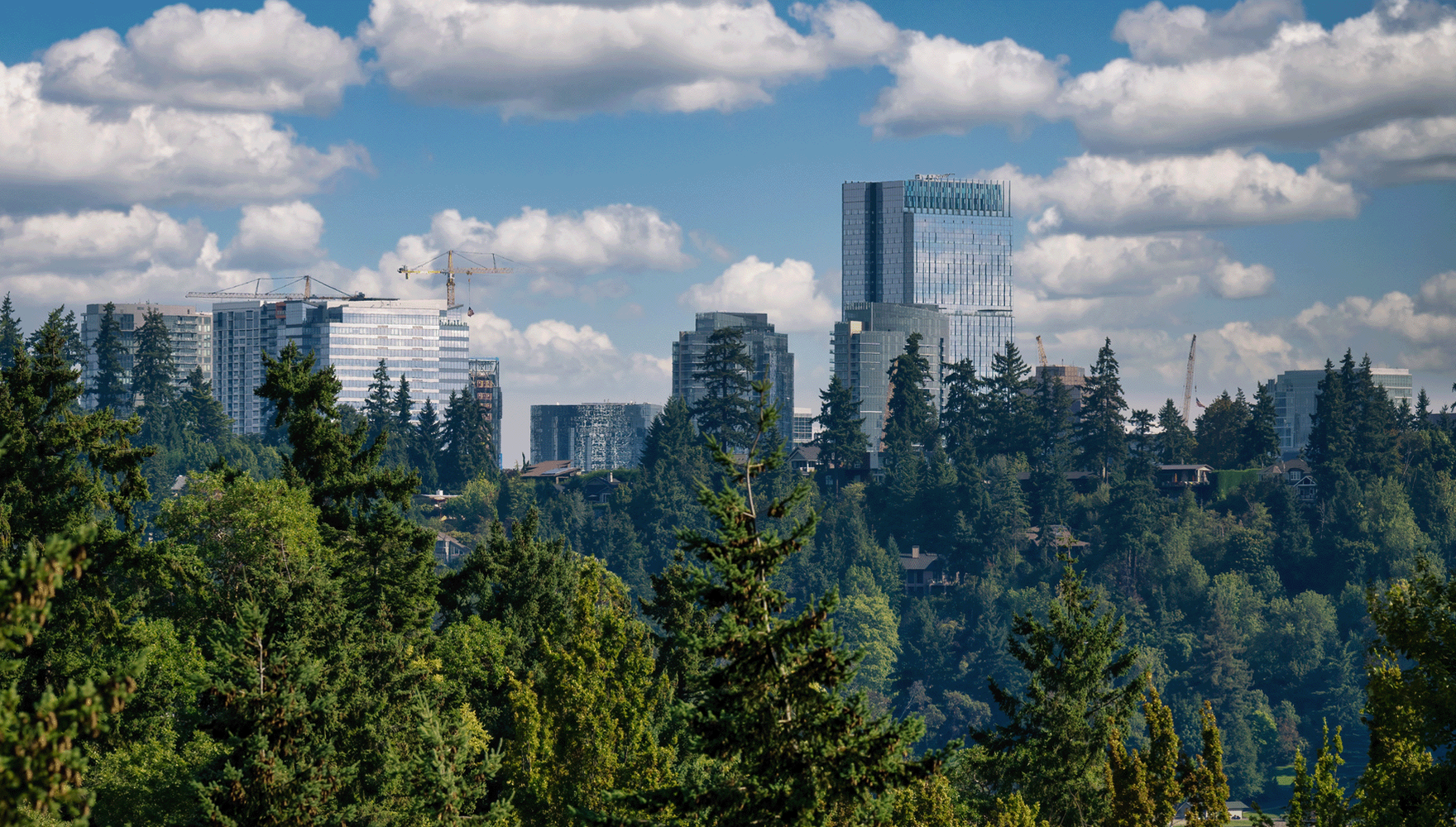
And then, on the other side, we’ve seen 139 receiving-area projects using TDR, and they have added thousands of homes in our urban areas. In our Seattle partnership alone, developers have added over 1.7 million square feet of floor area to 50 buildings. To put that into perspective, that’s the equivalent of about 34 soccer fields. So, picture 34 soccer fields added to buildings in downtown Seattle.
The King County TDR Bank has sold about $35 million worth of development rights since 2004-ish. And then, the private market, separate from the bank, has seen about $25 million worth of volume.
We’ve made meaningful progress, we’ve done a lot. But we’re not sitting still. We recognize that there’s still lots more to do.
Margaret Walls: Yeah. Can I ask you a quick question? One thing—and we studied the Calvert County, Maryland, program quite a bit here. It’s a very active program, but very rural in nature.
What we found really worked in that program is developers just became very used to using TDRs. It just became part of doing business, whereas I feel like in some of these programs that are, as I mentioned, dormant—that isn’t the case. But in King County, are developers pretty familiar with them? Do they know what they’re doing? How does that play out?
Nick Bratton: In my experience, it’s a mixed bag, and I think you make a great point. The example of Calvert County is wonderful in that there is this ingrained familiarity and recognition of the tool not only as an option, but as a way to add value. And that is also the case in some places out here, like in Seattle, developers … Real estate is so expensive, and developers want to maximize the return on their investment. So, they tend to want to extract every square foot possible from a building site and when they design their building. So, incentives like TDR and affordable housing tend to get used quite a bit, and it’s a fairly routine process.
On the other side of the spectrum, there are parts of King County, maybe developers building small subdivisions, or short plots, or townhouse projects, where they’re just not even aware of the opportunity. There’s this educational opportunity and knowledge gap there. When I talk to some of these developers, they’ll say, “Hey, I didn’t even know this was available. And if I’d been aware of this, I would’ve used it.” So, I think there’s still some work we can do to improve the visibility and let people know this is an option.
Margaret Walls: Yeah, that’s interesting. I was just getting ready to ask you what some of the biggest challenges are to making the TDR program work that you’ve faced? And is it that part of convincing developers to participate, or getting the landowners to sell their rights, or signing those agreements with the cities, or what exactly do you think have been the biggest challenges?
Nick Bratton: Well, you have just identified a number of big challenges. I think those all play into the difficulties of making a program work effectively. In my experience, I think the biggest challenge to making any TDR program work is designing it and adopting it in the first place. It’s a complex process. A lot of stars need to align to bring a new program into existence, and it can require substantial investments of time, money, and political capital.
Once you have a TDR program, you can’t just sit back and expect it will work as you anticipate it. You have to keep refining it, keep feeding it, and keep adjusting it so it continues to work. Every year, King County makes some kind of change to our program. Sometimes it’s really minor, and we’re just changing a little bit of wording in our code. Sometimes it’s more substantial, and we’re adding or removing major portions of our program. We’re continually looking for ways to improve it.
So, we’re also fortunate that we have dedicated staff to facilitate program activity, and make it easier for participants to use. There are days when I feel like my colleagues and I are like the invisible hand of the marketplace, helping to connect people, make deals happen, answer questions, and provide resources.
Margaret Walls: Yeah, that’s so interesting. I think you make a great point about … You can’t just sit back, you have to keep adjusting.
You told me, Nick, when we talked a few weeks ago, that you often get calls from other communities that are considering setting up a program. Tell me: what do you think are the two or three most important things? If somebody’s just starting from scratch in a community to get a TDR program set up, what do you think are the key things?
Nick Bratton: It’s funny you mentioned that, Margaret, because just last fall, King County hosted some researchers from Japan who were looking to set up a TDR program for Tokyo. They flew out here and spent a day with us to learn, see behind the curtain, and understand how the mechanics of our program work. Later on today, I’m talking to a group from Australia who are doing something similar in New South Wales. So, I think this idea is spreading globally. It’s great to see.
In my years of design work, I’ve identified a list of nine ingredients that all TDR programs need to succeed. Of those, the two that I think are the hardest to get right are the economics and the political will.
With economics, the program has to create value for landowners and developers alike in order for people to use it. So, tuning the mechanics of the program to local market conditions is essential. Developers have to see that there’s profit in it for them. Landowners have to see that there is sufficient value in it for them to motivate them to use the tool.
The political will is important, because your local elected officials need to make decisions on land use policy and development regulations that align TDR with growth, and these are not always popular decisions. This is not to suggest that the other seven ingredients are easy. But in my experience, these two are the reasons why most TDR programs around the country fail to meet their goals.
Margaret Walls: Yeah, those are just really great spot-on points, I feel like.
So, tell me about how your markets are functioning right now. I think when we talked, you said that some developers have purchased TDRs, but they’re sitting on their projects in Seattle right now and are hesitant to go forward with building. I know Seattle’s one of those places with some pretty sharp increases in house prices over the last few years.
So, talk about the residential property market there right now, Nick. What’s going on, and what are you seeing?
Nick Bratton: Yeah, absolutely. Things are tricky right now. When Seattle and King County adopted their partnership in 2013, it was right at the onset of a major development cycle. The big tech companies were really taking off. We were seeing this forest of cranes on the downtown Seattle skyline. There was growth everywhere, and it was one of the fastest-growing places in the country for quite some stretch.
And so, not by design—I think maybe through luck of timing—the TDR program and this partnership just got out in front of that. There were development rights flying out the door and being used in projects all over the city. King County was actually selling our development rights faster than we could bring them in, and at one point we were actually in danger of depleting the inventory in the bank.
Since the pandemic, things have slowed down quite a bit for obvious reasons. But I still try to keep my finger on the pulse in the development community. The consensus view right now is that demand for growth remains high, but conditions pose challenges. We’ve been weathering this perfect storm of high land costs, high interest rates, high construction costs, tariffs, and all these things created an environment where new construction struggles to be financially viable.
At the same time, the need for housing remains high, and it’s grown. But these economic forces are constraining production. In Seattle, the market for TDR has been quiet for the last three years. We haven’t made a single sale in a bank since early 2023. But we’re starting to see an uptick in activity as dormant projects restart; developers are redesigning what were maybe originally supposed to be new office towers. They’re shifting those to be residential buildings.
And also following a change in state law, zooming out now, we’re seeing greater infill in single-family neighborhoods where developers might be building two, three, or four homes on lots that were previously zoned for one. So, those don’t use TDR, but they certainly help to meet the need for housing.
Margaret Walls: Yeah. Okay, that’s all interesting. That’s a whole other podcast episode, actually.
Nick Bratton: We’ll hold that for another time.
Margaret Walls: Yeah, exactly.
So, the last subject I want to cover with you, Nick, is about using TDRs to achieve climate-resilience goals. This is another one of my hobby horses. But one of the biggest reasons we have a lot of damage from things like wildfires, hurricanes, and flooding is that we have properties that have been built in high-risk areas.
Personally, I think if communities could use TDRs with a resilient zoning overlay, let’s say—that could be an effective way to reduce that risk exposure. At least for future development, we could just shift the patterns in communities and have more low-risk development, less high-risk. Can you comment on that? What are your views on that?
Nick Bratton: I think you’re spot-on. This is already a pressing land use challenge, and it will only continue to become more acute. I think it’s easier to remove development potential from areas that have not yet been built than it is to relocate existing homes. So, I think your moving in that direction makes a lot of sense to me, and TDR is a flexible enough tool to play a role in that approach.
Responding to natural disasters is increasingly expensive as they grow in frequency and magnitude. So, removing development potential from high-risk areas can not only reduce the risk to people, but it reduces costs to communities. So, I think the question we have to ask ourselves is, Can we afford not to use TDR?
Margaret Walls: When you have these communities reaching out to you that we talked about a minute ago, are they sometimes thinking about this kind of thing, or is it some other kind of goal that they have for their programs? Is anybody talking about this as a potential?
Nick Bratton: Yes, they are. I’m hearing it a lot from communities that are looking to reduce the human-wildfire-interaction risk in urban wildfire areas, where there’s exposure to that. So, I think between flooding, hurricanes, sea level rise, and wildfires—those are challenges that communities are increasingly facing in more places around our country.
Margaret Walls: Yeah. When you and I talked about this a few weeks ago, you gave me another spin on the resilience angle, Nick, and that’s … You were talking about the big, severe precipitation events you had in the Pacific Northwest, I think it was in December, which caused really catastrophic flooding, and mudslides, and things. And you told me, I think I got this right, that King County’s flood impacts were less basically because … I think you were saying because of the conservation lands, a nature-based solution that the TDR program has generated.
So, can you talk about that angle on this a little bit? Did I understand you right?
Nick Bratton: Yeah, I think so. Last December, much of western Washington experienced historic levels of flooding, including King County. And let’s be clear about the scale of destruction and damage affecting our communities: these impacts were severe across the board, King County included.
But afterward, we looked at what happened and, I think just as importantly, what didn’t happen. We realized that things could have been a lot worse if not for the strategic and coordinated approach that King County has taken to conserving land, restoring our rivers, keeping development out of floodplains, and improving natural function within our watersheds.
So, we still saw levees breach. We had neighborhoods being evacuated. Our own tally was something like $117 million worth of damage countywide in the span of a week or two.
These events are not going to become less frequent, and last winter’s flooding illustrated the value of what we’re doing countywide to make our communities more resilient to climate change. I think we’re on the right track. That has validated what we’re doing, and it shows we also need to do more, and also that TDR is only a part of this. I think our broader strategy is showing its value—TDR can play a role.
Margaret Walls: Yeah, right.
All right, Nick, I hate to come to the end here, but we’re getting up close to time, and we have to close the podcast with a regular feature we call Top of the Stack. So, I want to ask you what you might be reading, or watching, or listening to right now that you want to share with our listeners.
What’s on the top of your stack?
Nick Bratton: Well, I’m a huge fan of music, and an album that I keep going back to for inspiration in my own creative work is this record called Jazz Cruise Series Vol. 1 by a … It’s a bit of a mouthful, but it’s by this South African artist named Kelvin Momo, and this is just two hours of pure bliss. If you have not yet discovered Amapiano music from South Africa, this is a great introduction to the genre. I keep going back to it—it is phenomenal.
Margaret Walls: Oh, that’s so terrific. I love having a music recommendation. We don’t get those too often. That’s great.
Well, Nick Bratton, it’s been a pleasure having you on Resources Radio, educating us about transfer of development rights and telling us about the King County, Washington, program. Thank you so much for coming on the show.
Nick Bratton: Thank you for the invitation, Margaret. It’s been a pleasure.
Margaret Walls: You’ve been listening to Resources Radio, a podcast from Resources for the Future. If you have a minute, we’d really appreciate you leaving us a rating or a comment on your podcast platform of choice. Also, feel free to send us your suggestions for future episodes.
This podcast is made possible with the generous financial support of our listeners. You can help us continue producing these kinds of discussions on the topics that you care about by making a donation to Resources for the Future online at rff.org/donate.
RFF is an independent, nonprofit research institution in Washington, DC. Our mission is to improve environmental, energy, and natural resource decisions through impartial economic research and policy engagement.
The views expressed on this podcast are solely those of the podcast guests and may differ from those of RFF experts, its officers, or its directors. RFF does not take positions on specific legislative proposals.
Resources Radio is produced by Elizabeth Wason, with music by Daniel Raimi. Join us next week for another episode.