As federal support wavers for renewable energy, geothermal is having a moment. This clean, reliable power source could meet growing US energy needs. But what’s the status of the geothermal industry today, and what challenges does it need to overcome?
A quick scan of recent headlines reveals several consequential shifts in US energy markets: electricity prices have been rising amid growing demand, natural gas prices are climbing, and recent investments in renewable energy resources like solar and wind are being undermined by Trump administration policies and actions. But one headline may go unnoticed: geothermal energy is gaining momentum, receiving interest and support from federal, state, and local governments; advancing quickly technologically; and attracting a passionate group of stakeholders throughout the United States and the world.
We see good reasons for this excitement. Geothermal energy harnesses naturally occurring underground thermal energy to generate power and to heat and cool buildings in residential, commercial, and industrial settings. With new and continually developing technologies, the potential to cost-effectively tap into this resource is enormous, making geothermal energy a promising way to meet consistent levels of electricity demand and reduce stress on the electric grid during times when power demand is particularly high and emissions intensive.
In the current policy environment, geothermal energy also presents an opportunity to pursue domestic energy. It produces essentially no air pollution or carbon dioxide emissions, uses little to no freshwater, and has a small land footprint. If technological advances continue to drive down costs, geothermal could add significantly to the US supply of affordable, reliable, secure energy.
In this article, we dig into the status of the industry and the challenges it faces in realizing its potential benefits.
Digging Into the Basics
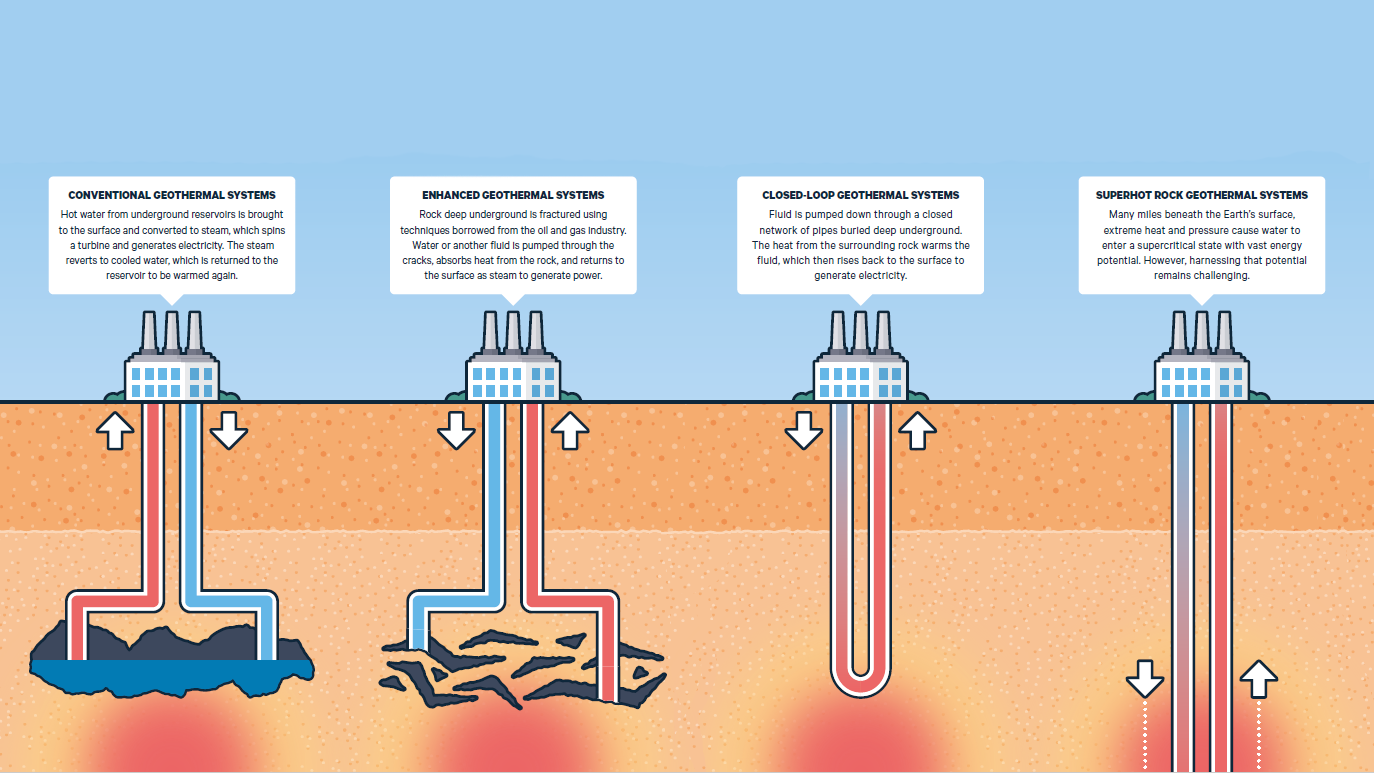
Historically, geothermal power has come from conventional wells that tap into naturally occurring hot-water reservoirs in places like California, Iceland, Kenya, and New Zealand. These wells are geographically constrained to tectonically active regions, so have limited potential to scale.
By contrast, “next-generation” wells do not rely on existing reservoirs. Instead, these wells run fluids through hot rocks in fractured geological systems (i.e., those cracked by fracking) or in closed-loop systems where fluids are contained in pipes and transfer heat indirectly. The potential of these technologies exceeds conventional geothermal in terms of the volume of energy that can be harnessed, despite still being somewhat geographically constrained. The thermal resource also tends to be more expensive to identify and access, in large part because well depths for these systems tend to be deeper (in some cases kilometers deeper).
Credit: James Round
Deeper drilling often means higher costs and more uncertainty, but also the potential to unlock much larger amounts of energy. “Superhot” rock geothermal extraction methods target energy at even greater depths, where temperatures exceed 374°C and water reaches supercritical conditions. In much of the United States, this method requires drilling more than six miles below the Earth’s surface. While theoretically offering an almost unlimited source of energy at nearly any location, superhot rock systems also face particular technological challenges because drilling tools, pipes, rocks, and fluids all behave differently at these temperatures. In fact, no such systems currently exist.
Geothermal currently accounts for less than half a percent of total US electricity generation capacity and is largely produced from conventional sources. However, an uptick in new power purchase agreements has occurred in the past five years. Sixty percent of these agreements involve next-generation systems.
Geothermal use for heating and cooling also has attracted interest. The technology takes advantage of the fact that temperatures just below the surface of the Earth are less variable than temperatures at the surface. Geothermal heating and cooling isn’t new; it is used in over 100 US universities and hospitals and in over a million homes (although this is only about one percent of total US residences). However, technological advancements and government support for pilot projects are expanding the potential for wider use, particularly through thermal energy networks, which connect heat pumps in multiple buildings to boreholes that exchange heat with the subsurface. One benefit of networked systems, which are much less common than individual heat pumps, is their ability to store thermal energy and efficiently use waste heat and cooling from sources such as wastewater, industrial processes, and data centers.
Geothermal energy could also be stored for industrial processes or to serve as a kind of battery on the electric grid. One emerging technology would act similarly to pumped hydroelectric energy storage, which carries water up to a mountain reservoir when electricity is cheap, then releases water to turn a turbine when electricity is more expensive. The analogous geothermal system leverages depth and pressure. Electricity is used to pump water into fractures, where the water is pressurized and heated by the surrounding rock; the water later is released to drive a turbine. In some cases, a heat exchanger captures the heat in the form of steam, which drives another turbine, thereby creating generation efficiencies.
Advancing Geothermal: Potential Promise
Technological advances in drilling and characterization of underground heat resources have expanded the potential of geothermal to contribute to the US power supply cost-effectively. Particularly exciting is the technology transfer that has occurred between the oil and gas industry and the geothermal industry, including advancements in fracking, drill bits, drilling efficiency, and information technologies for the characterization of deep heat resources.
If costs decline for geothermal as they did for solar and wind energy, geothermal power could become an increasingly competitive source of electricity. Continued declines in cost are possible and anticipated. A 2025 report from the National Renewable Energy Laboratory (renamed the National Laboratory of the Rockies by the Trump administration) notes that “all forecasts consistently indicate a downward trend in geothermal costs.” According to a 2024 report from the International Energy Agency, next-generation geothermal power could be accessed for only 20 percent of current costs by 2035 if given sufficient support. These trends would result in new geothermal projects delivering electricity at a cost of about $50 per megawatt-hour, which is highly competitive with electricity from solar or wind paired with battery storage. Based on a similar cost projection ($45 per megawatt-hour), the US Department of Energy projects that geothermal electricity generation capacity could reach 90 gigawatts by 2050, compared to the current geothermal capacity of about 4 gigawatts.
The potential for geothermal to provide a low-cost source of clean, firm, reliable power in the future is particularly compelling, given recent and projected demand growth and the urgent need for increased reliability of the electric grid. Along with the potential to provide energy storage, these characteristics of geothermal technologies mean that geothermal can complement the growing penetration of clean energy sources that are intermittent and less predictable, such as wind and solar. Geothermal heating and cooling also could have positive effects on the power sector by providing storage capacity and reducing peak electricity demand, such as during summer daylight hours when cooling needs are greatest.
Geothermal energy offers additional benefits. Relative to many other sources of power, geothermal has a lower explosion and accident risk. In some cases, geothermal fluids can dissolve valuable minerals, such as lithium, which can be extracted later, offering an additional value stream for geothermal energy production. Potential economic benefits also could accrue to the oil and gas workforce, whose skills are highly transferable to geothermal, and to fossil fuel–dependent communities that anticipate a loss in revenues from the energy transition. Geothermal power is a domestic source of energy, which provides benefits related to energy security and may offer opportunities for boosting international competitiveness as US geothermal companies pursue projects in areas of the world like Eastern Europe, Japan, Kenya, and Taiwan.
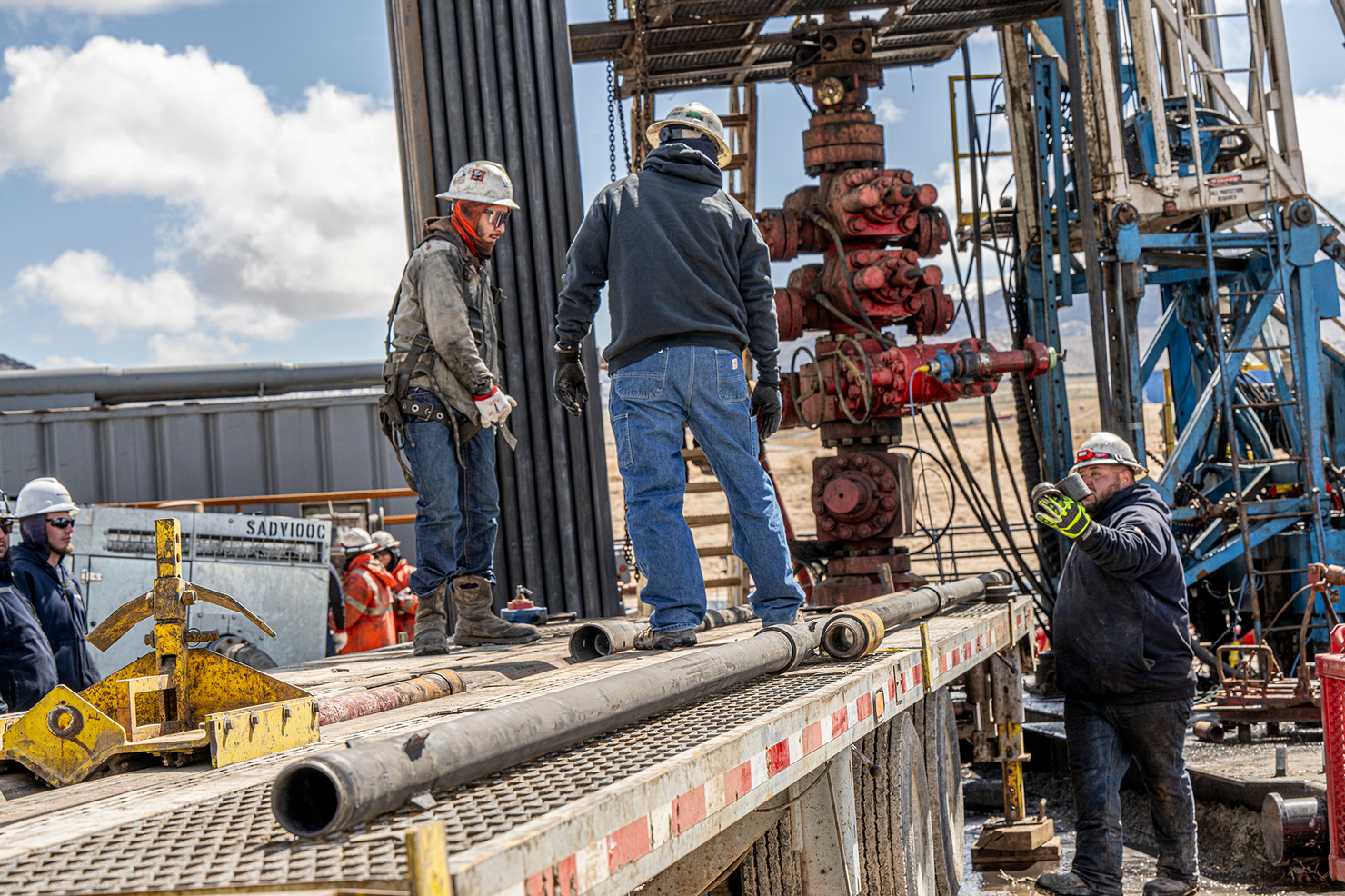
Workers facilitate stimulations of geothermal injection and production wells and conduct tests of water circulation through the fracture network.
When used for heating in place of natural gas, geothermal systems can reduce the risk of pipe leaks and explosions, improve local air quality, and potentially reduce variability in energy bills. As in the case of geothermal power, existing workforce skills are transferable to building out geothermal heating and cooling systems. Additionally, gas utilities could benefit from diversification into geothermal heating and cooling, which could provide a new revenue stream and a way to preserve their business model as pipeline-distribution infrastructure becomes increasingly outdated and more buildings electrify.
Despite these advantages, environmental concerns are worth considering. One concern is the potential impact on aquifers that supply drinking water. As is true for oil and gas wells, risks of aquifer contamination from geothermal operations can be minimized through proper well design and construction. Geothermal also can rely on non-freshwater sources, such as brackish water, which reduce withdrawals from aquifers. Induced seismicity is another concern; earthquakes can be caused when fluid flows into cracks in the rocks beneath the Earth’s surface during the development of wells. But notably, seismicity from oil and gas production largely results from the underground injection of wastewater for disposal; this is less of a concern for geothermal systems, which don’t produce large amounts of wastewater and aim to circulate water under consistent pressure. Earthquake risk can be reduced by drilling wells for monitoring purposes, using sensors in monitor wells to detect ground vibrations, and taking corrective action as needed.
Obstacles to a Geothermal Future
So, what’s holding geothermal back from achieving its full potential? Some of the challenges for geothermal are technology specific, while several common obstacles stem from the high up-front costs of geothermal projects. These costs create a need for financing and mean that it takes an extended period of time before revenue streams can offset investment costs. These challenges are compounded by uncertainties and delays in project development, which in some cases stem from bureaucratic and policy issues.
Challenges for Geothermal Power
A key challenge for geothermal power is the high risk and uncertainty associated with the many steps in the development process, which includes identifying high-quality resources, securing permits and leases (for federal or state lands), and selling the energy that’s produced.
While the US Geological Survey produces maps that broadly show where thermal resources can be found at various depths, the detailed information needed to sufficiently reduce risk is largely unavailable. As a result, “exploration risk” is a major barrier to the scaling of geothermal power. Drilling, stimulation, connectivity, and data processing also present technical challenges, particularly at great depths and high temperatures. Projects in the public and private sectors—including the Frontier Observatory for Research in Geothermal Energy (FORGE) in Utah, sponsored by the US Department of Energy—have helped advance drilling technology, increase drilling speeds, and reduce uncertainty around the quantity and quality of the heat resources at specific locations. The geothermal industry has benefited as a result; for example, an industry leader in enhanced geothermal systems called Fervo Energy has secured financing and currently is developing the world’s first large-scale, commercial, enhanced geothermal–driven plant near the FORGE site, expected to begin operations this year. But so far, only one FORGE-style project has been funded, and companies still face formidable challenges in identifying and developing high-quality enhanced geothermal resources.
Challenges around securing rights to drill, establishing resource ownership, permitting, and leasing also lend uncertainty to the development of geothermal projects. The rules that govern the ownership of underground resources are sometimes unclear and vary by state. Permitting likewise is heterogeneous; involves many stages and requirements; and often is subject to long delays, which are made worse by staffing shortages and limited expertise. Leasing poses its own set of concerns. Traditional leasing frameworks, while intended to maintain competitive and fair access to public resources, may not sufficiently incentivize up-front exploration and resource characterization. Some firms engaging in resource discovery are concerned that they will be outbid by other, more deep-pocketed firms at a competitive auction, thereby losing the opportunity to develop these resources. The result is reduced exploration and production.
These concerns haven’t gone unnoticed. By the end of 2025, nine leasing bills had been introduced in the US House of Representatives, mainly with the aim of reducing permitting barriers (such as reviews mandated by the National Environmental Policy Act), offering more frequent lease sales, and facilitating faster approvals. The US Department of the Interior announced plans to hold annual lease sales rather than continuing the prior two-year schedule. And one bill would direct the Department of the Interior to publish standard procedures and guidelines that clarify the permitting and leasing processes on federal lands. None of these efforts, however, address a fundamental problem: companies investing in discovery cannot fully protect nor capture the value of what they learn during the process of exploration.
Another obstacle is the lack of sufficient incentives for developing clean firm power. Reliability poses a growing challenge to the power sector, but the benefits of reliability and system flexibility that geothermal brings to the grid are not fully captured in current industry policy or regulations. While the lack of incentives remains a challenge, we have seen some promising developments. Since 2021, 26 power purchase agreements for geothermal have been signed, which a federal report largely attributes to a 2021 procurement order by the California Public Utilities Commission that requires retail electricity providers to procure one gigawatt-electric of firm power by 2026.
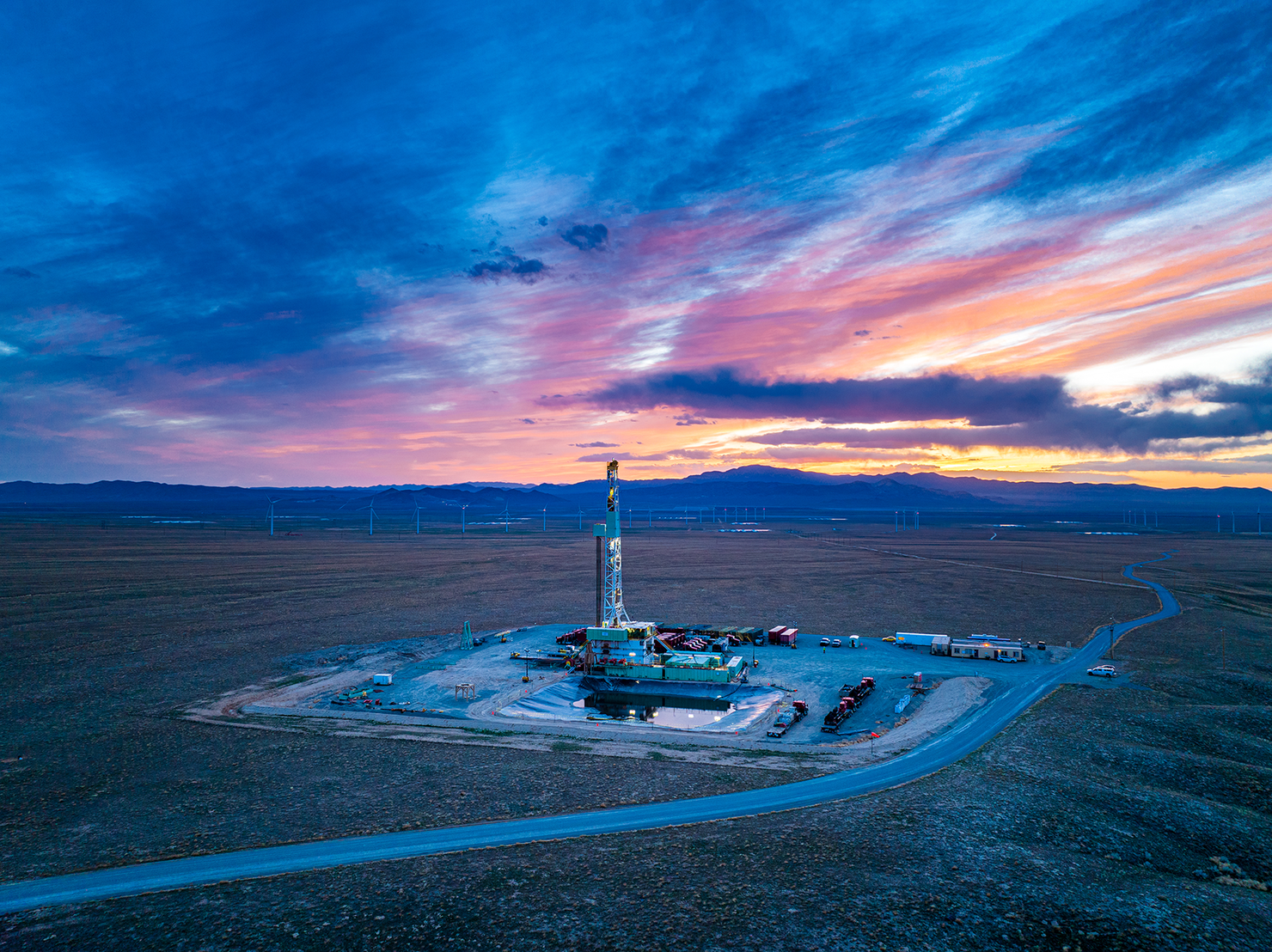
Sunset at a drilling rig. This rig will be used by the Utah Frontier Observatory for Research in Geothermal Energy to test drilling technology for geothermal energy.
Geothermal energy also faces challenges in terms of federal support. The Bipartisan Infrastructure Law, which was passed in 2021, provides only $84 million for demonstration projects of enhanced geothermal systems (compared to multibillion-dollar investments in other clean energy technologies), and both loan and grant programs through the Department of Energy and support from tax credits are somewhat limited. Geothermal energy projects are eligible for technology-neutral investment tax credits and production tax credits (sections 48E and 45Y in the tax code, respectively) under the Inflation Reduction Act, and geothermal-related manufacturing also can take advantage of the advanced energy manufacturing credit (48C). Due to its high up-front costs, geothermal energy benefits the most from the investment tax credit, which can vary from 30 percent to as much as 70 percent for projects that qualify for all available bonuses. The budget reconciliation bill signed into law last summer (also known as the One Big Beautiful Bill Act) largely maintains these credits for geothermal energy, although the bill eliminated support for residential heat pumps. Nonetheless, owners of commercial buildings with geothermal heat pump systems remain eligible for an investment tax credit (section 48 in the tax code).
Although advances in geothermal power likely require large-scale demonstrations, federal support for geothermal research and development has been relatively minimal. Geothermal energy received $1.19 billion in federal funding for research and development from 2010 to 2023, compared to $18.5 billion for nuclear energy, $5.97 billion for coal, $4.24 billion for solar energy, $1.67 billion for wind energy, and $1.55 billion for hydropower (all in 2023$) over the same time period.
Challenges for Geothermal Heating and Cooling
In contrast to the technological challenges that are front and center for geothermal power, the geothermal technologies for heating and cooling are relatively well understood. Obstacles to expanding geothermal heating and cooling remain, however.
Geothermal heating and cooling offers a clean method of meeting demand that otherwise may be met by electricity; however, most states do not have systems in place to take advantage of geothermal benefits within their renewable energy commitments. The benefits of these technologies to the power sector largely stem from reducing stress on the electric grid during peak demand; these benefits also are not captured by market or policy incentives.
The economic and regulatory environments also raise challenges for the expansion of geothermal heating and cooling. Geothermal heat pumps (and heat pump networks) are characterized by high up-front installation costs. Natural gas, which is the most common alternative for heating and cooling, remains relatively cheap despite recent price increases. For thermal energy networks, installation costs tend to be higher when serving existing versus new buildings, particularly when new buildings are designed with geothermal systems in mind. However, the case for conversion may be particularly compelling when one considers that by 2040, an estimated $740 billion of natural gas piping, representing thousands of miles, will need to be replaced in the United States, particularly in California, Texas, and the Mid-Atlantic and Northeastern states.
Unclear and poorly targeted regulations also can raise costs, particularly for thermal energy networks. The installation of such networks falls under multiple existing regulations that were not designed with geothermal in mind and requires the expertise of many different trades, which themselves are regulated. For example, while the drilling required to establish a thermal energy network requires specialized knowledge and training, driller licensing is inconsistent across state lines, spreading thin the already limited workforce across potential projects. Even for individual heat pump systems, low consumer awareness and lack of qualified installers may limit adoption.
Challenges with ownership and rate design are particularly complex in the case of thermal energy networks. While multiple ownership structures are possible (including ownership by utilities or ownership by other private and public actors), clear regulatory frameworks that establish how these ownership models could function are lacking in most places, making it challenging to identify and pursue potential opportunities. Uncertainty about rate design creates additional challenges for project planning and financing. Traditionally, customers face a demand charge for maximum heating and cooling capacity, along with an energy charge for volume used. However, in the case of geothermal, the demand charge may be far larger than the energy charge, and appropriate incentives have not been established to encourage behavior that benefits the thermal energy network. Questions also persist about the ratepayer base (e.g., how rates for geothermal and gas customers change when a thermal energy network comes online) and how metering and submetering will work at the level of individual buildings.
Similar to the situation with geothermal power, a key economic issue is the lack of any national price or mandate to reduce greenhouse gas emissions. However, some policies do support the adoption of individual heat pumps and thermal energy networks. For example, in addition to the investment tax credit discussed earlier, the Department of Energy launched the Federal Geothermal Partnerships initiative in 2022 to help expand geothermal heating and cooling at federal sites. Twenty-six utility-led pilot projects are currently being considered nationwide, and 13 states have passed legislation to support thermal energy networks. One purpose of such legislation is to permit gas utilities to sell geothermal energy. Another goal is to reform the “obligation to serve” borne by utilities; reforming this legal requirement would prevent situations in which the existence of one or more households that don’t want to switch to geothermal can stop a project that other households would like to adopt.
Looking Ahead
As geothermal technology continues to advance, many challenges could be lessened or eliminated by well-designed policies. We see a critical need for a better understanding of the policy tools that can efficiently and effectively create appropriate incentives and mitigate market failures. Careful economic and policy research is essential as geothermal projects continue to surface.
A version of this article appeared in print in the Spring/Summer 2026 issue of Resources magazine.