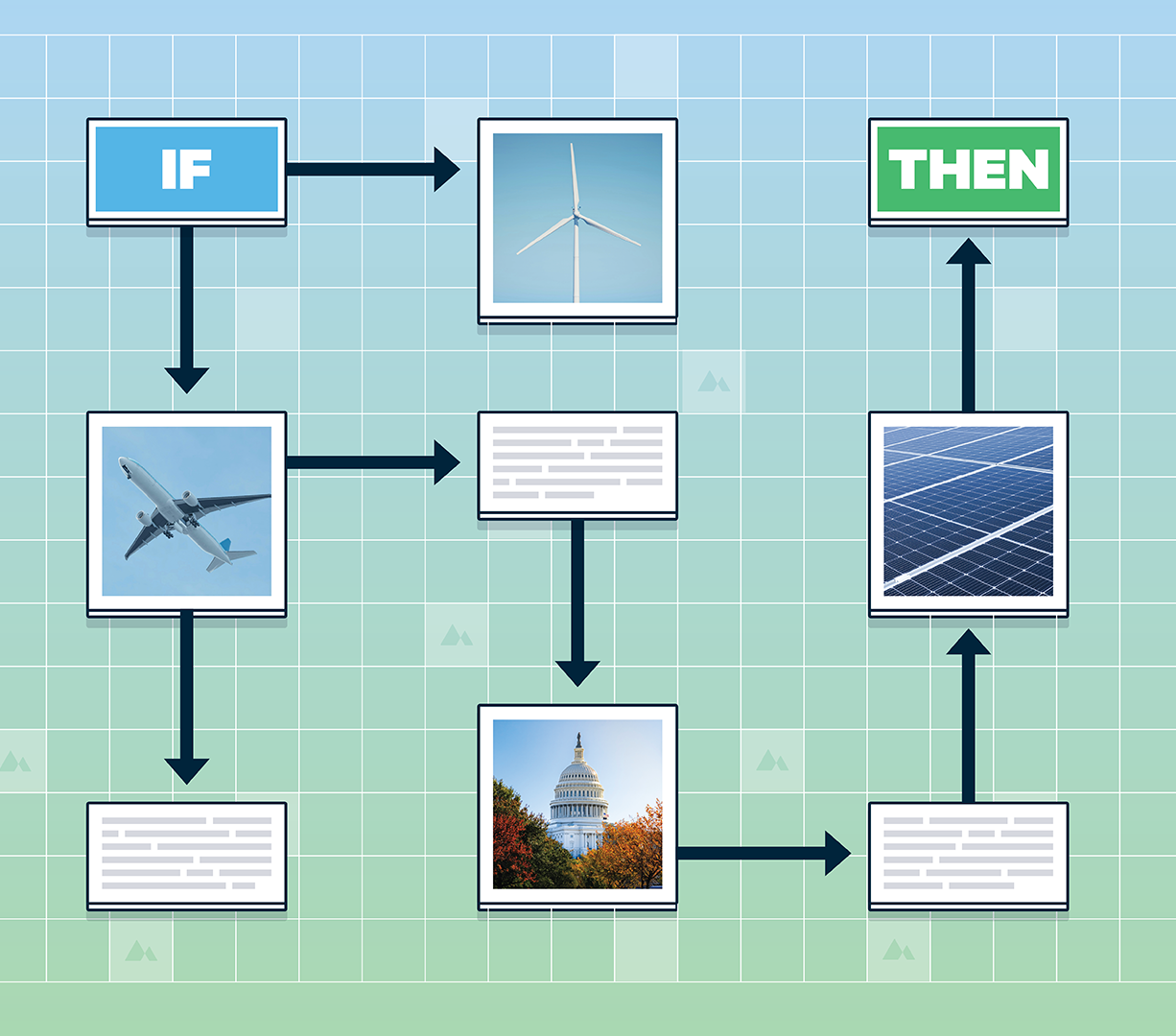
Shortly after the start of the new presidential administration, Resources for the Future launched a multi-channel series to lend expertise in a context of rapid, largely deregulatory federal actions. We’ve called the series “If/Then,” with the collection intended to interrogate proposed and realized policy changes through empirical evidence and economic arguments. As we near the one-year mark of this effort, we reflect on both the still-evolving policy context and the series so far. Here’s how things went and what could be next for us in this space.
In April 2025, Resources for the Future (RFF) began If/Then. We designed the series as a multi-channel project that provides insights from evidence, computer models, experience, and expertise on the economic consequences of planned, proposed, or actual policy decisions. Our goal was to provide as rapid a response as we could, with the hope of informing the actions and opinions of policymakers, stakeholders, and the general public.
What Progress Have We Made?
RFF researchers produced over 20 blog posts, video responses, issue briefs, and explainers on a full range of topics reflecting current administration priorities. Most notable among these has been the slew of deregulatory actions (particularly focused on energy and greenhouse gas emissions) and the methods underlying legally required cost-benefit analysis.
In particular, the energy regulation rollbacks by the administration so far have focused on the power and transportation sectors. Our analyses have followed suit.
Federal incentives for fossil fuel production have been a priority we’ve written about. Grant cancellations have surfaced as another key administration priority, so we’ve published on their impact, along with major reductions in government staff. A signature effort by the administration has been tariffs, particularly on automobile imports, which aligns with our modeling capabilities. We’ve also published an If/Then blog post that addresses the international consequences of rescinding the endangerment finding.
Following administration efforts to privatize and open up federal land, and as responsibility for handling disasters has shifted from the Federal Emergency Management Agency to US states, we’ve addressed the likely consequences.
Given that the focus of the If/Then series is any significant recent policy changes, we also have started looking at major shifts in state policies, such as the extension of the reform of California’s carbon cap-and-invest framework. In short, RFF has produced If/Then content across a breadth of policy topics.
If/Then pieces were some of our most visited RFF articles last year, likely reflecting the timeliness, relevance, and accessible nature of our coverage. Particularly popular have been the If/Then articles about recent proposals to sell federal lands, cuts to oil and gas royalty rates, and vehicle import tariffs.
A few other metrics are worth considering: citations in the media and impacts on policymaking. Select articles from the series were cited in more than a dozen news stories in the past year, including mentions in the New York Times, Washington Post, and National Public Radio.
At RFF, the most important end point is improving public policy decisions with our research. Even though the purpose of If/Then has been to react to highly fluid policy changes, in some instances, we have a more direct line of sight regarding our impact. For example, policymakers who proposed harnessing federal lands for a range of economic development opportunities as part of the recent budget reconciliation bill, which was signed into law on the Fourth of July last year, paid attention to our analysis that questioned the benefits of public land sales. Those proposals eventually were dropped.
By these accounts, If/Then has been well worth the effort so far.
What’s Next for the If/Then Series?
Here’s where we see the policy conversation going. We’re sure to experience no shortage of issues to address, given the midterm elections; critical debates around energy affordability and reliability, hazard mitigation, and “clean firm” energy sources; and further environmental policy changes that the administration may pursue.
The general deregulatory push undoubtedly will continue. We can expect the administration to press for repeal of the endangerment finding (which undergirds the government’s ability to regulate greenhouse gas emissions under the Clean Air Act) on multiple grounds; even in the event that the courts reject the case for repeal, the greenhouse gas standards for power plants and vehicles would be dramatically altered for years to come. Relaxing clean air standards, water pollution rules on industry and power plants, chemical standards, and a host of deregulations beyond climate policy and decarbonization likely will be included among the administration actions.
RFF currently has a major project underway to consider these consequences in a state-of-the-art regulatory impact analysis, which will address the interactions between these regulatory rollbacks and the loss of other non–greenhouse gas regulations such as the Mercury and Air Toxics Standards rule. In addition, we will evaluate the implications of the loss of key data-gathering efforts, such as the Greenhouse Gas Reporting Program. That work will result in a series of additional RFF analyses.
Credit: Henry A / Unsplash
The actions will not be all about repeals and cuts, however. We’ve noted bipartisan support for increasing the use of clean firm resources to generate electricity, including geothermal and nuclear power. A successful takeoff of geothermal power will need much more government support beyond eligibility for investment tax credits. The form this support could take—such as permitting and leasing reforms, automatic approvals for certain project types, direct government support, and derisking measures for exploratory drilling and technological innovation—likely will be considered in the If/Then series as such plans evolve.
Indeed, the permitting delays associated with all forms of energy and infrastructure projects garner bipartisan attention and may well be addressed in congressional actions and administration efforts. Permitting issues certainly will provide fodder for more analysis and commentary.
Another expanded direction will involve highlighting activities in other countries that have energy and environmental consequences for the United States, including new regulatory activities affecting trade, demonstrations of technologies abroad for which transfer or further testing could or should be supported by the US government, and any important developments that follow the most recent Conference of the Parties meeting in Brazil. RFF’s work informing two bills on border measures (the Foreign Pollution Fee Act and Clean Competition Act) will expand and could result in more rapid-response pieces.
Of course, much of the core work on energy and environmental policy is playing out among US states. Many states across the nation are scrambling to address the loss of grants and regulations from federal activities. Even states that have incurred less fallout from federal actions have economic interests to shore up in the face of such losses, such as the wind energy industry in Texas. Depending on future federal actions related to wildfire protection and response, states also will develop new programs that our scholars likely will scrutinize for the If/Then series. Thus, with policy advancement shifting to the states for any emissions-reduction efforts, our If/Then series may shift in tandem.
Where If/Then goes depends largely on the policy world. We expect all of these policy conversations to provide additional fodder—and a continued need—for more If/Then pieces, as deregulatory and policy actions continue bearing important implications for energy and the environment.
A version of this article appeared in print in the Winter 2026 issue of Resources magazine.