The repeal of standards for light-duty vehicles and power plants will increase air pollution that contributes to death and disease, adding to the already substantial forgone climate-related benefits of these regulations by about $780 billion.
Losing the Endangerment Finding: What Are the Costs and Benefits of Deregulation?
In February 2026, the US Environmental Protection Agency (EPA) repealed the endangerment finding—the federal government’s formal scientific determination that greenhouse gases cause climate change that endangers public health and welfare. Concurrently with this action, EPA rolled back all greenhouse gas standards for vehicles. In September 2026, EPA rolled back the standards for power plants, marking the end of greenhouse gas regulation for the two largest contributors to US emissions. This blog series uses best-practice benefit-cost analysis to show how regulatory rollbacks will affect the health and well-being of everyday Americans.
Previous blog posts in this series discussed how the rollback of greenhouse gas standards that regulated light-duty vehicles and power plants affect costs, increase greenhouse gas emissions, and contribute to climate-related economic damages. In this blog post, we complete the picture by providing estimates of the forgone air quality–related health benefits resulting from those rollbacks.
Eliminating these greenhouse gas standards changes the nation’s light-duty fleet and electric power sector, which in turn directly affect the emissions of traditional air pollutants, including sulfur dioxide, nitrogen oxides, and particulate matter with a diameter of 2.5 micrometers or smaller (PM2.5). The potential rollback or significant weakening of vehicle criteria pollutant standards announced by EPA in May 2026 would further increase pollution.
Changes in emissions of traditional air pollutants affect ambient concentrations of ozone and PM2.5. Ambient concentrations of these two pollutants cause a wide range of human health effects including premature death, hospitalization, asthma exacerbation, and respiratory and cardiovascular illnesses. They also contribute to acid rain and other environmental harms.
The effect of emissions on air quality is complex. Emitted pollutants affect the ambient air quality of people directly downwind of emitting sources, but can also react with other pollutants and, transported by the wind, affect the air quality of people many hundreds of miles away.
Our modeling shows that the finalized and proposed rollbacks will significantly increase PM2.5 and ozone pollution, causing 95,000 premature deaths per year between 2032 and 2050. Hospital visits, chronic diseases, and lost work and school days also result from the increase in pollution. These mortality and morbidity impacts are concentrated in the US Midwest and East.
Based on our estimates for the rollback of the power plant greenhouse gas standards, the dollar value of forgone health benefits alone is more than double EPA’s estimated cost savings. For the combined rollback of both power plant and vehicle greenhouse gas standards, when climate-related damages are added in (which we calculated in previous blog posts in this series), the dollar value of forgone air quality and climate benefits exceeds cost savings by over five times, or over $3.4 trillion.
Air Pollution Rises Substantially Due to Rollbacks of the Standards
As in previous analyses, we used Resources for the Future’s light-duty Vehicle Market Model and Engineering, Economic, and Environmental Electricity Simulation Tool to estimate changes in emissions associated with the rollbacks of the light-duty vehicle greenhouse gas standards and the Section 111(d) greenhouse gas standards for fossil fuel–powered electricity generation.
We also evaluate the potential impacts of EPA’s announced plans to reconsider the Tier 4 criteria pollutant standards for light-duty vehicles. We estimate how the proposed and finalized rollbacks change emissions by comparing regulatory rollback scenarios to a baseline that includes the repeal of elements of the Inflation Reduction Act and Good Neighbor Plan, and an expected increasing demand for electricity. We take an incremental approach to estimating the impact of the rollbacks, starting by comparing the rollback of the light-duty vehicle greenhouse gas standards to the baseline and then estimating the additional impact of also rolling back the power plant standards or vehicle criteria pollutant standards. In our upcoming report, we explored the impacts of these rollbacks using an additional baseline with lower energy demand, which approximates what the future would look like in the absence of rapid data center growth.
Figure 1 shows the projected changes to vehicle-related emissions from 2032 to 2050. This figure shows the impact of the finalized rollback of the light-duty vehicle greenhouse gas standards alone, as well as the combined impact of the rollbacks of the greenhouse gas and criteria pollutant standards. Even though manufacturers no longer have to comply with the greenhouse gas standards, we modeled the scenarios to exclude backsliding; manufacturers in our model do not reduce fuel economy nor sell fewer plug-in vehicles than in 2025.
Figure 1. Changes in Emissions of Air Pollutants Resulting from Rollbacks of Greenhouse Gas and Criteria Pollutant Standards for Vehicles
The difference between the two lines is the incremental impact of rolling back the criteria pollutant standards after the rollback of the greenhouse gas standards. This incremental change has a large impact on nitrogen oxide and PM2.5 emissions because they are primarily tailpipe emissions directly controlled by the criteria pollutant standards. By contrast, sulfur dioxide emissions from the combined rollbacks are largely due to the increase in refinery emissions resulting from the rollback of the greenhouse gas standards, which we project to increase diesel and gasoline consumption to a much higher degree than the rollback in criteria pollutant standards.
Figure 2 shows the projected changes in pollutant levels from the rollback of the power plant standards, which projects greater use of higher-emitting fossil fuel generation to meet electricity demands.
Figure 2. Change in Emissions of Air Pollutants Resulting from the Rollback of the Greenhouse Gas Standards for Power Plants
How Does the Change in Air-Pollution Emissions Affect Ambient Air Quality?
We apply a simplified approach to estimate air quality developed by EPA called the Pattern Constructed Air Pollution Surfaces method. This method translates county-level emissions from PM2.5, nitrogen oxide, sulfur dioxide, and volatile organic compounds from vehicles, refineries, and power plants into annual average ambient PM2.5 and seasonal ozone concentrations for each county in the continental United States.
Our air-quality modeling shows that the combined regulatory rollbacks will have widespread impacts on ozone and PM2.5 across the United States, with the greatest impacts in the Midwest and East, where fossil fuel–fired generation is highest, and in and around counties where refineries are located, especially in Texas, Louisiana, and California.
Figure 3 shows the spatial patterns of changes in ambient average annual PM2.5 (top-left panel) and seasonal ozone concentrations (top-right panel) in 2050. This figure shows the changes between the baseline and the combination of rollbacks of the vehicle greenhouse gas standards, criteria pollutant standards, and the power plant greenhouse gas standards.
Figure 3. Effect of Light-Duty Vehicle and Power Plant Rollbacks on Air Quality and Premature Mortality
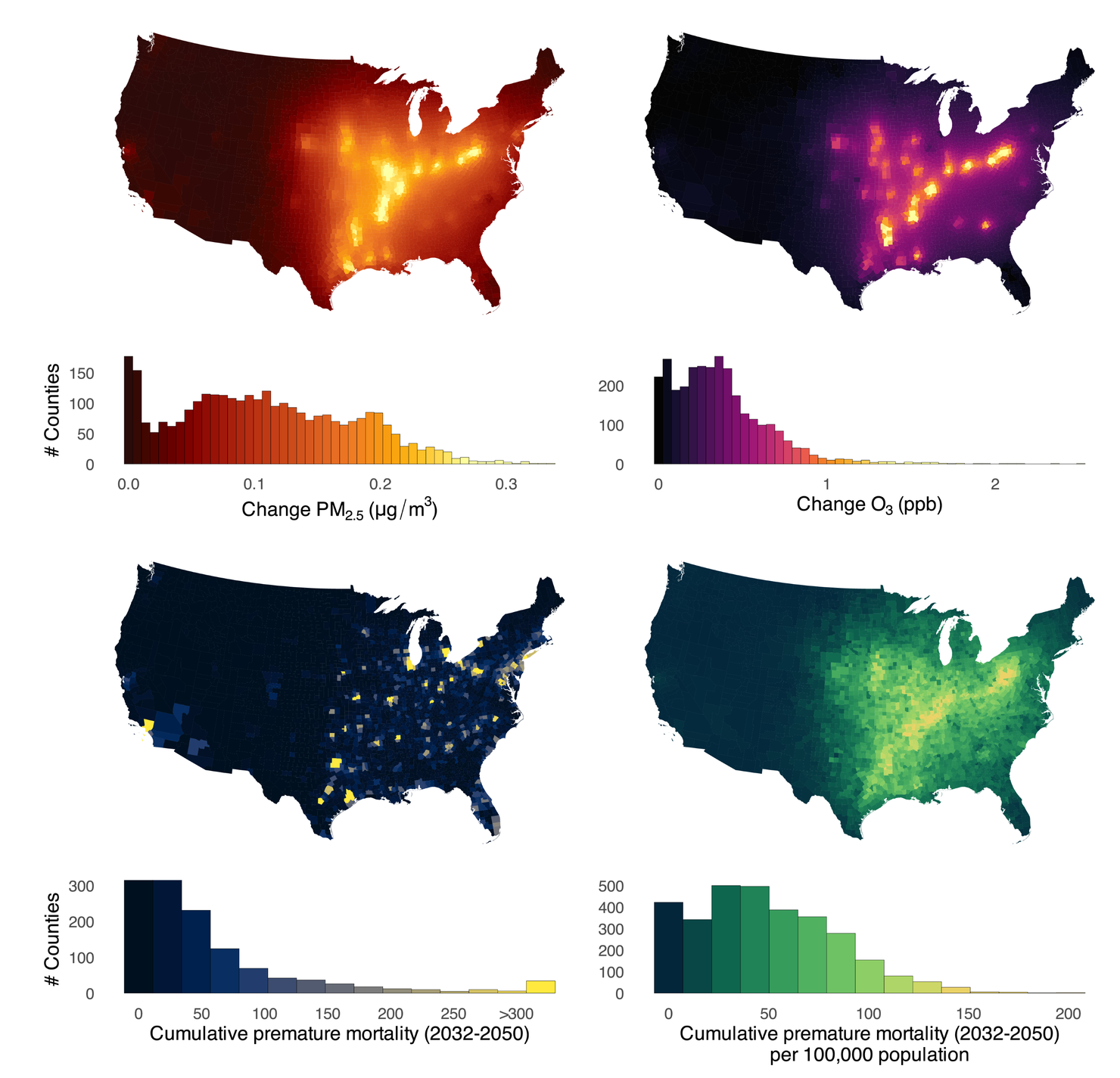
O₃ = ambient ground-level ozone, ppb = parts per billion, µg/m³ = micrograms per cubic meter.
The bottom panels of Figure 3 show the incidence of premature mortality attributable to these air quality changes. The left-hand map shows cumulative numbers of premature mortalities, which are strongly related to the number of people exposed to pollutants. Brighter areas on the map indicate a greater number of deaths. The highest increase in premature deaths occurs in Harris County, Texas, with our modeling projecting that 2,500 people will die early due to these regulatory rollbacks. The right-hand map normalizes for population by showing cumulative premature deaths per 100,000 people. Based on this metric, the highest rate of premature mortality is in Tyler County, West Virginia—we estimate 200 premature deaths per 100,000 people, or approximately 17 premature deaths based on the county’s 2020 Census population of 8,313.
Regulatory Rollbacks Will Result in Hundreds of Billions of Dollars in Air Quality–Related Health Damages
We estimate that the increases in ambient PM2.5 and ozone from these rollbacks will result in a substantial number of excess premature deaths nationwide. Relative to the baseline, the finalized rollbacks of the vehicle and power plant greenhouse gas standards and potential rollback of the vehicle criteria pollutant standards cause 4,300 to 5,300 PM2.5- and ozone-attributable deaths per year between 2032 and 2050, for a cumulative total of about 95,000 premature deaths over this period.
During these years, we also estimate chronic and acute morbidity impacts from changes in air quality. PM2.5-related morbidities include
- 43,000 hospital and emergency department visits;
- 1,300 heart attacks;
- 2,300 strokes;
- 2,500 cases of Parkinson’s disease;
- 24,000 cases of Alzheimer’s disease;
- 2,800 cases of lung cancer;
- 4.3 million days of lost work;
- 17 million cases of aggravated asthma; and
- 25 million cases of acute respiratory symptoms.
Ozone-related morbidities over the same time period include
- 36,000 hospital and emergency department visits;
- 7.3 million days of lost school; and
- 20 million cases of aggravated asthma.
The estimated number of annual and cumulative premature deaths, broken out by regulation, is shown in Figure 4. The number of premature deaths caused by the vehicle standard rollbacks increases over time. Premature deaths from rolling back power plant standards increase through 2040 and then fall slightly by 2050 due to the retirements of coal-fired plants. Morbidity effects display similar trends to mortality effects.
Figure 4. Estimated PM2.5- and Ozone-Attributable Deaths from Rollbacks (2032–2050)
Annual forgone benefits of regulation resulting from the increases in premature death and morbidity are $55 billion–$68 billion (2024$, 3 percent discount rate), with a present value of about $780 billion over the 2032–2050 period. The majority (about 98 percent) of these forgone benefits is from premature deaths. Among the morbidity effects, cases of stroke, heart attacks, and lung cancer contribute the most to forgone benefits.
EPA’s recent regulatory impact analysis for the final rollback of the power plant greenhouse gas standards did not report the forgone air-quality benefits; EPA reported only the cost savings from eliminating controls on carbon dioxide emissions. In our full report, which will be released shortly, we show that the forgone benefits of these rollbacks overwhelm the cost savings. EPA’s methods therefore misrepresent the net effects of these rollbacks on the US economy, public health, and climate change—misinformation that is detrimental to decisionmakers, stakeholders, and the general public.