
A new survey shows that Americans are generally supportive of using trade agreements to reduce greenhouse gas emissions, even though the level of support has dropped over the past year.
An essential question to ask at the beginning of a major project is, “Who cares?” This is equally true for researchers seeking a new focus and politicians carefully stewarding their political capital. Polling can provide valuable insights to shape the questions researchers ask and where politicians focus their energy.
The intersection of climate and trade policy is a welcome subject for such polling. Both climate policy and trade policy are complex issues, and combining them in policymaking does not simplify them. Climate-related trade policy also is very topical and draws bipartisan interest. In 2022, Republican senators pitched Senate Democrats on a bill that united climate and trade as part of the talks then–Democratic Senator Joe Manchin (I-WV) convened in a last-ditch effort to come to a bipartisan agreement on the bill that would become the Inflation Reduction Act. Three thematically related bills followed this bipartisan exchange: the Providing Reliable, Objective, Verifiable Emissions Intensity and Transparency Act, the Foreign Pollution Fee Act, and the Clean Competition Act. Language from the emissions intensity bill passed earlier this year, while the Clean Competition Act and Foreign Pollution Fee Act are still before Congress, revised from versions submitted in previous years. Resources for the Future (RFF) has done considerable work at the intersection of climate and trade, ranging from fundamental accounting of the carbon intensity of goods to close evaluations of the Foreign Pollution Fee Act and potential impacts of the Clean Competition Act on carbon dioxide emissions.
The interest in carbon border adjustment mechanisms is not limited to the United States. The European Union’s Carbon Border Adjustment Mechanism has prompted action by countries around the world to implement domestic carbon prices, or to add these border mechanisms onto pre-existing carbon prices. A key principle in the design of the EU carbon border adjustment mechanism has been to create a level playing field between domestic producers and importers. The globe-spanning interest in domestic prices and carbon border adjustment mechanisms led to a robust discussion of carbon prices at the 30th Conference of the Parties in Belém, Brazil.
All of which brings us back to where we started: Who cares? Thanks to new polling led by Christopher Borick as part of the National Surveys on Energy and the Environment, we now have some rough answers. The national surveys included three questions tied to the nexus of climate and trade policies in its most recent poll, only the second time it has done so. A group of researchers workshopped these questions with the Pricing Carbon Initiative (which Danny Richter led), informed by dialogues focused on this nexus with policymakers and other stakeholders. RFF adopted the Pricing Carbon Initiative in October 2025.
How Does the American Public Feel About the US Approach to International Trade Agreements?
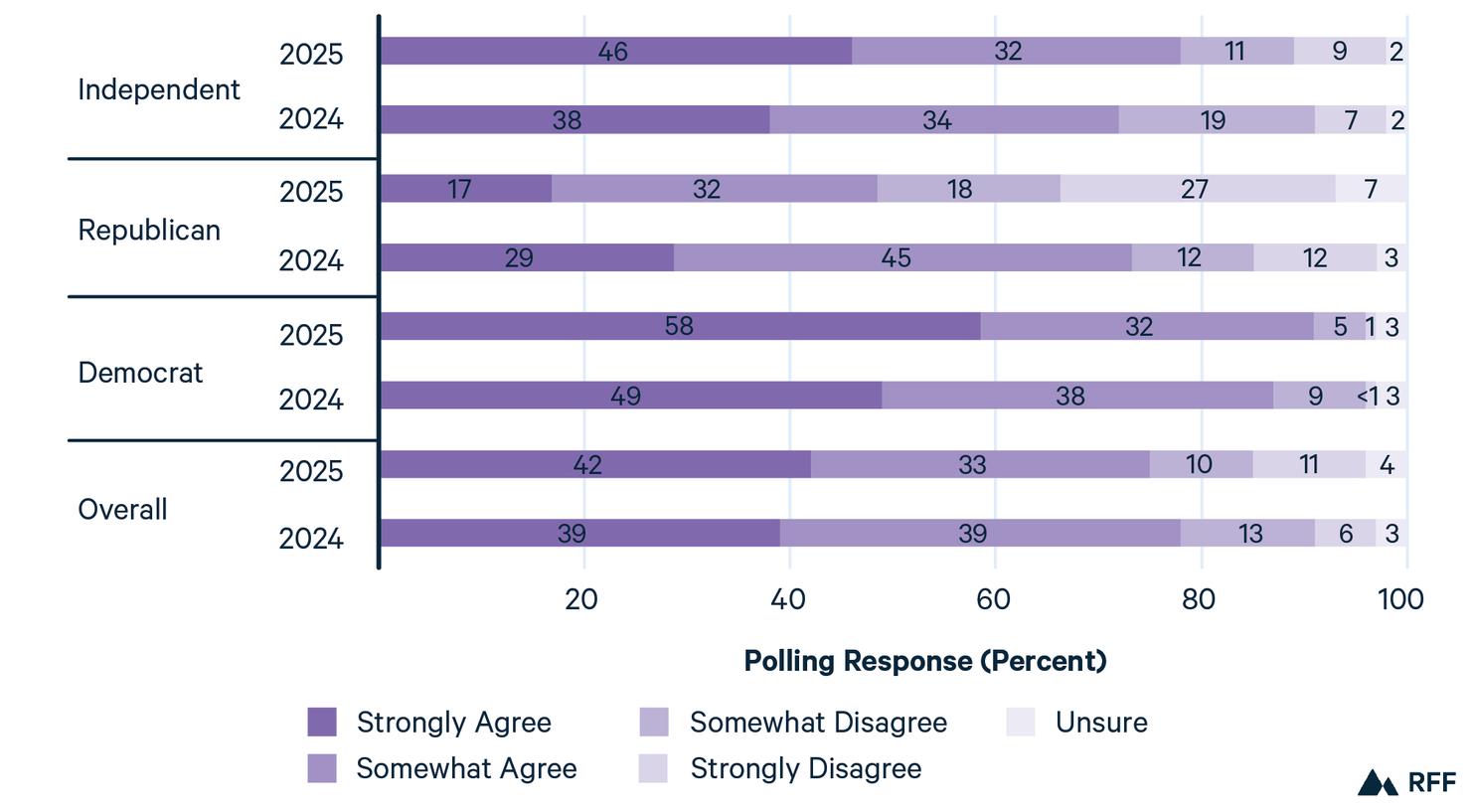
In 2025, strong majorities of Americans believed that reducing greenhouse gas emissions should be a priority when negotiating trade agreements with other countries (Figure 1).
Figure 1. US Public Opinion on Whether Greenhouse Gas Emissions Should Be a Priority in Trade Agreements, 2024 and 2025
These numbers may sum to more or less than 100 due to rounding.
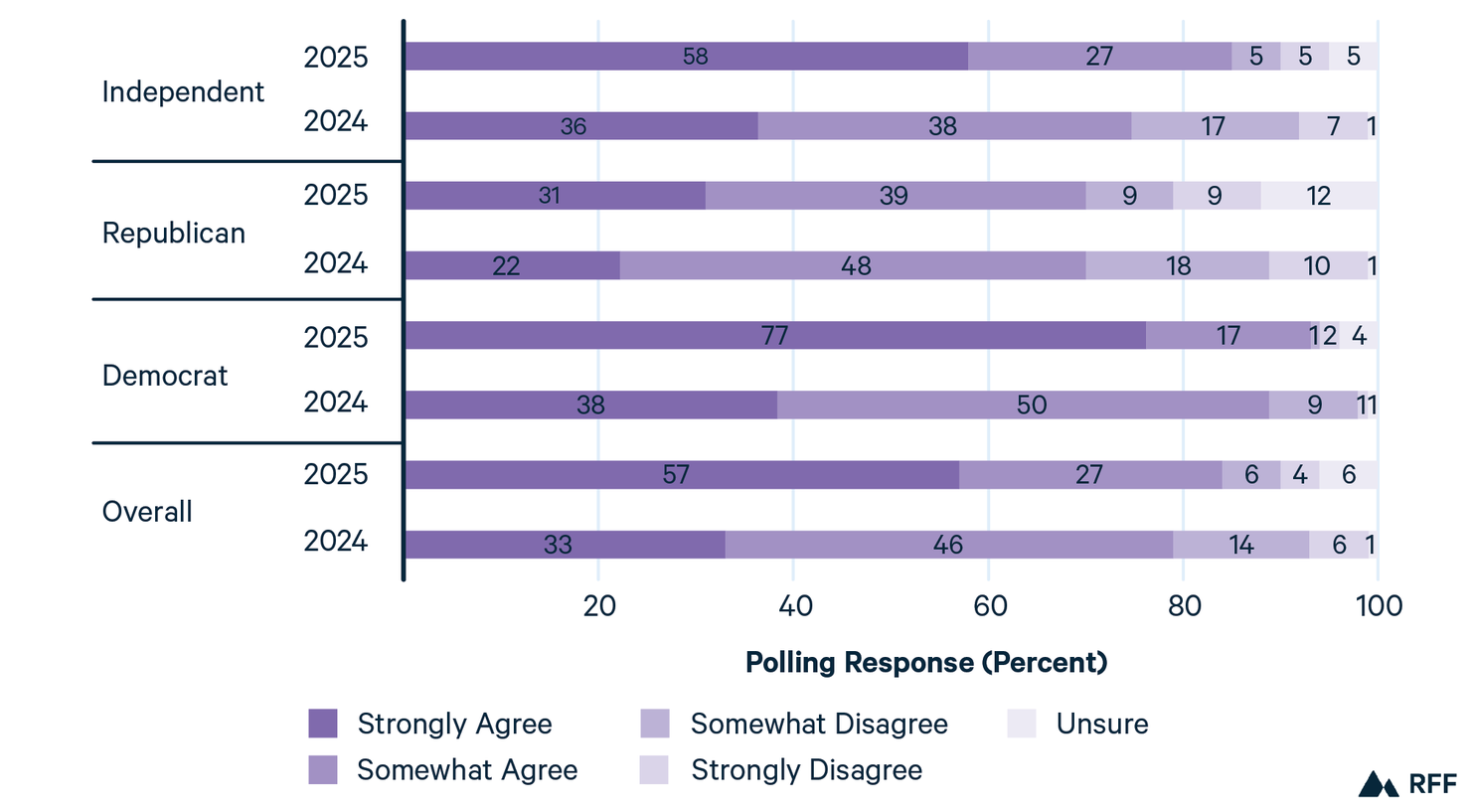
Majorities also believed that the United States should follow trade agreements of which it is a part (Figure 2).
Figure 2. US Public Opinion on Whether It Is Important for the United States to Follow Trade Agreements, 2024 and 2025
These numbers may sum to more or less than 100 due to rounding.
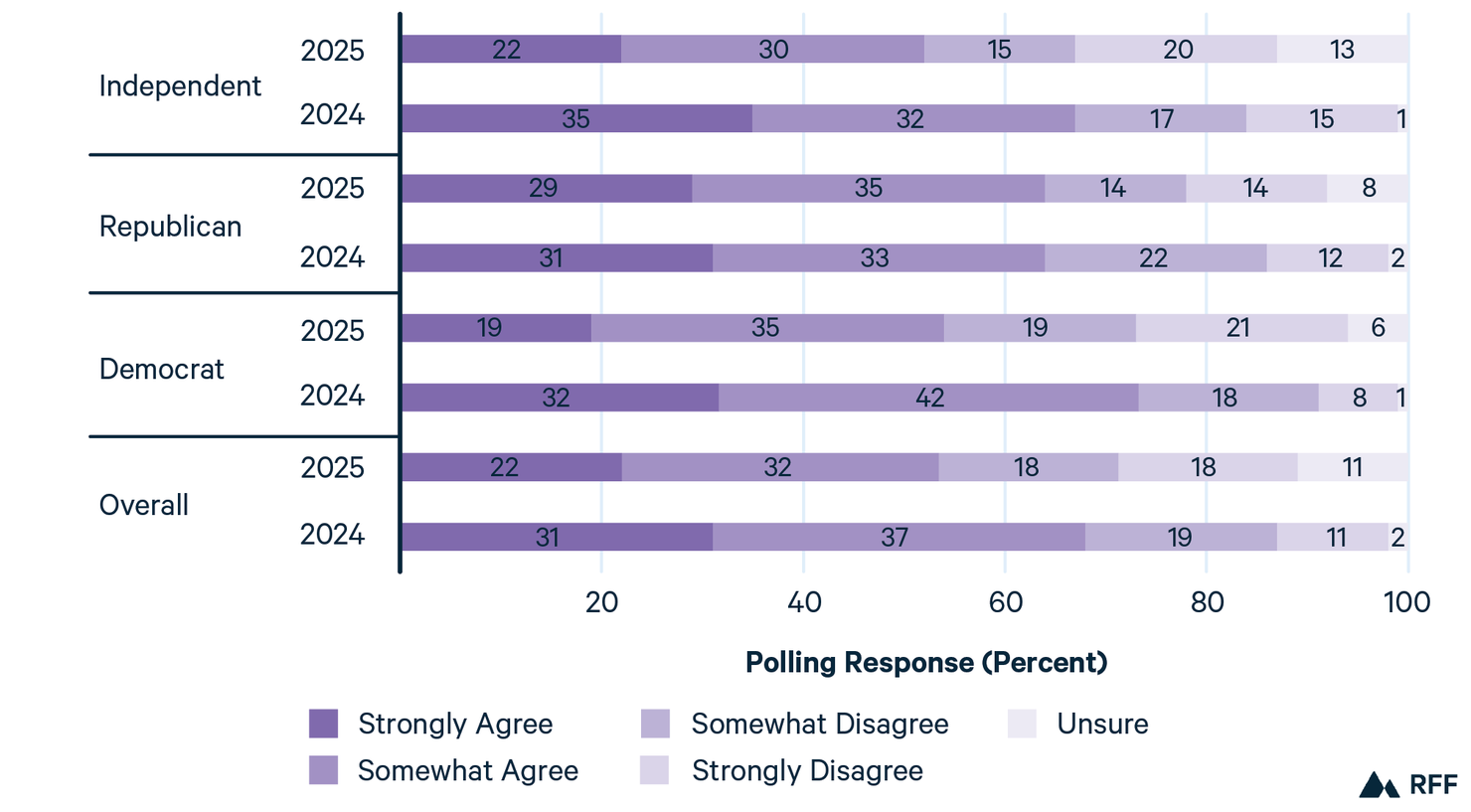
A smaller percentage—but still a majority—agree with the statement that the United States should place a tariff on imports based on a product’s carbon content, even if the tariff raises the costs of buying goods in the United States (Figure 3). These are striking results, particularly when Americans are grappling with an affordability crisis, and tariffs are front-page news and a key pillar of the Trump administration’s economic agenda.
Figure 3. US Public Opinion on Whether the United States Should Place a Tariff on High-Emissions Goods, 2024 and 2025
These numbers may sum to more or less than 100 due to rounding.
In the aggregate, American views on the relationship between trade and climate moderately shifted between 2024 and 2025. Americans became more intensely supportive of the idea that the United States should follow trade agreements, with the percentage that “Strongly Agree” with this position growing dramatically from 33 percent to 57 percent in a single year (Figure 2). Conversely, Figure 3 shows a 14-point decrease in the percentage of Americans that agree the nation should place a tariff on goods manufactured in other countries through more greenhouse gas–intensive means.
The changes in support for both ideas are likely the product of Americans’ generally negative experience with tariffs during 2025. But on the core matter of prioritizing greenhouse gas emissions in trade agreements, the American experience with tariffs in 2025 had more limited impact, with 75 percent of Americans supporting this prioritization in 2025 compared with 78 percent a year earlier (Figure 1).
Of course, aggregate results may mask changes that are occurring within political affiliations. Comparing the 2025 results with the results from a year before indicates notable shifts in intensity. Figure 1 shows that Republicans became much more likely to disagree with the sentiment that the United States should prioritize the reduction of greenhouse gas emissions when negotiating trade agreements, with a minority in agreement in 2025 (47 percent) compared to a majority in 2024 (74 percent). Democrats and Independents barely budged in their overall support, though the two political parties show a strong shift in intensity away from strong support.
By contrast, all three analyzed party affiliations became more likely to strongly agree that the United States should follow trade agreements (Figure 2). Republican support for following existing trade agreements was 70 percent in both 2024 and 2025. However, in 2025, more Republicans were likely to strongly agree. In 2025, 31 percent of Republicans strongly agreed (up from 22 percent in 2024), 18 percent disagreed (somewhat or strongly), and 12 percent were unsure. Democrats and Independents both shifted by large double-digit margins, strongly agreeing that the United States should follow existing trade agreements (77 percent strongly agree in 2025, up from 38 percent for Democrats; for Independents, 58 percent strongly agreed in 2025, up from 36 percent).
Some Caveats and Conclusions
As with any poll, caution is warranted. These results offer only a snapshot in time (e.g., November and December of 2025) and certainly do not explore the full range of considerations that researchers and politicians alike will have to consider while formulating research questions or stewarding political capital. But these results do provide a first rough answer to the question for carbon border adjustment mechanisms: “Who cares?” A lot of Americans care about following trade agreements, and they also have an interest in trade agreements that consider the greenhouse gases emitted during the manufacture of goods that cross international borders. A majority are even willing to bear increased costs to see those emissions accounted for. If politicians are paying attention to their voters, it should not be surprising if we see more policymaking at the nexus of climate and trade.