Carbon pricing is not popular among federal policymakers in the United States. However, its popularity in developed countries shows that the policy option has a place on the world stage to reduce global carbon emissions.
2026 already has been a big year for global carbon pricing policies. On January 1, the EU Carbon Border Adjustment Mechanism went into effect, levying fees based on the European Union’s domestic carbon price, currently just over €75 (about $85) per ton, on carbon-intensive products imported into the trading bloc. Large emerging economies such as India, Brazil, and Turkey are in the process of implementing carbon prices, and discussions continue around an Open Coalition on Compliance Carbon Markets, which may be the forum from which a climate club emerges.
In the United States, congressional representatives have proposed border carbon policies—one of which would also institute a national carbon price—but no proposal has come close to passing into law. The evolving face of global trade and shifting winds in US politics offer an opportunity to focus on an oft-overlooked fact—the United States is the only developed economy without a national carbon price. This point cuts across two common misconceptions: carbon pricing is not widespread, and carbon pricing is politically toxic.
A quick look at the World Bank’s Carbon Pricing Dashboard (Figure 1) shows that carbon pricing is widespread, though it is not immediately obvious that the United States is the only country without a carbon price among developed economies.
Figure 1. Carbon Pricing Instruments Around the World, 2026
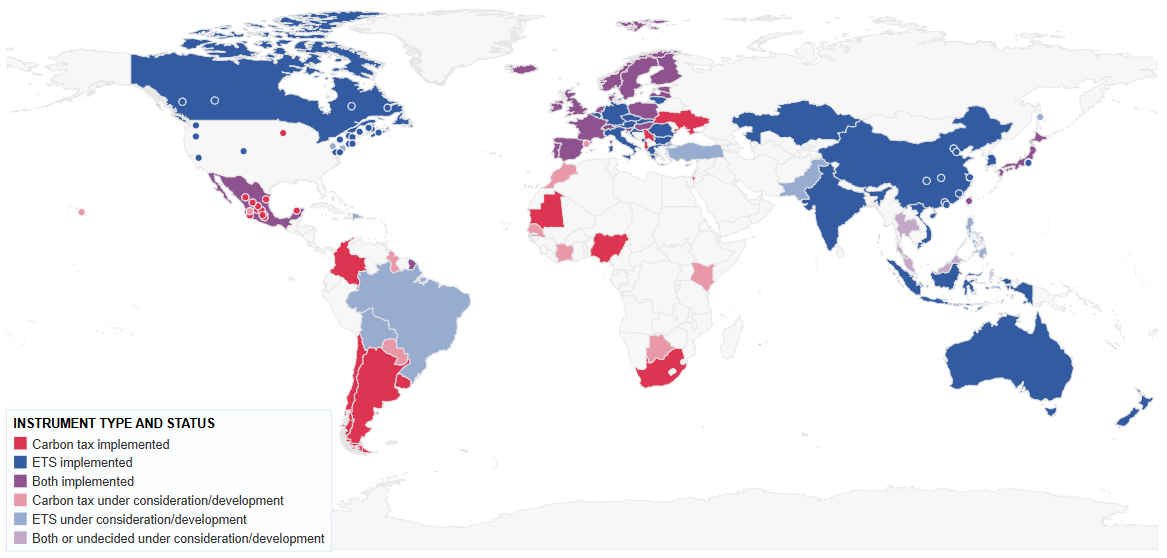
Source: World Bank Carbon Pricing Dashboard, Compliance Detail Map Block. 58 national jurisdictions have a carbon price in place, covering 29 percent of global emissions. ETS refers to an emissions trading system.
The United Nations counts 37 developed economies worldwide, and a look at the types of carbon prices employed by these economies undermines any notion that the United States is a leader on climate. While one could argue that the Inflation Reduction Act established the United States as a global climate leader, and even if the law had survived President Donald Trump’s second term, the Inflation Reduction Act is an expensive policy option on a scale that is unavailable even to most developed economies. Carbon pricing, on the other hand, is supported by many economists and scientists as an efficient policy tool to address climate change.
Framing carbon prices in the context of developed economies can be helpful (Table 1), as the framing gets as close as possible to comparing apples to apples, considering the great diversity among countries. That every single country (barring the United States) has implemented one or more carbon prices counters the idea that this policy is politically impossible or that this policy type is not yet widespread.
Table 1. Developed Economies and Carbon Pricing Mechanisms
Developed Economy | National Carbon Price? | Compliance Mechanism Type (Year in Effect) | Carbon Border Policy? |
Australia | Yes | ETS (’23) | |
Austria | Yes | EU ETS (’05) + ETS (’22) | In Force |
Belgium | Yes | EU ETS (’05) | In Force |
Bulgaria | Yes | EU ETS (’05) | In Force |
Canada | Yes | ETS (’19) | |
Croatia | Yes | EU ETS (’05) | In Force |
Cyprus | Yes | EU ETS (’05) | In Force |
Czechia | Yes | EU ETS (’05) | In Force |
Denmark | Yes | CT (’92) + EU ETS (’05) | In Force |
Estonia | Yes | CT (’00) + EU ETS (’05) | In Force |
Finland | Yes | CT (’90) + EU ETS (’05) | In Force |
France | Yes | EU ETS (’05) + CT (’14) | In Force |
Germany | Yes | EU ETS (’05) + ETS (’21) | In Force |
Greece | Yes | EU ETS (’05) | In Force |
Hungary | Yes | EU ETS (’05) + CT (’23) | In Force |
Iceland | Yes | EU ETS (’08) + CT (’10) | |
Ireland | Yes | EU ETS (’05) + CT (’10) | In Force |
Italy | Yes | EU ETS (’05) | In Force |
Japan | Yes | CT (’12) + ETS (’26) | No |
Latvia | Yes | CT (’04) + EU ETS (’05) | In Force |
Lithuania | Yes | EU ETS (’05) | In Force |
Luxembourg | Yes | EU ETS (’05) + CT (’21) | In Force |
Malta | Yes | EU ETS (’05) | In Force |
Netherlands | Yes | EU ETS (’05) + CT (’21) | In Force |
New Zealand | Yes | ETS (’08) | No |
Norway | Yes | CT (’91) + EU ETS (’08) | |
Poland | Yes | CT (’90) + EU ETS (’05) | In Force |
Portugal | Yes | EU ETS (’05) + CT (’15) | In Force |
Romania | Yes | EU ETS (’05) | In Force |
Slovakia | Yes | EU ETS (’05) | In Force |
Slovenia | Yes | CT (’96) + EU ETS (’05) | In Force |
South Korea | Yes | ETS (’15) | No |
Spain | Yes | EU ETS (’05) + CT (’14) | In Force |
Sweden | Yes | CT (’91) + EU ETS (’05) | In Force |
Switzerland | Yes | ETS (’08) + CT (’08) | No carbon border adjustment mechanism planned (but ETS linkage with European Union) |
United Kingdom | Yes | CT (’13) + ETS (’21) | |
United States | No | N/A | No |
“EU ETS” = European Union Emissions Trading System, “ETS” = a different or additional emissions trading system, “CT” = carbon tax.
The second misconception, that carbon pricing is politically toxic, is most notable when it comes from the US political Left, given that the US political Right is typically against price increases stemming from the government. Yet, if carbon pricing could be passed in peer countries, the problem shifts from the policy itself to the politics that policy must work through. This shift is a more helpful frame for action.
Finally, we see that many emerging and developing economies are also pricing carbon. This observation challenges both misconceptions. China frequently comes up in terms of large economies, and though it is not considered a developed economy, China does have a carbon price. Nor is Mexico considered developed, but Mexico, Canada, and China are the United States’ top trading partners, and all have a carbon price. Worldwide, 29 percent of emissions are covered by some sort of carbon price, and that percentage is growing. A particularly notable factor driving that growth is national policies demanding accountability for carbon emissions of traded products. The European Union is doing this with its Carbon Border Adjustment Mechanism, and the same motivation appears to be driving other countries, rich and poor, to consider carbon prices or expand the ambition of existing policies.
Certainly, there is room to quibble at the edges of these statements: China’s carbon price is low; 13 US states have a carbon price; and Canada recently repealed its consumer carbon price, though not its more impactful industrial carbon tax. However, none of these examples change the truth that, when it comes to essential climate policy, the United States is an island unto itself.

This blog post is based on commentary originally published by the Pricing Carbon Initiative. Resources for the Future acquired the Pricing Carbon Initiative in October 2025.