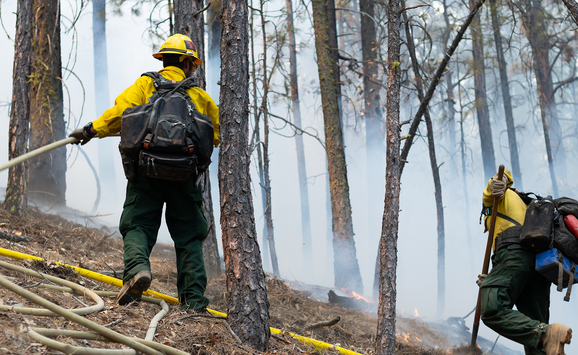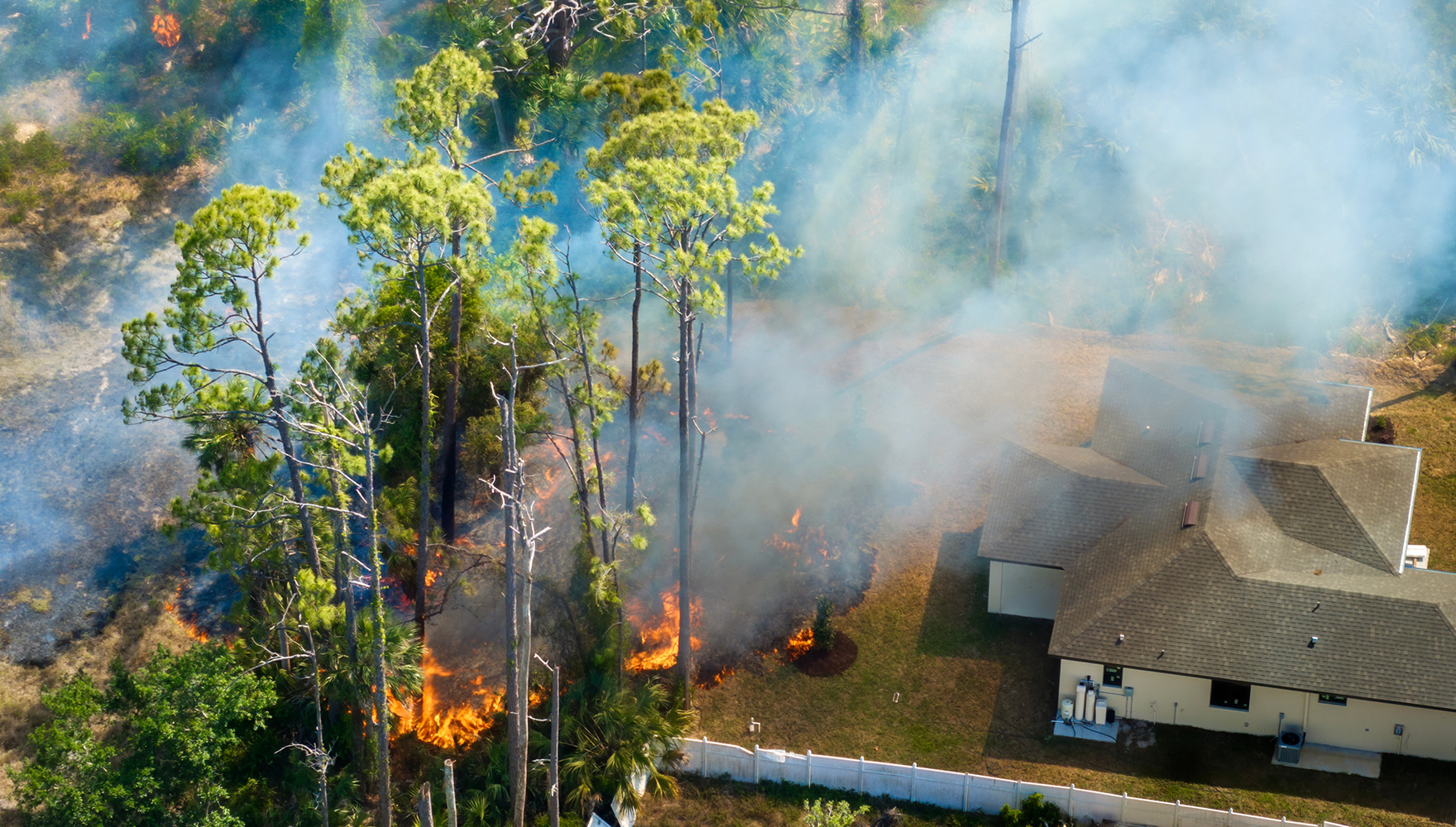


In this week’s episode, host Margaret Walls brings Mark Brown and Jason Brooks on the podcast to discuss their work facilitating fire-resilience efforts among the residents of Marin County, California. As the executive officer of the Marin Wildfire Prevention Authority—the agency tasked with coordinating the county’s fire-prevention activities—Brown relies on data and strategies created by Fire Aside, a software company co-founded by Brooks. Together, the pair have contributed to an evolution in how the county approaches fire mitigation and response, promoting collaboration among homeowners, local fire services, and insurers. Brown and Brooks relate key takeaways from five years of their public-private partnership, including how to effectively advocate for behavior change, enable homeowners to improve their insurance plans, and unite communities to protect one another against the growing threat of wildfire.
Listen to the Podcast
Audio edited by Rosario Añon Suarez
Notable Quotes
- Making fire safety a habit: “Behavior change is hard. It takes time to change people’s behaviors, their habits, how they see things. We see it overwhelmingly in the data—five years in now, people are changing their behavior. They’re thinking about things differently. Now, when I’m mountain biking through the community, I’m seeing more and more people that are swapping out their wood fences with metal fences.” —Jason Brooks (15:35)
- Fire services need effective messaging: “If you brought up marketing to a fire department 20+ years ago, they would’ve said, ‘What are you talking about? We don’t need to do marketing. We’re the fire department.’ [We had Jason] come in with the idea of, ‘Wait a minute, we need to get the residents to actually listen and engage. Your fire-service style of communication isn’t working.’” —Mark Brown (19:43)
- A new era of fire prediction: “What you’re going to see the fire service trend toward is what the weather industry has done: Have an ensemble of models. When the ensemble starts to agree, then that’s going to give us a strong indication of what we can expect. We have finite resources when it comes to our funding and our ability to get work done. This is going to allow us to really prioritize and focus on the highest-risk areas.” —Mark Brown (25:24)
- We’re all in this together: “[Wildfire] is a ‘tragedy of the commons’–type problem. What your neighbor does impacts the resilience of your home. For communities to be able to show the progress on all homes—as in, everyone in this neighborhood has made changes—that is going to be so powerful for communities in the coming years to prove their resilience and ultimately make them more insurable.” —Jason Brooks (29:13)
Top of the Stack
- Fire Safe Marin
- Fire Aside
- The British Are Coming by Rick Atkinson
- The Death of Expertise by Tom Nichols
The Full Transcript
Margaret Walls: Hello, and welcome to Resources Radio, a weekly podcast from Resources for the Future (RFF). I’m your host, Margaret Walls.
Today on the show, we’re going to talk about wildfire. In particular, we’re going to dive into what’s happening at the community level to build resilience to wildfire.
I have two guests today, Mark Brown and Jason Brooks. Mark is the Executive Officer of the Marin Wildfire Prevention Authority, which is an agency in Marin County, California that was created to coordinate fire prevention activities across all the jurisdictions within the county. I’m going to let Mark tell us about all the different things that the Authority does, but a lot of their efforts are, understandably, focused on individual property owners and the actions that they can take to make their properties more fire resistant. They do a lot of their work with a company called Fire Aside.
Jason’s on the show because he’s the co-founder of Fire Aside, which provides data platforms and analytical solutions as well as marketing and communication products for communities like Marin. Fire Aside’s really grown by leaps and bounds since they launched in 2020, and they now work with a lot of different communities, mostly across the western United States, but I believe Marin County was their first partner.
Jason and Mark have worked closely together since the founding of both of their organizations. That’s why I thought it would be great to have them on the show together to talk about all this.
We’re going to talk about the challenges that communities are facing with the growing wildfire problem; about Marin County’s approach (they’re held up as a leader in this area). We’re going to talk about the public-private partnership that Marin and Fire Aside have, and the intersection of this work with homeowners insurance and some of the insurance problems we’re seeing, and a lot more, so stay with us.
Hello, Jason and Mark. Welcome to Resources Radio. Thanks for coming on the show.
Mark Brown: Thank you for having us, Margaret. We really appreciate the invite.
Jason Brooks: Thank you so much for having us.
Margaret Walls: Well, we want to start with a little get-to-know-you question, you guys. Can you each tell us a little bit about yourself and your journey? How did you come to do what you’re doing?
Mark, let me start with you.
Mark Brown: Sure. I started as a volunteer firefighter, way back in 1986, and then got hired with the Marin County Fire Department. Spent 30 years there, retired as deputy fire chief and responded to some of the state’s most devastating fires in their history in a command role.
It really just got time for me to stop chasing fire, so to speak, and get my focus out in front of fires and get work done before fires ever happen.
Margaret Walls: Yeah, that’s interesting. Quick aside question, Mark. Do you think that story is unique, or do you think more people that were working on fire from the suppression side are now getting into the prevention side? What do you think about that?
Mark Brown: It’s really starting to happen more and more now. Many people like myself who have the experience that I have are just realizing, “You know what? It’s time to change our focus and get out in front of things.” It is a growing trend.
Margaret Walls: Yeah, that’s interesting. Jason, what about you? What’s your story?
Jason Brooks: I actually come out of a very different background. I didn’t know anything about fire or the Fire Service until I started Fire Aside. I have a background in working with big-data companies and marketing technology, which actually is very relevant to what we’re doing in prevention these days.
But this journey, for me, started as a homeowner. I was simply trying to figure out what to do for my personal property, to make it resilient, and started just thinking about the problem. How do you help someone like myself understand what to do first? What’s the most impactful thing to do? That was really the genesis for Fire Aside.
Margaret Walls: Yeah, that’s great.
Let me go back to you, Mark. I only gave a little bare-bones introduction to the Marin Wildfire Prevention Authority. Tell us a little bit more about it. What do you all do, how are you organized, and so forth.
Mark Brown: You bet. We came about largely because of the North Bay Fires in 2017. We interviewed the Sonoma County Law Enforcement fire and land management agencies. We asked them what they were doing before the fires, during the fires, after the fires. We came up with six and a half pages of action items, and our solution was to create a joint powers authority called Marin Wildfire, and we had a tax measure to support it.
Our tax funding supports the creation of shaded “fuel breaks,” or extended defensible space along the wildland-urban interface boundary. We perform over 30,000 inspections a year to help our residents understand what they should be doing around their homes. We improve evacuation routes; we improve evacuation systems, notifications, alerts, and warnings. We provide grants for our residents for home hardening and Zone Zero. Zone Zero is the first five feet from the house, and our goal is to have nothing combustible within that first five feet.
Then we spend an incredible amount of money on public education, because we feel it’s just so important for the public to be well-informed. They know why … They’re making well-founded decisions rather than doing something the fire department told them to do.
Margaret Walls: Mark, are your Zone Zero … Do you have your own local ordinance about that? I know the state is still working on the regulations for that, right? Where does that stand in Marin?
Mark Brown: Right now, in Marin, we’re recommending that our residents adhere to Zone Zero best practices. We’ve been waiting for the state to come up with a definition. Our fear was that we would come up with a definition and then have it be vastly different from the state’s. But from day one, we’ve been recommending Zone Zero best practices to our residents.
Margaret Walls: Yeah, okay. We might go back to that in a minute, but let me also follow up with you, Mark, about the money. I have—from when we talked before, or maybe I saw this online—that you figured out that you needed about $20 million per year to do what you needed to do.
My first question is, how did you come up with that? Do I have that number right? How did you come up with that figure?
Mark Brown: You do have that number right. This is going to sound cliché, but that truly is back-of-a-napkin math. Our fire chiefs would meet once a month for their regular meeting, and then they would have an informal breakfast before the meeting. Sometimes chiefs would attend, sometimes they wouldn’t. It was as they were available.
They started talking about this wildfire problem. We talked about our lessons learned, and we started with how many inspections a year we thought that we needed to get done. We multiplied that by how many inspectors we would need and how much inspectors cost. Then we started thinking about how much on-the-ground work we would need and multiplied that by how many people would need to do that work. That’s how we came up with a rough number of $20 million. Unfortunately, I don’t have the napkin anymore, but I do have a picture of the napkin.
Margaret Walls: Do you have a picture? That’s good.
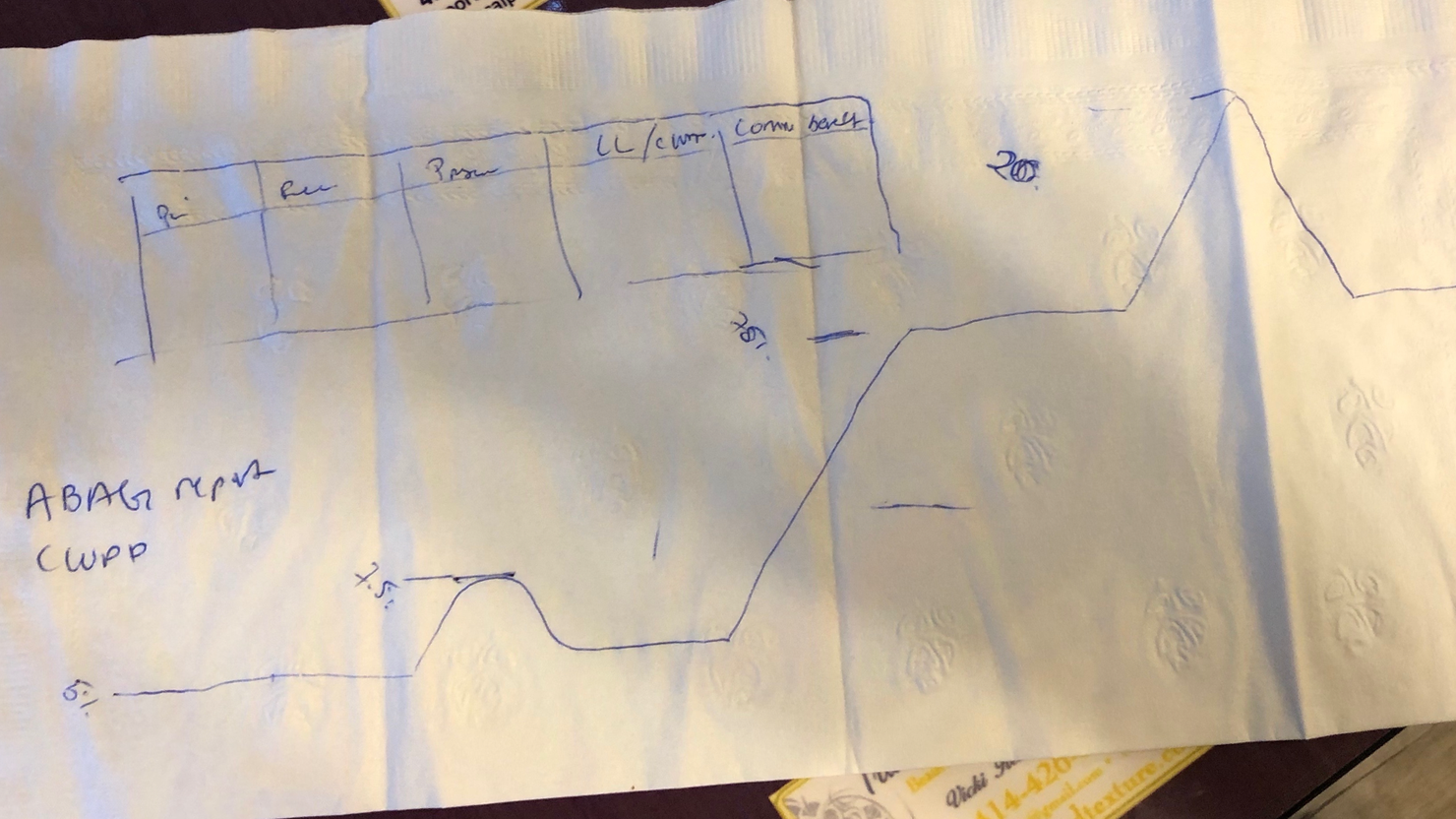
Mark Brown and fellow Marin County fire chiefs used this napkin to calculate the budget of a new risk-mitigation program, which eventually became the Marin Wildfire Prevention Authority.
Margaret Walls: Then, where you were going to get the money from became the next question. Tell us about what you all do in Marin and how you came to that.
Mark Brown: Well, once we decided we were going to put a tax ordinance on the ballot, of course we started polling, and we polled two different ways. We polled for a sales tax, and then we also polled for a property tax. It’s probably no surprise that the property tax polled higher than the sales tax because of the regressive nature of sales taxes. Some of the cities and towns were already reaching their cap for the allowable sales tax.
But I really think the property tax—we started off with 10 cents per square foot for commercial and residential— I think it really resonated with the voters, because if you think about the size of the building and the level of effort to defend it, the bigger the building, the more effort to defend.
Margaret Walls: Yeah. Can you give us a sense of what an average homeowner is paying? Do you have a number like that at your fingertips?
Mark Brown: Yeah, I do. We see about $200 to $210 a year per residence as the average.
Margaret Walls: Okay. That doesn’t sound too bad to me, actually. But yeah, everything costs money, so you’ve got to find it somewhere.
Jason, let me turn to you. I gave an even more bare-bones description of Fire Aside. Tell us more about the company and what you all do.
Jason Brooks: Yeah, for sure. Similar to how Marin Wildfire started with the North Bay Fires, I had the same experience, as I mentioned. I wasn’t directly impacted, but very near to my home were several homes that were lost in the Sonoma and Santa Rosa areas. That was really the background: “What could I do differently so that that outcome doesn’t happen to my home and my neighbors’ homes?”
I started a software company, and we made some mistakes, had some lessons learned, but we were very fortunate to partner early on with Marin Wildfire—almost starting at exactly the same time.
What we do, today, is we now work with all of our agency partners and Fire Safe Councils and help them be a lot more efficient in how they reach their homeowners, collect really fine-grain data to help inform their modeling and their policy decisions, measure the return on investments. With the data, you can measure what’s working, what’s not, and then really try to drive toward what the right education tools are on a house-by-house basis.
I say this a lot, but every home is different—everything to do on a home is different. The agencies or the local communities really need ways to reach each resident where they are individually. A person who’s renting a mobile home in Northern California is very different from a longtime owner in San Diego, and you need the tools to reach them differently, and that’s what we provide.
Margaret Walls: Give us a little bit more detail on what you do in Marin. Who’s doing the actual inspections? And then, you have created this platform for collecting all this data and information. Can you just tell us a little bit more about what that looks like? What are the pieces of information you’re collecting, and so forth?
Jason Brooks: So, we’re the software. An organization like Marin Wildfire or the local fire agencies are always the boots on the ground. They’re the ones who are interacting with the public. But when an inspector or an assessor goes out in the field, they’re carrying an iPad—that iPad is running a software that Fire Aside provides. Going deeper and deeper into the layers, it has everything, including which homes to prioritize based on, potentially, risk or lack of action, because you can’t get to every home. You don’t even have to think about when to prioritize certain properties for an assessment. We integrate that kind of information for the field inspector.
In the field, they’re collecting all the attributes, both positive and negative, about a home that are related to wildfire. We always focus, as Mark talked about, on Zone Zero or that zero-to-five space. There might be a lot of focus on the combustibles near the home, but a lot of homes are doing a lot of work, and they’ve done a lot of mitigation. That also gets collected, to make sure those homeowners can get credit for it.
Then finally, on the backend for our policy leaders, chiefs, and people like Mark, they have the ability to log in to dashboards and see exactly what’s been done. See change year over year, see what change isn’t happening, where it might need more interventions—whether that’s assistance or other types of policy.
Margaret Walls: Yeah, that’s great. It’s a really rich product.
Listen, you two have been working together in Marin for five or six years. Tell us a little bit about some of the progress this made. What do you think have been some of the biggest challenges? What’s been the big success? You’re five years in, how are things looking? I’m curious, what’s the next big thing you’re looking up at?
Mark, let me just start with you on that question. How do you think things are going?
Mark Brown: Well, you would think that for the answer to this question, I would start talking about some of the on-the-ground work—how many miles of fuel breaks we’ve made—but I’m actually going to focus on some of the cultural and societal changes that we’ve made in Marin.
At five years, it just now feels like we’ve caught our stride. It took quite a while for us to get there. But one of the first things we had in our lessons-learned document is that we wanted to get up to 20 Firewise communities. Firewise is a designation where a community comes together, and it’s really community driven. It’s not driven by the fire department, it’s driven by the residents. They work with each other, but they put peer pressure on each other to get work done. Our goal was to get to 20 Firewise communities within the first year. We are now at 92 Firewise communities in Marin, and that’s just our community members coming together and saying, “We need to work on this together.”
The next thing I look at is our Chipper Day Program, which is run through software from Jason at Fire Aside. Our residents, after they receive an inspection, are invited to participate in Chipper Day. They remove vegetation around their house; they put it in a pile in front of their house. We come by, we pick it up. About a $300 savings for the residents. So, if you think about the average of $200 per resident to be a member of Marin Wildfire through their taxes, they automatically get a return on their investment if they use Chipper Day once.
But the societal change and the cultural change that we’re seeing is that our early registration for Chipper Days, before inspections ever happen, have gone through the roof. Now our residents have gotten into the routine: “It’s springtime, it’s time for me to do work around our house. I’m going to sign up for Chipper Days.” That’s before they even have an inspection. Now they’ve just got it into their routine, and it’s turning into a cultural change.
I think that’s probably the thing that I have enjoyed seeing the most. Jason talked about our dashboards, and when you look at our defensible-space dashboard, to me, that’s the residents showing us what they have done. We do our inspections, we model the fire risk, then we reinspect, or the resident tells us what they’ve completed. Then we remodel the fire risk for that property, and we can see that change. We really are seeing our residents take action.
Margaret Walls: Yeah. Mark, what about the landscape businesses and gardeners, and so forth? Do you work with them, and are they also seeing a cultural shift? How does that play out?
Mark Brown: You bet. We do work with a lot of landscaping companies in and around Marin. When I say landscaping, I’m talking about the people going onto properties and getting the work done for their residents. Through our partnership with Fire Safe Marin and the University of California Cooperative Extension, specifically Marin Master Gardeners, we have a lot of outreach to these folks as far as the day-to-day and weekly maintenance that occurs on people’s yards. But we also have landscaping companies that we’re paying to create our shaded fuel breaks, to help people with their defensible space.
What I love about our tax measure is we have grown several Marin companies based on our tax revenue. Taxpayers are paying into it, and then we’re creating more jobs with that tax revenue in Marin. It’s really been a synergistic effect for our communities.
Margaret Walls: Oh, that’s a really good point.
Jason, do you want to add anything on this big picture question about progress and challenges, and so forth?
Jason Brooks: I’d say, when you think of challenges, behavior change is hard. It takes time to change people’s behaviors, their habits, how they see things. To build off of what Mark says, we see it overwhelmingly in the data, right? Five years in, now, people are changing their behavior. They’re thinking about things differently. Now, when I’m mountain biking through the community, I’m seeing more and more people that are swapping out their wood fences with metal fences. Little signs like that, that just appear over and over again, are really encouraging.
When I look ahead to the next couple years, as you mentioned, the implementation of Zone Zero—the state ordinance to mandate or restrict what can be combustible within zero to five feet of the home—is going to be a big challenge for communities to help educate and roll that out.
We work with other communities that have gone ahead with an ordinance already. Berkeley, for example, South Lake Tahoe, etc., are partners of ours. Just seeing how they’re implementing that … It’s necessary, but it is going to be a challenge for the policymakers to implement that correctly.
Margaret Walls: Yeah. Do you get—this question is for both of you, I guess—but do you get some pushback? You must; of course, there’s going to be some pushback from some residents. “I just planted that tree. I love that tree.” That kind of thing.
Mark Brown: Oh, well, for sure, we are getting resistance. There’s a letter to the editor in our local newspaper about Zone Zero, and the writer was saying, “This would be the biggest societal pushback the government has ever seen.” That might be a little bit blown out of proportion.
Margaret Walls: Hyperbole.
Mark Brown: It might be a little bit of hyperbole, yes, but it is an indication of the pushback that we’re likely to see. We’ve been at this for five years. I think if we get Zone Zero right, it’s going to take 10+ years to get it right.
I use seat belts as an analogy. The seat-belt law came into effect in California in 1986, and believe it or not, there was a lot of pushback on the seat-belt law, but now when you get in a car, doesn’t it feel weird if you’re not wearing your seat belt? If we do Zone Zero right, and our residents embrace it, when you drive around your community, and you see a house without Zone Zero in place, it’s going to look weird. To me, that will be a definition of success.
Margaret Walls: Yeah, good point.
You all have a public-private partnership here, and I just want you to talk about that a little bit. How’s that working out? Are there particular issues that come up, maybe, where your goals aren’t aligned, or what are some of the pros and cons of having this public agency partner with a private company?
Jason, you want to start?
Jason Brooks: Yeah, sure. I would just start and say it’s fantastic. I can’t truthfully ask for a better partner. Fire Aside wouldn’t exist without Marin Wildfire and some of the early feedback ideas and partnership we had in building, developing, and rolling out and continuing to—even to this day, as recently as this week—innovate the product.
Some things that I think that have been so instrumental to that, that have made it work, is—while I’m a for-profit company, and Mark’s with a public agency—the fact is we’re both super aligned on the exact same mission, which is to reduce and eliminate wildfire risk as much as possible for residents here in Marin County, and of course our Fire Aside beyond.
That orients every decision you make, because when you both are trying to achieve the same thing, what your organizational structure is actually doesn’t really matter, because it’s about your mission. I would say, the amount of times that I’m either texting Mark—just with a, “I have an idea, I want to run it by you,” or he’s throwing something at me—that probably happens almost once a week, and then that allows us to continue to innovate and build together.
Margaret Walls: Mark, what do you have to say about that, from your side of things?
Mark Brown: I’ve always been a fan of public-private partnerships, and I’m so happy that Fire Aside was our first one. Jason is spot on when he says we have an ongoing dialogue; “Hey, I got an idea.” Believe me, a lot of those ideas didn’t get past the conversation stage, and some of them have come to fruition.
But I think one of the key points—Jason touched on it with his introduction—is he had nothing to do with wildfire. He had nothing to do with the Fire Service coming into it, and the Fire Service needed that. The term “marketing” … If you brought up marketing to a fire department 20+ years ago, they would’ve said, “What are you talking about? We don’t need to do marketing. We’re the fire department.”
Having someone come in with the idea of, “Wait a minute, we need to get the residents to actually listen and engage, and your Fire Service style of communication isn’t working, so we’re going to have to change that up.” That part I absolutely loved.
A challenge that I see for Jason, and it’s something that frustrates me as well, is I hate the speed of government. Government’s too slow. We need to become more nimble, and Jason allows us, and pushes us, to speed up our pace, but I also have to remember that I’m spending the taxpayers’ dollars, so I have to be a little bit more cautious.
That’s what tends to slow us down and cause us to be a little bit more deliberate with our decisions. Working with a private partner, though, allows us to push the envelope, so to speak, as far as our speed.
Margaret Walls: Right. The tools that Jason brings—that wouldn’t be something you would have among county employees, to do all the software products that he brings. I’m sure that’s the main benefit.
Mark Brown: The software, but also just how we frame the message. The Fire Service really wouldn’t have done that without people who have a marketing background, who can frame a message in a way that it’ll be received by people.
Margaret Walls: Yeah, super interesting.
Speaking of the software, Jason, I know that there’s a lot of data being collected that is highly confidential data, that you’re very, very careful about keeping confidential. But at the same time, there are people out there in the scientific community working on modeling fire behavior in a developed environment. The wildland-urban interface is challenging as it’s still in early stages, I would say.
I’m wondering if these efforts and the data you’re collecting can ultimately be used to improve the modeling and ultimately prioritize actions. What do you think about that? What’s going on in that world?
Jason Brooks: Yeah, I think that’s actually a really exciting area and one that’s going to continue to get more attention and investment in the coming years. As you said, the data that Fire Aside collects ultimately …
When I say “Fire Aside collects,” Fire Aside’s a processor. The data always belongs to the agencies and the residents and is used for public good. It is their data, and we’re super clear on that.
When you start to think about what you can do with this information—this was shocking to me, remember, I didn’t come in through the Fire Service—but when I first started asking questions five, six years ago, one of the first things I learned was that all the wildfire-risk models treated every single home as unburnable, because they didn’t know what else to do. If a wildfire model had fire in the forestlands or the wildlands, as soon as it hit homes, they just assumed it would not burn. Clearly, we know that was wrong, but there was just this absence of data.
I get so excited about the fact that now these communities and places like Marin actually have really good data about what the built environment looks like. Then, on the back of that, you can actually start to run models now, so you can understand what would happen when fire transitions from the wildland into the urban environment, and then take it forward. The power of that—as you mentioned, Margaret—the power of that is now agencies can be very thoughtful about where they put interventions and put resources.
I’ll keep this as a simple example, but if you know that three homes are the most likely places to ignite—and the most likely places where fire would transition into the urban or the built area—you can put a lot of intervention into those three homes rather than just spread it around. You can then run the model again, actually measure the impact, and show how you’ve reduced what the risk is to the community.
So, you’ve done a couple things. You’ve been very strategic in where you’ve applied interventions and applied public dollars, and you’ve also been able to show strong public good for all the residents in that community, not just those three homes. So, I’m really, really excited about where this is starting to go.
Margaret Walls: Yeah, me too. Mark, do you want to add anything to that? I know you have these discussions with the modelers too, so what do you think?
Mark Brown: It’s amazing. When Marin Wildfire started, there were probably three wildfire-propagation models, and they were all running on what’s called the Rothermel equations, which were developed in the ’60s by an out-of-work rocket scientist. As Jason mentioned, they would treat the built environment as unburnable. The first experiments at treating the built environment as burnable, they modeled it as 15-foot-tall grass. It really wasn’t accurate.
Jason and I had an opportunity last week to participate in a wildfire risk–modeling workshop that was hosted by Moore [Charitable] Foundation and UL [Underwriters Laboratories Research Institutes]. We looked at 28 different models. The number of models went from 3 to way over 30, because we obviously didn’t touch on all the models that are out there, and we got to dig into them, look under the hood, see what drives them. They all modeled these two fictitious communities, and we were able to see how one model would say the community would behave this way; another model, the model was saying the community would behave this way. And we were able to lift up the hood and see why that difference was there, and it was super informative.
What you’re going to see the Fire Service trend toward is what the weather industry has done: have an ensemble of models. When the ensemble starts to agree, then that’s going to give us a strong indication of what we can expect. Then as Jason said, that allows us to … We have finite resources when it comes to our funding and our ability to get work done. This is going to allow us to really prioritize and focus on the highest-risk areas.
Margaret Walls: Yes, that’s super exciting. I’d be really interested to see where that goes.
I’m going to switch gears now, you guys. I want to ask you about insurance. I want to talk about that just a little bit. I know many of our listeners already know that there’s been a lot of problems in the California homeowners insurance market. People have been dropped by their insurance company; trouble finding coverage elsewhere; growing enrollments in the California FAIR [Fair Access to Insurance Requirements] Plan, which is often called the “insurance of last resort.”
So, what do you think about community efforts like you all are doing in Marin—if that program is working, are insurers more willing to provide coverage to people, or lower premiums, or anything like that?
I know there’s a number of challenges here, but are you engaging with insurers, and what do you have to say about that? I can start with you on that one, Mark.
Mark Brown: You bet. Marin Wildfire’s reputation is growing. We’ve done outreach to insurers. Insurers have reached out to us. If you asked me a year ago if we had any insurance success stories, I’d have to say no. Now, I can say that we have success stories.
Jason helped me connect with Mercury Insurance, one of the most aggressive insurers in the state when it comes to high-risk areas. We were brainstorming with Mercury, and they told us their number one goal is to get people off the FAIR Plan. Well, we tracked the percentages of FAIR Plan policies within Marin by ZIP code, and we knew that Inverness was the area where we had the highest FAIR Plan concentration. 36 percent of the homes in Inverness are on the FAIR Plan, and Mercury gave us a list of requirements, and this list was very reasonable and achievable.
We dug into our data through Fire Aside and found out that out of the 800 to 900 structures in Inverness, 200 to 300 of them were 1 to 2 items away from matching Mercury’s requirements. We created a conversation between Mercury and the residents directly. We took ourselves out of the equation. The residents started working with Mercury’s wildfire team directly. We have three houses that have been pulled off the FAIR Plan, and we have six more houses that are receiving quotes from Mercury.
Now, Mercury’s calling us up and going, “Okay, let’s roll this out through the rest of Marin.” Mercury’s team drove through many parts of Marin with us, and they’re literally pointing at a house: “I want to insure that house. I want to insure that house.” We got Mercury engaged, and now we are looking to get other insurers to follow Mercury’s lead.
Margaret Walls: Yeah, that’s a great story. Do you want to add anything, Jason? I don’t know if you engage with insurance companies at all.
Jason Brooks: Yeah, I’d love to. Building off of what Mark said around the success, I think there’s two things that we think about a lot at Fire Aside. One is that residents need to get credit for the mitigations that they’re doing, but the only way that can happen is if the data and the proof, if you will, of their work can bubble up.
That’s where I get really excited about the program that Mark mentioned out in West Marin, where essentially, by being able to use the data and identify there are a lot of homes that are really close to being insurable, that sets up a plan for those residents. They can choose to do the work or not do the work, but at least they have an achievable path rather than just feeling lost out there.
At Fire Aside, we’re involved in several other pilots, both in California and outside of California, that are seeing similar results or are on a similar trajectory. Again, it just gives me a lot of hope.
The other piece that we think is really important for wildfire in particular, and insurance, is that it is a “tragedy of the commons”–type problem. What your neighbor does impacts the resilience of your home. That’s been well documented and well proven.
For communities to be able to show the progress on all homes—not individual homes—as in, in this neighborhood, everyone in this neighborhood has made changes. Everyone in this neighborhood has now created Zone Zero or enclosed their deck, that type of thing. That data, I think, is going to be so powerful for communities in the coming years, to basically prove their resilience and ultimately make them more insurable.
Margaret Walls: Yeah, that’s great. I want to squeeze in one last question here for you all. Jason, Fire Aside’s working with a lot of communities. Let’s suppose I’m a local official or fire chief, and I’m just getting started on my wildfire risk problem. What’s the couple of things that you would say to me as the first steps I ought to take? What would you say to that?
Jason Brooks: Oh, yeah. I give this talk a lot, but I’ll be quick.
The first one is: Start now. As I mentioned, we see this when you think of insurance or being able to prove resilience. What people want to see is longitudinal data. That means year-over-year data, and they want to see data at scale. Those are just the facts of the world. And so, sometimes we run into communities that are thinking about starting next year or trying to figure it out. I would really argue strongly that they’re doing a disservice to their community by delaying, just because of the fact that you need that longitudinal data. That’s one that’s really, really important.
Then the second one is, when you’re in the field, and you’re doing these assessments, collecting all the data, sometimes we see some departments or some areas that, maybe, are just going to focus on vegetative. “Oh, we’re just here to do a defensible space vegetative inspection.” They won’t mark down any attributes of the home. Often, the wood fence or the vent are actually the riskiest thing on the home, but the agency has a bias toward vegetative assessments.
So, I would try to encourage every department to start now. It’s better to get going than do nothing, because the sooner you build that data and really think about the totality of the home, not just the vegetative state …
Margaret Walls: Oh, that’s helpful. Very good points. Mark, do you want to add anything?
Mark Brown: I would add that the Fire Service is really good at responding to incidents without worrying about jurisdictional boundaries. But when it comes to fire prevention, and wildfire prevention and mitigation, we are very much siloed within our jurisdictional boundaries. I encourage other areas to forget about those boundaries; create a governance structure, first, that covers all of those areas, so you can have a unified message, a unified call to action to all the residents, despite what jurisdiction they live in.
Margaret Walls: Yeah. Great point. Thanks, you guys.
Well, we have to close the podcast, and we’re going to do that with our regular feature, Jason and Mark, which we call Top of the Stack. I’m going to ask you to recommend something to our listeners.
I’ll start with you, Mark. Do you have something on the top of your stack to recommend to us?
Mark Brown: Yeah. Well, I do a lot of reading on history, and currently I’m reading a book by Rick Atkinson on the Revolutionary War called The British Are Coming. What I really like about Atkinson’s style of writing is that he digs deep into the leadership principles, but also into the decisionmaking, both good and bad, because there’s so much that we can learn from bad decisions that have occurred throughout our history.
Margaret Walls: Nice. Okay. How about you, Jason? What do you want to recommend to us?
Jason Brooks: So, I’m reading The Death of Expertise right now. I’m just about finished with it. It’s been around for 10 years. I just discovered it, so I’m probably a little late to the party, but it’s really, really interesting. You think about what it means—exactly as the title would say, the death of expertise. How society is just working through what it means when we don’t trust experts anymore.
Especially, bringing it back to the wildfire space, when you have everyone taking their own views as to what really is going to make their home safe, rather than listening to the expert, it can sometimes make it harder. Just really enjoying that book quite a bit right now.
Margaret Walls: Oh, thank you. Those are both great recommendations.
Well, Mark Brown and Jason Brooks, it’s been a pleasure having you on Resources Radio, talking about your public-private partnership and about how to build wildfire resilience in communities. Thank you so much for coming on the show.
Mark Brown: Thank you for having us.
Jason Brooks: Thank you.
Margaret Walls: You’ve been listening to Resources Radio, a podcast from Resources for the Future (RFF). If you have a minute, we’d really appreciate you leaving us a rating or comment on your podcast platform of choice. Also, feel free to send us your suggestions for future episodes.
This podcast is made possible with the generous financial support of our listeners. You can help us continue producing these kinds of discussions on the topics that you care about by making a donation to Resources for the Future online at rff.org/donate.
RFF is an independent, nonprofit research institution in Washington, DC. Our mission is to improve environmental, energy, and natural resource decisions through impartial economic research and policy engagement.
The views expressed on this podcast are solely those of the podcast guests and may differ from those of RFF experts, its officers, or its directors. RFF does not take positions on specific legislative proposals.
Resources Radio is produced by Elizabeth Wason, with music by Daniel Raimi. Join us next week for another episode.