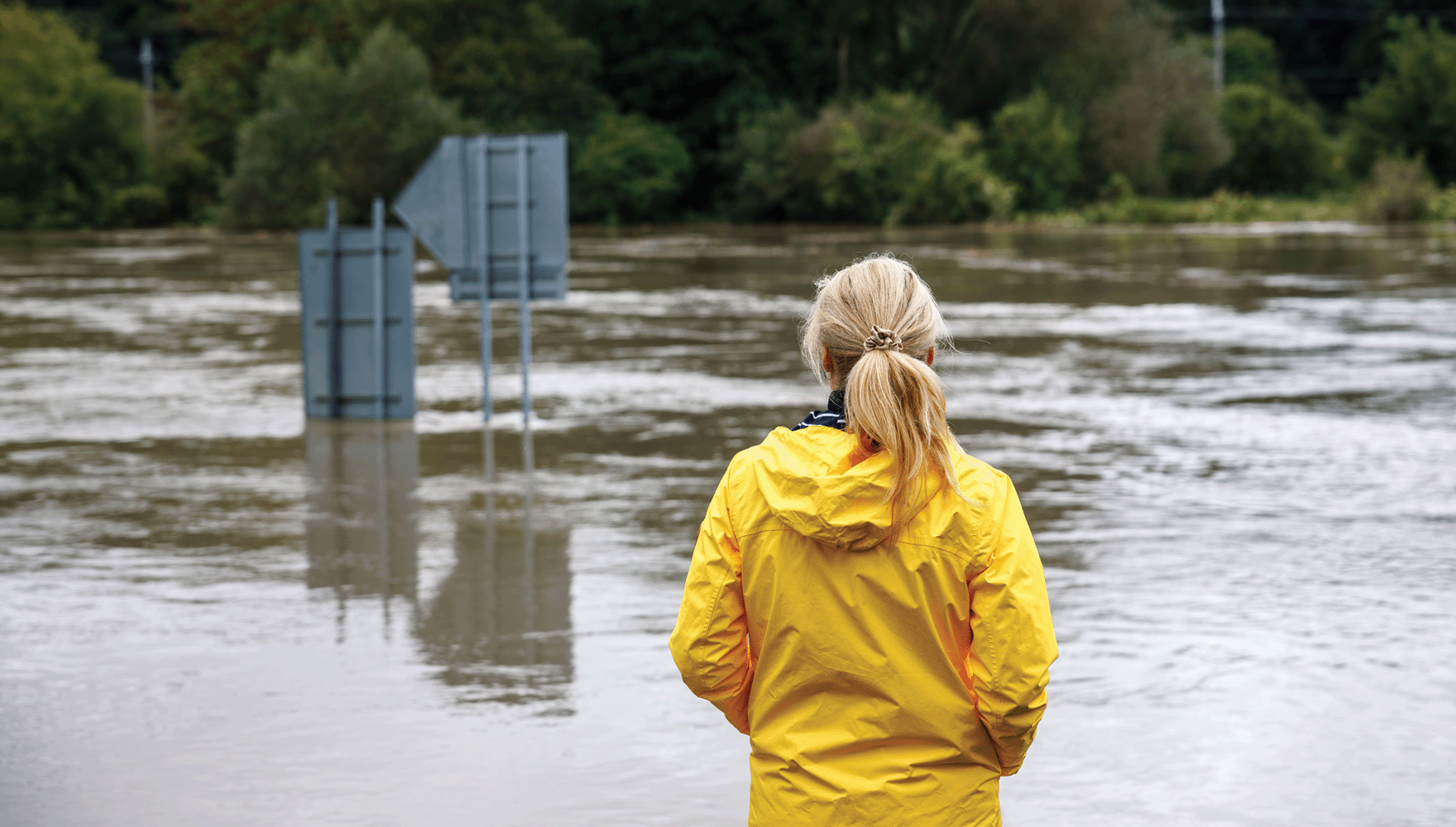

This week, host Daniel Raimi brings Gabrielle Wong-Parodi on the podcast to discuss how people connect climate change to their personal experiences with extreme weather events—and whether these experiences impact their willingness to take action. As a social scientist at Stanford University with a psychology background, Wong-Parodi offers a glimpse into the complicated, and often unpredictable, path between experiencing a consequence of climate change and deciding to contribute to solutions. Research has shown that extreme weather events can lead to increased desire to take adaptation measures (like making homes more resilient) and mitigation actions (like purchasing electric vehicles or solar panels). However, translating these cognitive responses to behavior isn’t always straightforward; Wong-Parodi explains how psychological biases and political affiliation can affect the actions that result from observed attitudinal trends.
Listen to the Podcast
Audio edited by Rosario Añon Suarez
Notable Quotes
- Research shows a link between personal experience and changing attitudes: “When people are experiencing [extreme weather] events, they are reporting that they intend to purchase things like electric vehicles or support climate change mitigation policies. We are seeing people, post-climate-driven disaster, investing and being interested in improving homes so they are more resilient to climate change.” (22:15)
- Psychology can inhibit action on climate change: “People are motivated to process information in a way that aligns with their preexisting beliefs. There is a strong tendency for people to want to have things remain the same; to have our economic systems remain the same. It can be quite threatening when we think about the extent to which we may have to change our sociopolitical, economic system to really address climate change.” (24:55)
- Extreme weather is beginning to affect everyone: “We need to think about what unites us all. Extreme weather events are something that we are all experiencing now. It is a good starting point for opening up conversations about climate change, impacts, and what we can do.” (26:03)
Top of the Stack
- “Personal experiences matter for climate action” by Gabrielle Wong-Parodi
- “Households’ Perceived Personal Risk and Responses in a Multihazard Environment” by Michael K. Lindell and Seong Nam Hwang
- “The effects of weather experiences on climate change attitudes and behaviors” by Matthew Ryan Sisco
- “Experience of extreme weather affects climate change mitigation and adaptation responses” by Christina Demski, Stuart Capstick, Nick Pidgeon, Robert Gennaro Sposato, and Alexa Spence
- All That Breathes documentary
The Full Transcript
Daniel Raimi: Hello, and welcome to Resources Radio, a weekly podcast from Resources for the Future (RFF). I’m your host, Daniel Raimi.
Today, we talk with Dr. Gabrielle Wong-Parodi, Associate Professor of Earth System Science and Senior Fellow at the Woods Institute for the Environment at Stanford University.
Gabrielle recently published a short article on a really interesting topic: How do personal experiences with extreme weather events affect the way that people think about climate change? Does it make them more supportive of climate policy? Does it make them want to reduce their own emissions by buying solar panels or an electric vehicle? And how do these differences vary across party lines? I’ll ask Gabrielle these questions, and more, in today’s episode. Stay with us.
All right. Gabrielle Wong-Parodi from Stanford, welcome to Resources Radio.
Gabrielle Wong-Parodi: Hi. I’m happy to be here.
Daniel Raimi: Yeah, it’s great to have you. Nice to talk to you again. It’s been a while since you and I have connected, but I don’t think I’ve ever asked you how you got into this field in the first place. How did you get interested in working on energy- and environment-related topics?
Gabrielle Wong-Parodi: Yeah, thank you for asking this question. It’s sort of a long path that got me here, and not a straightforward one. I was the type of kid growing up where I always was very interested in understanding people’s stories, what motivated them, and why they did the things that they did. That always fascinated me. And I was always interested in doing something as I grew up that would help people, in some way.
And so, as an undergraduate at [the University of California,] Berkeley, I majored in psychology, and I was initially interested in going into clinical psychology. However, when I started volunteering at an outpatient unit close to campus, I soon realized I was not the type of person who’d be able to walk away from the work that I was doing. And so, just for my own mental health, I was searching for something else that I could be doing where I felt like I was making a difference and making an impact in the world.
It so happened that at that time I was also working as a research assistant, just doing paperwork, filing types of work, for the Lawrence Berkeley National Laboratory and the Energy Efficiency Standards Group. I became interested in the work that they were doing with one big question that I was seeing again and again that people were grappling with: Why weren’t people buying the most energy efficient appliances when they were most cost-effective?
This is the work that I had started doing on furnaces and boilers rulemaking—basically, setting efficiency standards for those—and this is something that started really niggling at me. And I asked my supervisor, “Can I do more research on this?” And he was like, “Sure, go ahead.”
When I dug into it, it seemed like this had a lot to do with people’s psychology. People weren’t the initial decisionmakers, necessarily, when they were making decisions about what to purchase. So, for example, you’re taking a shower, your hot water heater goes kaput, and then it’s not working. You call your contractor, and it’s basically whatever they have in the back of their truck that they’re going to sell that morning. Or, people were interested in purchasing appliances based on aesthetics, based on sound, based on moisture.
So, all of these other things that I didn’t initially think mattered, mattered a lot in terms of how people made decisions about purchasing appliances, which then has implications for energy consumption and ultimately for climate change, when you think about types of fuels or how efficient these appliances are. So, that’s how I became interested, and it was something that really captured my attention and hasn’t let up since.
Daniel Raimi: Yeah, that’s super interesting. It’s funny how we make decisions about things. Economists sometimes like to pretend that we’re all rational, but of course, we know that we don’t always make rational decisions.
Today, we’re going to talk about the way that people’s personal experiences with things like extreme weather affect their views on attitudes and actions related to climate. You have this psychology background. One of the important concepts to understand as we go forward in this conversation is this concept of psychological distance. So, what is psychological distance, and why does it matter for the way people perceive climate change and the way people think about climate change?
Gabrielle Wong-Parodi: So, psychological distance draws from a theory called “construal level theory,” which helps us understand human behavior as it relates to how we think about things that are abstract versus things that are concrete, and how that affects our behavior. Psychological distance generally can be defined along four different dimensions: temporal, spatial, hypothetical (which means how uncertain or certain something is), and social.
So, when we think about temporal: Is something (whatever it is; let’s say it’s a threat) something that is going to happen soon, or far into the future? Spatial: Is it something that’s going to be close to me and where I live, or far away? Hypothetical: How certain am I that the threat is going to happen? And social: Is it happening to me, or people like me, or people who are not like me?
So, it’s hypothesized that when these dimensions are reduced or closer to us, this makes the threat more real, more visceral, more meaningful. It may not necessarily mean that it’s actionable, that we can do something about that threat, but it’s real. So, as much as risk perceptions or threat appraisal matters, this could be motivating for people in terms of their attitudes and beliefs toward that threat, especially if they’re able to act on it to reduce their risk or their exposure.
When we think about this as it relates to climate change, on balance, most literature suggests that decreasing that distance does increase concern about climate change and people’s willingness to engage on the topic. But that effect can depend on a variety of different things, including individual differences, cultural context, and how that information is communicated to people—the specifics of that communication, including how well-trusted that communicator is. Other factors may mediate the relationship, such as prior knowledge, and also what we’re going to be talking a lot about today, which is personal experience.
However, it’s important to note that psychological distance is a powerful concept, but if we use it to try to affect change, to motivate people, or to increase concern, it could backfire; people may disengage or may become upset with attempts to reduce psychological distance. Maybe there’s no clear solution that they can behaviorally, realistically act upon, or that threat or thinking about it is threatening to them in some way—whether their position is, “I’m not accepting of climate change, and therefore I don’t want to take action,” or in some other way that might be threatening to their status quo, their way of life, their well-being, and so on.
So, psychological distance is a super important concept. And for maybe the last 15 or 17 years, a lot of researchers have been considering how it relates to climate change and ways that we may actually motivate action on it.
Daniel Raimi: Yeah, that’s great. That makes sense. You write about this in your recent piece in Nature Climate Change, and one of the things that you do in that article that I really appreciated was you walked us through the research on this topic and how it’s evolved over the last, I don’t know, 15 or 20 years.
Some of the early studies that you talk about that look at the effects of personal experience with extreme weather and attitudes on climate are really nicely explained in the article. So, can you walk us through: What did some of those early studies find?
Gabrielle Wong-Parodi: I think in order to understand what some of those early studies found, it’s important to understand what people were looking at before people really started to consider personal experience as it relates to climate change beliefs, attitudes, and behaviors. So, prior to that period of time that showed the relationship between personal experience, extreme weather events, and climate change, researchers were largely examining the relationship between personal experience with a natural hazard—such as a tornado or hurricane—and outcomes such as hazard-mitigation efforts. So, it was very clearly linked to that natural hazard and to some sort of hazard mitigation, whether that be boarding windows, evacuating, and so on.
For example, one really nice piece by Lindell and Hwang in 2008 found that, among homeowners of single-family residences in Texas, past personal experience with some hazards were associated with proximity to that hazard, and that was related to their mitigation responses. This was across multiple hazards, including floods and hurricanes. So, that was a type of work that was done before thinking about personal experience and climate change.
After about that period, maybe after 2010 or 2011, especially after the Spence et al. piece that I discussed in that article, we see a marked increase in the number of studies looking at the relationship between personal experience with extreme weather events and attitudes on climate change.
One important study by Demski et al., which came out in 2017, compared the responses of about 160 individuals affected by severe storms that impacted the United Kingdom in 2013 and 2014 with responses of a nationally representative sample—I think they had somewhere on the order of 900 plus people. This piece was actually one of the first that I read and really got me engaged and interested in this topic. What they found is that those who were directly impacted by flooding experienced greater salience of climate change. They expressed greater emotional responses to it, and they expressed, also, higher levels of perceived vulnerability and risk perceptions.
This is what was, I think, fascinating about their results: They observed that direct experience related to individual sustainability actions, such as support for climate [change] mitigation policies and climate adaptation, and they observed this not just with respect to the specific threat that they had been facing—so, flood-related adaptation measures or climate-related policies—but more broadly, to other sorts of climate change impacts and mitigation policies.
This was really interesting, and suggested to me (and then subsequently our group and others have looked at) that people are actually making a link between their personal experience with extreme weather events and climate change. So, not only are they motivated to adapt or to mitigate their exposure, they want to mitigate climate change. What is the root cause of the impacts that they’re experiencing?
Daniel Raimi: Really interesting. You go on to write in your article about later studies that have taken advantage of the amount of time that’s passed to do more longitudinal work, where you look at the same individuals over time and try to understand how these issues are evolving over time. So, what have we learned from that more recent work?
Gabrielle Wong-Parodi: There have been studies that have looked at this along different temporal scales, and I can point to a few specific longitudinal panel studies. Longitudinal panel studies are basically where you follow the same group of people over time and ask them the same set of questions to understand within-person change—so, how they’re changing over time. And we can also look at this in terms of how they’re changing over time in response to exposures, for example, to extreme weather events.
One data set that was developed in collaboration with Dana Garfin, who’s at [University of California, Los Angeles], Roxane Silver and Alison Holman, who are at [University of California,] Irvine, among others, was to put together this wonderful longitudinal panel where we were able to follow people over a five-year period as their lives were punctuated by landfalling hurricanes in the US Gulf Coast. We were able to collect information and data prospectively— before hurricanes happened—immediately afterwards, and in the absence of hurricanes.
Some of the things that we had assessed were exposure to hurricanes, and we actually could track that in terms of what their exposure was. The quality of that exposure: Did something bad happen? Were they themselves injured? Was somebody that they know injured? Did they experience property damage? So, we were able to see it’s not just exposure, but it’s the quality of that exposure. Was there a negative experience? And behaviors; not only did we look at specific hazard-reducing behaviors, adaptation, but we also assessed individual and collective climate change mitigation intentions, or climate change action intentions.
And so, what we found is that repeated experience with hurricanes related to both collective as well as individual climate action intentions—but we did see a difference between Florida and Texas, where we saw more of a willingness to engage in climate actions in a place like Florida rather than in a place like Texas, especially if we’re talking about climate mitigation versus adaptation. That was really interesting, because it allowed us to understand how these exposures were affecting attitudes and intentions to act on climate change, as well as what interventions or messages to encourage or facilitate additional action might resonate most effectively with different audiences.
Daniel Raimi: That’s really interesting. One of the things that I often think about with extreme weather and climate is that extreme weather happens with or without climate change, and climate change can make certain extreme weather events, like hurricanes, more severe. So, I’m curious whether you even know if the respondents were thinking about whether this hurricane was exacerbated by climate change? Were they aware of that? Were they thinking about it? Did you try to capture that in the survey results?
Gabrielle Wong-Parodi: In that particular study, less so, but in subsequent studies that we have done, especially in a series of studies that we’ve done with the National Center on Atmospheric Research (NCAR)—this is with Julie Demuth, Rebecca Morrison and others at NCAR—we’ve looked specifically …
As I mentioned before, when people make the link between their personal experience with an extreme weather event and climate change, that means that they’re making some sort of attribution. And attribution really matters. One example that I use is, let’s say you go home and all of a sudden the lights go out, and you look outside and you see the lights have gone out for everybody in your neighborhood. What you attribute that to is going to direct your behavior. So, if you think that, I don’t know, some main line has gone out down the street, then you may call your local utility and say, “Okay, we need to turn the electricity back on. Can you come and see if something has happened?” But if you also smell smoke, you may think there’s a fire and call the police department. So, what you attribute, what you see and what you experience, too, really matters for directing your subsequent behavior.
So, when people attribute their experience with extreme weather events to climate change, they can then think about, “Okay, well, I need to address the root cause of that.” There are these underlying beliefs which take the evidence that people are pulling in and processing, and they’re coming up with some sort of attribution, a mental model for that. So, that really matters as well.
I wouldn’t necessarily say everybody who’s experiencing weather extremes is going to attribute it to climate change and then subsequently be motivated or engaged on climate change, but it really matters what your underlying belief is.
Daniel Raimi: Yeah. That makes a lot of sense. So, as you mentioned before, people adapt to the impacts of severe weather, and they can adapt to climate impacts by doing things like buying air-conditioning or moving away from a flood-prone location. When people make those adaptive behaviors, how does that tend to affect their perceptions about climate risk?
Gabrielle Wong-Parodi: So, it can have unexpected feedback. There was work that was done, , I think back in 2012, that looked at farmers’ behaviors related to adaptive measures that they would take when growing crops, and their perceptions of climate risk. And they saw a relationship, such that when they would do something to reduce their impact, they saw a decrease in risk perceptions.
And so, this was something that we said, “Oh, this is a potentially interesting relationship. Let’s look at this in the context of exposure to extreme events and look at this longitudinally”—so, over multiple waves of data collection, as people are repeatedly exposed to climate risk. What we found is that taking adaptation measures in response to extreme weather events, in this case hurricanes, is related to a decrease in the perception of personal risk. “I have done something to reduce my exposure, so my personal risk has decreased.” To me, that is totally sensible. Of course, that’s why you’re telling me to do something. I’m going to reduce my risk; that’s why I’m doing it. And I think that’s totally fine.
However, the perception of the risks of climate change are that they’re remaining the same or, in fact, they may actually be decreasing. So, this means that people may be taking action to reduce their personal risk, but the overall risk in terms of the magnitude or the frequency of the impacts they’re likely to see is actually increasing. So, they’re taking action that may not actually be commensurate with the overall, objective risk. That could be problematic, but that is a pattern that we need to be aware of. People are taking action, and when they do so, their risk perceptions go down, which is sensible, but it may not actually meet the challenges that we’re facing in an increasingly warming world.
Daniel Raimi: Right. Could reduce their risk, but of course doesn’t reduce risk for other people who haven’t taken the same adaptive measures.
Gabrielle Wong-Parodi: Exactly.
Daniel Raimi: Let’s talk about policy for a minute. Do we know whether and to what extent personal experience with climate impacts affects people’s willingness to pay for mitigation? Of course, in many cases, it’s costly to reduce emissions. And I’m wondering, for example, do personal experiences make people more likely to buy an electric vehicle (EV), adopt solar on their homes, buy wind power from their electric utility, or take some other action?
Gabrielle Wong-Parodi: The evidence is still coming in on this, but by and large, what we are seeing is yes, we are seeing a positive relationship between people’s personal experience with climate impacts and their willingness to make purchases that align with that understanding. I think it’s important, again, just to underscore that this depends on their attribution. What are they attributing their experience to? And it also relates to their understanding of climate change and that we are expected to see an increase in the magnitude of the impacts that we’re going to have, and these types of measures are a way to be more robust and resilient in the face of that change. So, the degree to which the options available to them are appropriate responses that help them to cope with that change that we’re seeing. But in my mind, the good news is that we are seeing that response.
Daniel Raimi: That’s interesting. I’m curious, are there examples that come to mind, like certain specific types of responses that people make when they have those personal experiences? Are EVs the big choice, or is solar the big choice, or do we know?
Gabrielle Wong-Parodi: Again, I think that the evidence is still coming in on this. Some of the work that we have done suggests that when people are experiencing these types of events, they are reporting that they do or they intend to purchase things like EVs or support climate change–mitigation policies. We are seeing people investing and being interested, post-climate-driven disaster, in improving homes so that they are more resilient to climate change. So, there is some anecdotal evidence on that. Although more needs to happen on that.
If we think about the post-disaster context, there’s also a lot of urgency—and rightly so—to rebuild quickly. And so, those types of policies and practices may not be in alignment with thinking about being more resilient and robust to climate change. For example, that may not result in the purchase of solar panels, but rather building back to just get back to normal.
Daniel Raimi: Yeah, right. Not building back better, but building back faster, or something like that.
One last question, Gabrielle, before we go to the Top of the Stack, which is a political question. As people who have looked at polling know, the issue of climate change is very divisive between Democrats and Republicans. It’s become increasingly divisive over time. So, I’m curious: What, if anything, do we know about the ways that personal experiences might affect people on such a divisive issue? Do we see different effects between Democrats and Republicans, or conservatives and liberals? Is there any kind of political valence here that you can talk about?
Gabrielle Wong-Parodi: Sure. I think when people experience these types of events, there’s no disagreement that people are experiencing extreme weather events. And largely, there’s no disagreement that the frequency of these events is increasing. Where we do see differences emerging is what to do about it. Maybe there’s some openness across the board to adapting to these types of events, but when it comes to climate change mitigation, that’s where we really see some differences. Again, it’s so important to think about attribution. What are people attributing these impacts to? Is it natural variation? Is it just bad luck? These are things that are outside of our control? If that’s the case, then climate change mitigation doesn’t make sense, but rather, adapting may make sense.
This can be driven by a variety of different things, including motivated reasoning. Basically, people are motivated to process information in a way that aligns with their preexisting beliefs. This could also have something to do with status quo bias, for example. There is a strong tendency for people to want to have things remain the same, to have our economic systems remain the same. It can be quite threatening when we think about the extent to which we may have to change our sociopolitical, economic system to really address climate change. That’s, I think, where we start to see some of the division. It’s what to do about it.
Daniel Raimi: Yeah. And does it sort of break down the way that people might expect that it breaks down, with Democrats being more likely to attribute things to climate change and being more likely to pursue mitigation, and Republicans being less likely to do so?
Gabrielle Wong-Parodi: This is outside my area. I don’t study this. But from what I have read, we do see this, in terms of political ideology and identification breaking down in that way.
But I think we need to think about what unites us all. Experiencing extreme weather events is something that we are all experiencing now. I recall some article that came out in the Washington Post a few years ago: something like a third of all Americans had experienced an extreme weather event at that point in time in the summer. So, this is something we are all experiencing. It is a good starting point, I think, for opening up conversations about climate change and impacts and what we can do.
Daniel Raimi: Yeah, and those shared experiences can be uniting forces.
Gabrielle Wong-Parodi: Absolutely.
Daniel Raimi: Really interesting, Gabrielle. Thank you so much for walking us through this body of work. It’s really fascinating to learn about the ways that people are absorbing information and making decisions as our world changes.
I’d love to ask you now the same question we ask all of our guests at the end of each episode, which is to recommend something that you think is great. It can be a book, an article, a movie, or really anything related to our topic that you think folks will enjoy. So, what’s at the top of your literal or your metaphorical reading stack?
Gabrielle Wong-Parodi: Oh my goodness. I really believe in the power of art and music and literature to unite us and to help us think about the world in a new and different way, and to open up doors in our own minds in terms of being able to change our mindsets.
This is not necessarily right on topic—it is an environmental topic—but one documentary that I saw recently is All That Breathes, which is a documentary that came out in 2022 about two brothers who rescue and treat injured birds, specifically kites, which in some circles may not be like, “Oh, we need to protect those birds.” But the way that this relationship is portrayed, the relationship with the birds and what is going on in the larger sociopolitical, cultural context, was really profoundly moving. I strongly recommend this documentary as a way to open up eyes and minds and hearts to a topic that maybe people hadn’t thought about.
Daniel Raimi: Fascinating. I just looked this up. It looks like it’s based in New Delhi.
Gabrielle Wong-Parodi: Yes. It’s beautiful, yeah.
Daniel Raimi: Looks great. Well, one more time, Gabrielle Wong-Parodi from Stanford University, thank you so much for coming onto the show and sharing all this great information with us. We really appreciate it.
Gabrielle Wong-Parodi: Of course. So happy to be with you.
Daniel Raimi: You’ve been listening to Resources Radio, a podcast from Resources for the Future, or RFF. If you have a minute, we’d really appreciate you leaving us a rating or a comment on your podcast platform of choice. Also, feel free to send us your suggestions for future episodes.
This podcast is made possible with the generous financial support of our listeners. You can help us continue producing these kinds of discussions on the topics that you care about by making a donation to Resources for the Future online at rff.org/donate.
RFF is an independent, nonprofit research institution in Washington, DC. Our mission is to improve environmental, energy, and natural resource decisions through impartial economic research and policy engagement.
The views expressed on this podcast are solely those of the podcast guests and may differ from those of RFF experts, its officers, or its directors. RFF does not take positions on specific legislative proposals.
Resources Radio is produced by Elizabeth Wason, with music by me, Daniel Raimi. Join us next week for another episode.