
If the US Environmental Protection Agency finalizes a rule on greenhouse gas emissions without quantifying related effects on human health, Then Congress could respond by requiring this and future rules to account for human health effects.
This summer, the US Environmental Protection Agency (EPA) will likely issue a final rule that deregulates greenhouse gas emissions from fossil fuel–fired electric generating units. We expect that the rule will not provide quantitative estimates of how the deregulation will increase morbidity and mortality risks for Americans, although the adverse health effects of the deregulation are likely to be large. If EPA publishes the final rule without quantitative health estimates, then Congress could counteract the loss of that crucial information by requiring EPA to convey better information on the health effects of this and similar future rules.
Established Approaches to Benefit-Cost Analysis
In January, as part of its final rule that sets less stringent standards for stationary combustion and gas turbines, EPA announced that it will not be providing estimates of the health effects associated with rules that affect ambient levels of fine particulate matter and ozone. EPA explained that it was taking this step because of the substantial uncertainties embedded in such health estimates. This new policy of omitting estimates of health effects from new regulations represents a significant departure from EPA’s past benefit-cost approach, which President Ronald Reagan established in a 1981 executive order and President Bill Clinton reinforced with a 1993 executive order.
The well-established approach to benefit-cost analysis—supported by all subsequent presidents up to the current Trump administration—required quantifying and monetizing the effects of pollutant regulation on human health, discussing uncertainties, and providing quantitative examples that illustrate the effect of these uncertainties on the estimated health effects.
In the months following its January announcement this year, EPA issued three final major rules with regulatory impact analyses that provided only boilerplate qualitative discussions of the associated health effects of each rule. All three rules rolled back Biden-era rulemaking which had aimed to reduce pollution from vehicles, power plants, and large municipal waste combustors. Based on the quantified health estimates from the Biden administration’s rulemakings, the rollback of these regulations will likely increase risks of illness, hospitalization, and death.
Potential Health Effects of Deregulation
EPA’s recent actions suggest that the agency will issue its final rule rolling back regulation of greenhouse gas emissions from electric generating units without providing quantitative estimates of the adverse effect of the rollback on morbidity and mortality risks for Americans. EPA also is unlikely to estimate the value of the regulation’s lost benefits.
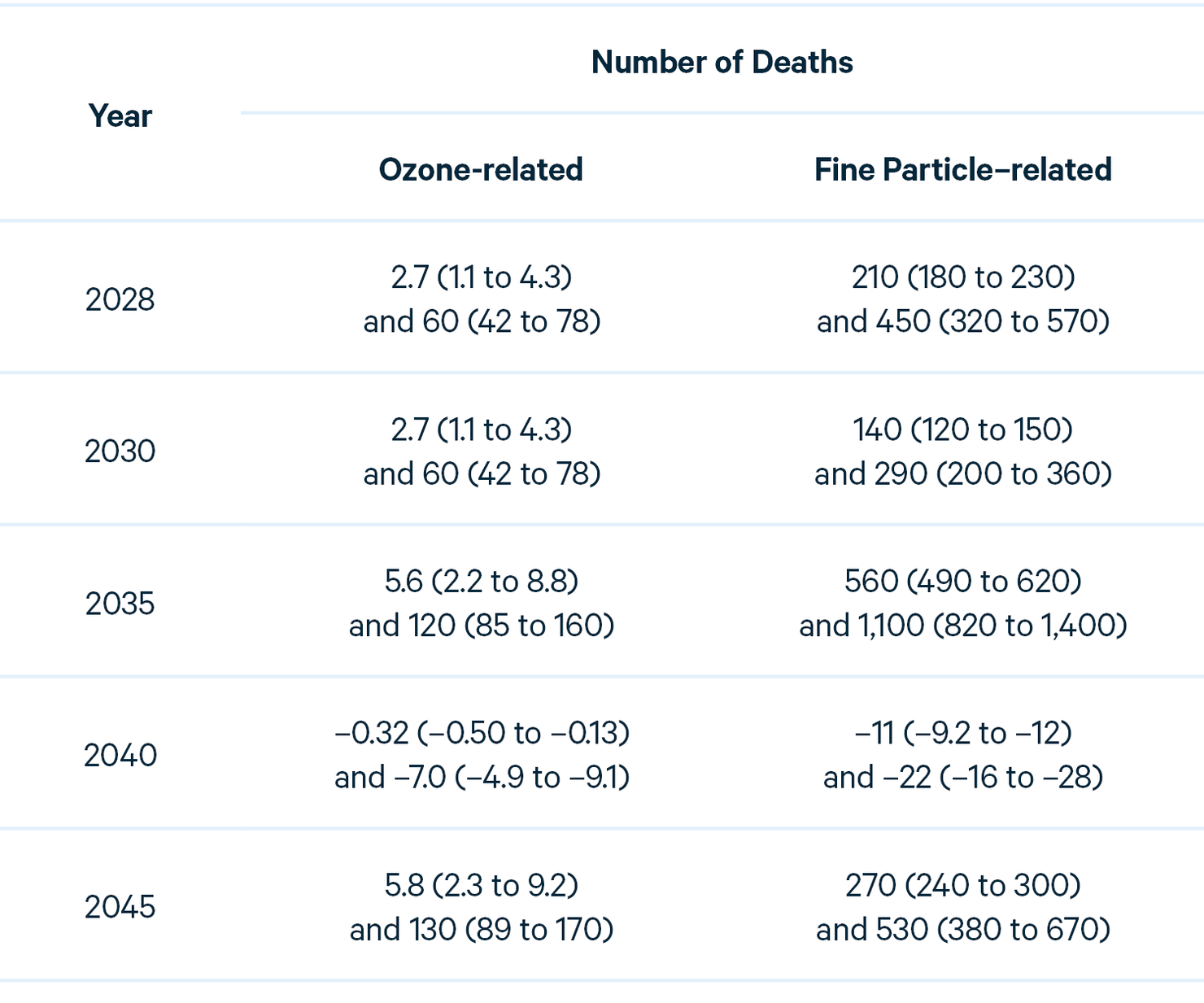
EPA’s 2025 proposed regulatory impact analysis (which EPA published before making its decision not to quantify health impacts) estimated that the proposed rollback would increase annual emissions of fine particulate matter by 1,000–2,000 tons, nitrogen oxides by 20,000–50,000 tons, and sulfur dioxide by 20,000–90,000 tons from 2028 to 2045. The 2025 analysis estimated that the resulting increases in human exposure to ambient ozone and fine particulate matter (comprised of fine particulate matter and fine particles formed through chemical reactions involving sulfur dioxide and nitrogen oxides) would result in substantial increases in premature death (Table 1).
Table 1: Estimated Increases in Mortality Related to Exposure to Fine Particles and Ozone
Source: US Environmental Protection Agency (2025) Proposed Regulatory Impact Analysis, Table 4-1
The two estimates in each cell are separate and do not represent estimates of lower and upper bounds. Each estimate is accompanied by a 95 percent confidence interval, represented by the range in parentheses. The first estimate in the ozone-related column represents short-term exposure risk, and the second estimate represents long-term exposure risk. For the estimates related to fine particles, both numbers represent long-term mortality risk from exposure to fine particulate matter with a diameter of 2.5 micrometers or smaller (PM2.5) but use different relationships between PM2.5 and mortality. The estimated number of premature deaths in each year is relative to a scenario with the 2024 rule still in place. The negative numbers for 2040 indicate a reduction in the number of deaths for that year.
These deaths in Table 1 are appropriate to include in regulatory impact analyses even when the deaths result from changes in air quality that are ancillary to the intended effect of the original rule, which was to limit greenhouse gas emissions. EPA’s 2025 analysis of the repeal of the Biden-era rule predicted increases in annual US emissions of carbon dioxide from 39 million metric tons to 123 million metric tons, depending on the year, through 2045. Notably, EPA during the current Trump administration provides estimates of the changes in greenhouse gas emissions with its rules, but the agency is not monetizing the change.
Considerations for Uncertainty
In 2025, EPA used three approaches to incorporate, in a limited way, the uncertainty associated with its quantitative estimates of health effects. These approaches included the use of alternative estimates of the mortality effects due to fine particulate matter drawn from two long-term cohort studies and the construction of confidence intervals around each risk estimate (Table 1). Hubbell and Krupnick recently showed that EPA’s approach to estimating health effects and its treatment of the associated uncertainty has been generally endorsed by a series of peer-review panels.
In its recent rulemakings, EPA uses language similar to that from its January rollback to defend its newfound concerns with, and departure from, its usual practice of providing estimates of health effects and the economic costs of new rules. EPA explains its new policy by stating that its prior approaches failed to address adequately the uncertainties associated with its health estimates. EPA states that it will no longer monetize health benefits, even for informational purposes, until the agency develops approaches to reduce uncertainties, submits approaches for peer review, and “the agency is confident enough in the modeling to properly monetize those impacts.”

Credit: V_E / Shutterstock
EPA can, however, improve its treatment of uncertainty without paralyzing its benefit-cost analysis. For example, EPA can develop quantitative estimates of health effects using alternative assumptions and scenarios regarding the effects on air quality—such as the way in which these pollutants affect health (e.g., different toxicity and threshold effects) and the value of reducing health and mortality risks. Fraas and Lutter showed in 2013 that standard assumptions in these cases all have large effects on the magnitude of estimated benefits, a point also examined by Evans in 2016. EPA’s recent practice of failing to provide quantitative estimates of the forgone benefits of its regulatory rollbacks is not a responsible way to handle uncertainty. This choice results in downplaying the associated adverse health and environmental effects of these rollback rulemakings.
Potential Solutions
The deliberative approach in both President Clinton’s Executive Order 12866 and President Reagan’s Executive Order 12291 sought to provide decisionmakers, Congress, and the American public with information on whether the benefits of rules justify their costs. Particularly for “mega-rules” with over $1 billion in annual economic impact, the American people, Congress, and federal courts have a right to know the expected health effects of EPA’s regulatory decisions, especially when those health effects are significant and adverse.
To maintain the tradition of transparency and rigor, EPA should conduct a regulatory impact analysis that includes a quantitative risk assessment—as required by the US Office of Management and Budget’s economic analysis guidelines for billion-dollar rules—of the adverse public health effects as the agency decides on the final rule for limiting greenhouse gas emissions from power plants. Barring that best practice and, potentially, with an eye toward preserving future regulatory rigor, Congress could require that EPA, for its billion-dollar rules, carry out both benefit-cost analysis before determining final rules and retrospective analysis after these rules have fully taken effect. Since compliance with such a requirement may be incomplete or untimely in this case, Congress could appropriate funds to direct the US Government Accountability Office or National Science Foundation to develop an independent economic analysis for this billion-dollar rule. Finally, Congress could make billion-dollar economic analyses judicially reviewable.
These requirements would serve to mitigate flip-flopping of major environmental regulatory initiatives with changes in presidential administrations.

For more timely insights about developments in environmental and energy policy, browse the If/Then series.