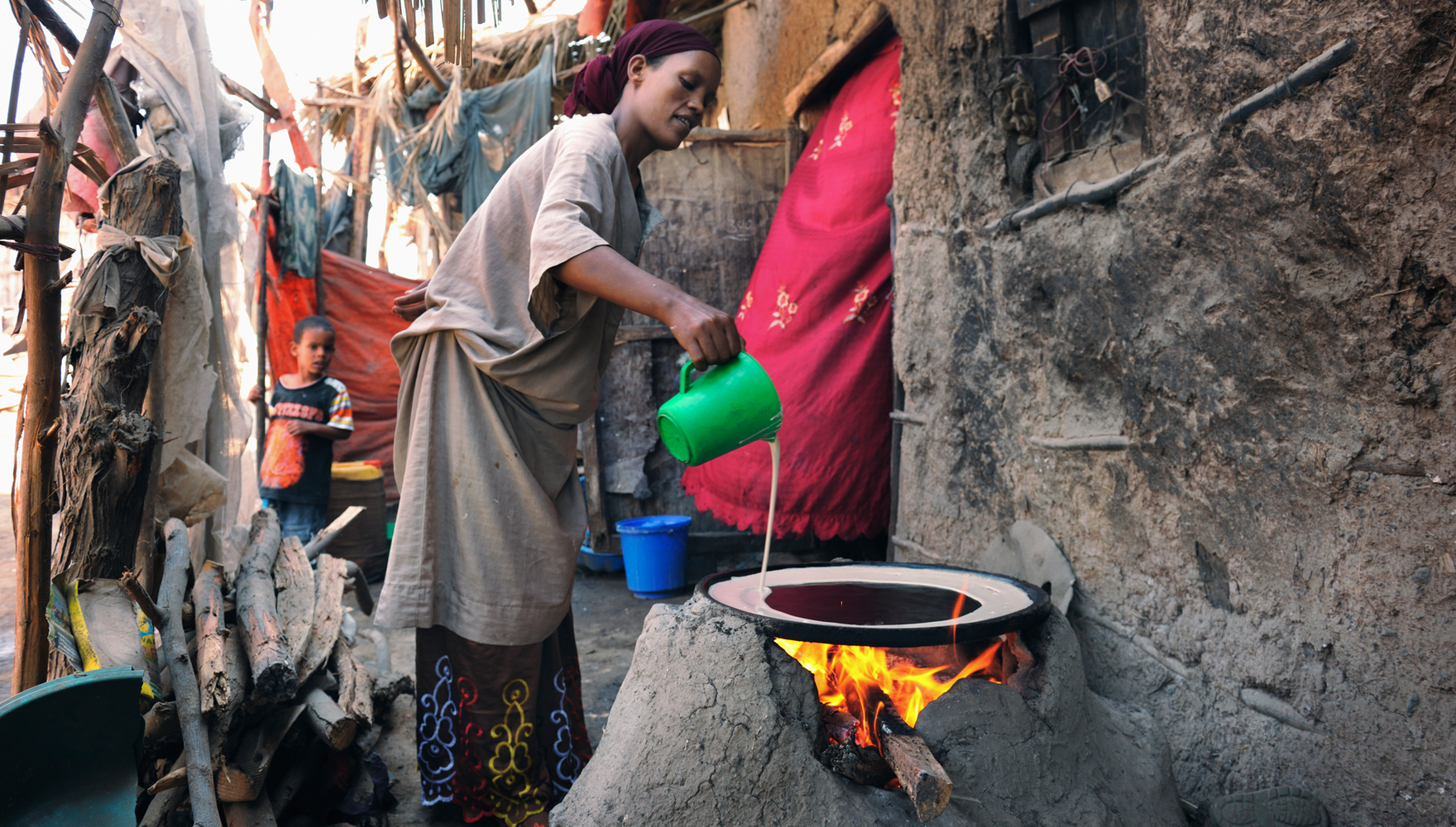

In this episode, Daniel Raimi talks with Susanna Berkouwer about their research on reducing the economic and environmental costs of energy access through a simple piece of technology: charcoal-burning cookstoves. Access to electricity is limited in low-income countries, which means that access to clean cooking in those countries is limited, too. Some areas of the world have shifted to using liquefied petroleum gas for their cooking, but Sub-Saharan Africa is trending toward higher use of biomass-burning cookstoves, which produce emissions that can harm human health and lead to local or regional deforestation. An assistant professor in the Wharton School at the University of Pennsylvania, Berkouwer and their colleagues applied a randomized experimental design with 1,000 households in Sub-Saharan Africa, aiming to see whether alternatives to charcoal-intensive cookstoves can reduce both the cost of energy and the negative environmental impacts. The conclusions are strong and striking: Corroborating results show that improvements in cookstove efficiency come with more efficient biomass use and cost savings, and the fiscal cost of subsidizing cookstoves is hundreds of times more efficient than other means of decarbonization. Berkouwer’s randomized study quantifies these gains in cost-efficiency, reductions in environmental pollution, and potential policy redundancies, opening up space for new climate solutions.
Listen to the Podcast
Audio edited by Rosario Añon Suarez
Notable Quotes
- A positive impact on pocketbooks and the environment: “For low-income households, probably the most noticeable dimension for charcoal is that it’s really expensive. You see this relationship even within the United States, where low-income families spend the largest proportion of their income on their energy needs … The idea is that if we can find ways to reduce charcoal consumption, that would both help folks save money on their daily expenditures—and it would reduce some of those deforestation rates that are contributing to climate change.”
- Measuring the cost-effectiveness of subsidies: “What we found was that to abate one ton of CO₂ [carbon dioxide] requires around $7 in subsidy expenditure. If you’ve read about the cost of abating with other technologies, that might seem like a really, really low number—and it is. Many estimates (for example, about the Inflation Reduction Act abating CO₂ through electric vehicle subsidies) found that it takes over $1,000 or even $2,000 in subsidy expenditure for every one ton of carbon that’s abated. We find $7 per ton of CO₂. It is hundreds of times more cost-effective … If you flip those numbers, we see that if you spend $1 million subsidizing clean cookstoves, you would abate hundreds of times more CO₂ than if you spend $1 million on electric vehicle subsidies.”
- Designing policy with measurably cost-effective subsidies: “In the group where we did not give a very large subsidy (so, the price was still pretty high), we found that around 8 percent of people bought the improved stoves. When we gave a larger subsidy, we found that 48 percent of people bought the improved stove … of that 48 percent of people who bought the stove with the high subsidy, 8 percent of them would’ve bought it with the low subsidy … We can account for that in our subsidy-efficacy calculations.”
Top of the Stack
- “The Cost-Effectiveness of Clean Cookstove Carbon Mitigation After Adjusting for Additionality and Impact” by Susanna B. Berkouwer and Joshua T. Dean
The Full Transcript
Daniel Raimi: Hello, and welcome to Resources Radio, a weekly podcast from Resources for the Future. I’m your host, Daniel Raimi. Today, we talk with Dr. Susanna Berkouwer, assistant professor at the Wharton School at the University of Pennsylvania, and a faculty research fellow at the National Bureau of Economic Research. We’ll talk about recent work that Susanna has published that uses an experiment to measure the effects of cleaner cooking technologies in Sub-Saharan Africa. I’ll ask them to describe how using these technologies can reduce health impacts and carbon dioxide emissions and how subsidies can help people get access to clean cooking at very low cost. Stay with us.
All right, Susanna Berkouwer from the Wharton School at Penn. Welcome to Resources Radio.
Susanna Berkouwer: Thanks so much. I’m glad to be here.
Daniel Raimi: We are glad to have you. I’m really excited to talk to you about some recent research you’ve published on the show today about cookstoves. But before we get into the details, can you tell us how you got interested in working on energy and environmental issues in the first place?
Susanna Berkouwer: Absolutely. I think climate change is obviously one of the most defining challenges of our time. And when you think about a lot of the environmental policies and businesses and NGOs that have been operating in the past several decades, a lot of focus has been on the United States, Canada, Europe—the OECD [Organisation for Economic Co-operation and Development], really. And I thought that this was interesting, because the majority of the world’s population really lives in low- and middle-income countries, and these are going to be generating the majority of growth in energy demand in the next several decades.
So, trying to understand the challenges in these regions that have really received much less focus when we think about things like carbon taxes or new energy subsidies: What are the impacts when you implement them in low- and middle-income countries? What are their needs? How do their economies differ from OECD or high-income economies? And how do we need to adapt those policies that we’ve seen in higher-income countries to be effective in lower- and middle-income countries?
And a second aspect to this is, of course, you’re also dealing with really high rates of poverty, and economic growth is really important for people who don’t have access to some of the resources that higher-income countries have access to. So, it adds a second layer of this problem, where you’re both trying to mitigate climate change while also respecting that fighting poverty is a real need that needs to be met and recognized in order for us to really do anything on the climate change front.
Daniel Raimi: Right. Yeah, fighting poverty and enabling access to clean energy, which is kind of what we’re going to talk about today.
Susanna Berkouwer: Exactly.
Daniel Raimi: So, in the United States and in the European Union and other developed, high-income countries, we’re used to cooking on ranges with natural gas or electricity, but billions of people around the world don’t have access to those technologies. They don’t have stoves in their houses. So, what are the types of things that those folks do to cook their food, and what are the implications of using those technologies for people’s health and their well-being?
Susanna Berkouwer: Absolutely. Billions of people across the world don’t have access to electricity or don’t have access to gas in their homes. So, the most common alternative is to use biomass. By biomass, I mean something like firewood or charcoal.
There’s been a really big push away from biomass; for example, in South Asia and Southeast Asia, where people are switching to LPG (or liquefied petroleum gas). That’s now really common in a lot of places. It’s a lot cleaner than wood or charcoal, but still more than a billion people are continuing to use wood or charcoal to cook basically all of their meals on a daily basis.
For people cooking with firewood, what they’ll oftentimes do is walk around their neighboring areas and gather firewood for free. In urban areas or towns, people will buy charcoal. And charcoal is still produced from trees, usually within the same country, or at least nearby.
The consumption of firewood, whether through gathering firewood or charcoal, has really negative effects across a range of dimensions. For low-income households, probably the most noticeable dimension for charcoal is that it’s really expensive. You see this relationship even within the United States, where low-income families spend the largest proportion of their income on their energy needs. We see that people spend between 10 and 20 percent of their daily income just buying charcoal every day in order to be able to cook their foods. So, there’s this huge expenditure aspect to it. It’s also unhealthy. They create a lot more smoke than cooking with gas, or especially cooking with electricity.
But what we’re really interested in, as well, is the impacts on the environment. It’s obvious that forest deforestation rates are really high in areas where the vast majority of the population relies on firewood or charcoal for cooking. That deforestation has massive CO₂ [carbon dioxide] implications and really contributes to climate change.
Because there’s these two main aspects that we’re studying—the cost aspect and the environmental aspect—the idea is that if we can find ways to reduce charcoal consumption, that would both help folks save money on their daily expenditures, and it would also reduce some of those deforestation rates that are contributing to climate change.
Daniel Raimi: Great. And am I right in thinking that the largest group of people who don’t have access to clean cooking is in Sub-Saharan Africa? You mentioned that there’s been a lot of progress on this in South Asia, and I’ve read about that in India, but where globally are these issues concentrated?
Susanna Berkouwer: That’s absolutely true.
If you look at maps from 10 or 20 years ago, you would see a broader range in Latin America and in parts of Asia. And then you see these rapid, remarkable declines in those areas toward LPG cooking, which has really taken off. But in Africa, especially Sub-Saharan Africa, there continues to be an increase in the number of people cooking with firewood and charcoal every year.
Daniel Raimi: Thank you. Let’s talk now about the paper that you published recently. The paper is called The Cost-Effectiveness of Clean Cookstove Carbon Mitigation After Adjusting for Additionality and Impact. We’re going to talk about what that title means, and people can check it out. We’ll have a link to it in the show notes.
Tell us a little bit about this study. How did you design it, and how did you implement it?
Susanna Berkouwer: Absolutely. We used a standard method of research, which we call a randomized trial, where we initially enrolled 1,000 households in Nairobi, and then we randomly assigned different subsidies for improved stoves.
What was neat about this is that the improved stoves were also charcoal stoves. So, at baseline households were already using charcoal stoves, but more of the ones that are standard in Kenya.
And then we offered them the opportunity to buy an improved charcoal stove. Everybody was offered this opportunity, and the thing that we randomized was the price at which people could buy the improved stove. Of course, as you can imagine, a much higher percentage of people bought the stove when they were given a lower price. We can use that source of random variation to then compare buyers and non-buyers of the stove.
Daniel Raimi: Got it. And where geographically did you do this?
Susanna Berkouwer: Yeah, so this is in Nairobi, the capital city of Kenya, and we worked in four low-income neighborhoods (kind of informal settlement regions), which are pretty densely populated areas. There’s not a lot of forests nearby, so people are not gathering firewood. They’re really primarily buying charcoal from regions nearby.
Daniel Raimi: Got it. Okay. Tell us about what you found.
Susanna Berkouwer: Yeah, so there’s kind of two aspects of our findings. The first is the impact of buying the stove. The second is: If you spend subsidy money, what happens to people buying the stove?
Let me start with the first one. What we find is that people who buy the stove see a 40 percent reduction in how much charcoal they use every day. Primarily, this is because the improved stoves are constructed using better materials. There’s better heat insulation. The pieces fit better together. It’s produced in a factory in Nairobi.
So, the engineering of it is that you only need 40 percent of the charcoal to reach the same cooking temperature for whatever meal you’re trying to cook. (That was the engineering estimate that we had been given before by the company.) And that’s also what we found through a host of different surveys.
We asked people one month after they bought the stove, a year after they bought the stove, three years after they bought the stove. We followed up numerous times, and we asked people who bought the stove (and also people who didn’t buy the stove) how much they’d been spending on charcoal. We found that the people who had bought the improved stove spent 40 percent less on charcoal.
We also measured this through phone surveys during COVID when we couldn’t visit people in person. We also deployed PurpleAir devices, which measure particulate matter. A lot of people in the United States are using those devices. We deployed them with the households in our study. And we also found that during the morning hours and the evening hours when people are cooking, we found a 40 percent reduction in the amount of PM2.5 that the PurpleAir devices captured.
Finally, we also gave every household a bucket. We said, “When you’re done cooking every day, instead of just throwing out the ash from your cookstove, dump the ash into that bucket.” They did that for a month. And then, at the end of the month, we weighed the amount of ash in the bucket. And again, we found a 40 percent reduction in the amount of ash that had been generated by the burning of charcoal, which again indicates a 40 percent reduction in the amount of charcoal that was used.
So, the fact that all of these measures that were independently collected—that they all point to a 40 percent reduction in charcoal usage made us quite confident in that reduction.
Daniel Raimi: Yeah, that totally makes sense.
Susanna Berkouwer: So that’s the impact side.
The other side of it is: When you give a subsidy, how does that actually change how many people own the stove and for how long they own the stove? So, an important part of our follow-up surveys one year after, and three years after, was: In the group of people who bought the stoves, how many still had them three years later, and how many were still using them? Also, in the group that originally didn’t buy the stoves, how many did end up buying them later on? That kind of difference, we thought was really important in terms of the subsidy efficacy.
Because we randomized the subsidies, we can say exactly: With the high subsidies, this many people buy the stove. With the low subsidies, this many people buy the stoves. And then you can compare: For every dollar of additional subsidy that you spend, how many more stoves do you sell? When you then combine all of these different measures, you have: When you spend a dollar of subsidy, how many more people buy stoves, how many more years do they own them, and then how much CO2 is reduced for every year that they own? We found a significant, a really cost-effective, manner for abatement here.
Daniel Raimi: Can you say a little bit more about that? What did you find in terms of CO2 abatement? How costly was it? How does it compare to the cost of other policies that people implement around the world?
Susanna Berkouwer: What we found was that to abate one ton of CO2 requires around $7 in subsidy expenditure. If you’ve read about the cost of abating with other technologies, that might seem like a really, really low number—and it is.
So many estimates (for example, about the Inflation Reduction Act abating CO2 through electric vehicle subsidies) found that it takes over $1,000 or even $2,000 in subsidy expenditure for every one ton of carbon that’s abated. We find $7 per ton of CO2. It is hundreds of times more cost-effective.
Electric vehicles are particularly expensive, but the comparison is similar, albeit a little bit muted when you think about things like solar panel subsidies or energy-efficiency appliance subsidies, as well. So, if you kind of flip that cost number around, you can also ask: If you were to spend $1 million subsidizing clean technologies, what would the benefit be for the climate?
If you flip those numbers, we see that if you spend $1 million subsidizing clean cookstoves, you would abate hundreds of times more CO2 than if you spend $1 million on electric vehicle subsidies.
Daniel Raimi: Another data point that might be useful for folks when thinking about cost-effectiveness is the social cost of carbon, which RFF has done a lot of work on. There’s a lot to debate about what the right number is for the social cost of carbon, but some of the estimates that you see in the literature are on the order of $200, $250 a ton, maybe higher depending on what you’re studying. So, $7 per ton really looks like a great deal when you compare it to these other numbers.
Susanna, you’re certainly not the first person to study this issue. There have been people looking at clean cooking for a long time and trying to measure its effects, both in terms of health and in terms of CO2 mitigation. How does your analysis compare to previous work that’s been done in this area?
Susanna Berkouwer: I think there’s two comparison groups. One is with other cookstove studies, and the other is with green technologies more generally.
Our results are more promising than many other cookstove studies. You might’ve seen in the news, recently, research documenting that many cookstove projects are not as effective as they claim to be. I think that’s absolutely true. I just think that there’s differences between different projects, right?
Some cookstove companies make really great stoves that are really effective, and some cookstove companies make less good stoves that don’t work as well. The key is in identifying which are the high-quality cookstoves. The company that we worked with, called BURN Manufacturing (or ECOA), they’re headquartered in Kenya. The way that I describe it is they’re just like a very good company, like Apple or like Google.
Why do people use their products? It’s just a great product. They’ve done a lot of R&D, they’ve done a lot of customer research, and they’ve made a product that people really like to use. I think the cookstove that we study is in that category. People really like to use it. It works very well. It saves them money, and that’s probably the really straightforward reason for why it works better than many other cookstove projects.
The other comparison is with electric vehicle subsidies in the United States, and you might wonder, Why is there such a big difference in cost-effectiveness between, let’s say, US electric vehicle subsidies and Kenyan cookstove subsidies?
I think there’s two reasons for that. The first is that the technology is a lot cheaper for the same CO2 reductions. I think a lot of people will be surprised to hear that if you think of an American household using their gasoline car for one year for an average amount, according to EPA [US Environmental Protection Agency], for an average vehicle that has some amount of miles per gallon, they emit around four to five tons of CO2 per year.
When you compare that with a Kenyan family that uses their charcoal stove for a year, the amount of charcoal that they use when you quantify that into CO2, it’s also around four or five tons of CO2 per year. So we’re comparing really similar emissions per household in terms of that one technology—the gasoline vehicle and a charcoal stove. But of course, an improved charcoal stove is much cheaper (around $40) than an electric vehicle (perhaps $40,000). One aspect of it is that the technologies themselves are just incredibly different.
And then, I think a second difference is a little bit more of an economics difference. I have done some research on this more recently, documenting that in the United States, there’s really good financing for vehicles. The majority (80 percent) of vehicles in the US are sold with financing. So, anybody who would save money with an electric vehicle is already able to buy one, especially if they want financing.
Whereas in Kenya, financial systems have a lot more of what we would call “market failures.” So, information asymmetries—lenders have a harder time identifying who’s a good borrower or a bad borrower. There’s no FICO scores. There could be people who would really want to use the improved stove, who would abate a lot of CO2, but who are currently not able to buy it because of those credit-market failures. So I think there’s also just underlying features of the economic differences that contribute further to the difference in abatement cost.
Daniel Raimi: That is all really interesting.
One topic that you focus on for a portion of the paper is what economists refer to as “inframarginal subsidies.” An inframarginal subsidy is a subsidy that goes to someone who would’ve done the thing anyway. For example, a wealthy person in the United States might not actually need a subsidy to buy an electric vehicle, but they could get a subsidy anyway under the Inflation Reduction Act. That would be an inframarginal subsidy—and you measure this in your analysis.
When you looked at this issue, what proportion of study participants would’ve bought a cookstove even without the subsidy, and what does that imply for policymakers when they’re thinking about implementing a policy like this?
Susanna Berkouwer: Yeah, absolutely. You’re right on the money that inframarginal adoptions is a really big concern—you’re spending subsidy money on people who would’ve bought the technology even if you hadn’t given them a subsidy. It’s really wasted subsidy dollars.
What we found in our study is we could compare the high-subsidy group and the low-subsidy group because we had randomly assigned them—we knew that there was no difference there.
What we saw was: In the group where we did not give a very large subsidy (so, the price was still pretty high), we found that around 8 percent of people bought the improved stoves. When we gave a larger subsidy, we found that 48 percent of people bought the improved stove. First of all, that’s a big increase, right? Price really matters here. When you lower the price—when you give a larger subsidy—you see a big increase in the fraction of people who adopt the stove.
But also we can account for the fact that of that 48 percent of people who bought the stove with the high subsidy, 8 percent of them would’ve bought it with the low subsidy. So, we can account for that. We can say, “Okay, of that 48 percent, 40 percent are really not inframarginal—40 percent really needed that additional subsidy, and 8 percent were inframarginal.” We can account for that in our subsidy-efficacy calculations.
Daniel Raimi: Right. That makes sense. And that’s the beauty of the randomized controlled trial—you can do that sort of thing.
One other thing that I was wondering about as I was reading your study is just about people’s preferences for cooking technologies. In the United States, people use charcoal grills to cook outdoors, even though there might be smoke blowing in their face. Or they might cook marshmallows over an open fire when they’re camping, even though there’s smoke getting in their face and burning their eyes and harming their lungs.
So, I’m curious: To what extent do you think cultural preferences might prevent the adoption of cleaner cooking technologies, either with the specific technology that you were looking at, or other technologies like LPG?
Susanna Berkouwer: That’s a great question. Food is so near and dear to our hearts. It’s really difficult to get people to switch what foods they eat. It’s really an uphill struggle. So, if a cookstove doesn’t allow you to cook the food that you like to eat, it’s really difficult to convince people to switch.
I think the importance here—in recognizing that there’s different technologies, and the solution when we think about it at the large scale, what do we want the cooking transition to look like—is it’s going to look different in different places.
For many people who are currently using traditional charcoal stoves, the first step that is easiest for them, in terms of the transition, is toward an improved charcoal stove. We actually found that in our study, the stoves are so similar in terms of how you use them—the taste is the same; they look the same. People literally that same day could switch from the old stove to the new stove. So, that’s a technology where the switch is really easy, the usage is the same, you don’t have to learn anything, your food doesn’t taste different—and that’s a really nice advantage of that type of technology.
Recently, we completed a study in a similar area in Nakuru County in Kenya, a couple hours north of Nairobi, and we studied electric stoves there. What we found was that, for people who buy induction stoves, they’ll shift around 50 percent of their cooking onto the induction stove, but they’ll keep around 50 percent of their cooking on the charcoal stove. There’s certain foods that just taste better when you cook them over charcoal, and people prefer to cook with that, even if it may cost a little bit more money, or it takes a little bit more time than an induction stove. And part of that is preferences, but part of that is also for some dishes, you want to let them simmer for three hours. And so you can light a little bit of charcoal and let that charcoal slowly burn out, and you can let your stew simmer for three hours. Whereas for something like boiling water, that can be done in three minutes on an induction stove, and so you turn it on, and three minutes later you just turn it off.
So, part of it is preferences, part of it is just the suitability to different types of foods.
But I think really what we are interested in is in the aggregate. When people make these transitions, what is the reduction in CO2 emissions that you see? Again, we think that requiring people to fully switch 100 percent to electric stoves is a really ambitious target that maybe this year is difficult to implement and to achieve, partly also because there’s power outages and voltage fluctuations. At least you can get that 50 percent shift, and then you can think about how to achieve the remaining 50 percent shift, as well.
Daniel Raimi: Yeah, really interesting stuff. Let me ask you, Susanna, one more question before we go to Top of the Stack, which is about financing. You mentioned financing earlier and how it can be challenging for people to have access to financing in many parts of the developed world. What are some of the strategies that you think could be adopted either by the public sector or the private sector to make financing more available, so that people can adopt these types of cleaner technologies?
Susanna Berkouwer: What we studied was individual financing—offering an individual household, let’s say, a loan to buy the stove. But that is really expensive to administer. If you’re the one lending out the money, you have to track repayments, you have to remind people to repay, you have to set up a whole payment-management system. So, when you do the calculations, given the benefits of the improved stoves, it actually makes a lot more sense to just subsidize the stoves.
And that’s actually what the company has done. Given the research they’ve been able to share with investors and philanthropists, they’ve been able to secure subsidies so that, even though the improved charcoal stove costs around $40 to make, they sell it for around $10 because of the green subsidies that they get. That financing flow is going to the company that makes the stoves, rather than flowing to the individuals, because if you try to flow it to the individuals, it comes with much higher screening and information requirements.
By and large, if we want to expand access to these technologies at scale, the way to do that is to work with companies that have the capacity to expand their manufacturing and their sales throughout the African continent to give financing through a variety of vehicles. Different cookstove companies have secured financing through different vehicles, whether that’s through multilateral investment banks, through private-sector investments, through philanthropists, or on the carbon-offset market—and then for individual companies to then be able to implement subsidies on their products so that they can then disseminate them at scale to individuals.
Daniel Raimi: Really interesting. Yeah, I was thinking about the carbon-market angle. We’ve talked about that topic before on the show, and it’s just another reminder that there is such a wide range in the quality of carbon offsets that people can purchase. We’ve all heard the sort of horror stories about fake carbon offsets. It sounds like these are some pretty legit ones.
Susanna Berkouwer: Yeah, it’s kind of a classic lemons market, where if you’re an investor, you maybe don’t have information about which cookstove projects are high quality and which cookstove projects are low quality. What we’re showing with our research—and if you’re really interested in that, you could take this randomization model and apply it pretty straightforwardly to really any cookstove project.
What we would advocate in a carbon offsets–framework setting, for example: instead of applying a blanket discount rate or other rates that are being applied uniformly across projects, let’s require independent evidence, or independent measurement and verification, so that we can set what is the additionality for this particular product, what is the abatement for this particular project, and then apply those rates specifically. I think that’s probably going to be a much more effective way to go about it, because that allows the market to identify the highest-quality products, and that allows those products to attract all of the investment.
Daniel Raimi: Yeah, absolutely. Plus, more cool work for experimental economists. What could be better?
Susanna Berkouwer: I’ll take it.
Daniel Raimi: Great. Susanna, this has been really fascinating. I’ve learned a ton about these technologies on the show, and I know our listeners have, too.
I’d love to ask you now the same question we ask everybody who comes on the show: to recommend something that you think is really great, that you think our audience might enjoy. It could be a book, movie, TV show, or really whatever. So, what’s at the top of your literal or your metaphorical reading stack?
Susanna Berkouwer: I was thinking about this, and I’m going to give perhaps a very boring answer. But I think what a lot of people don’t know: When you try to access articles online and there’s a paywall, almost always the author of the article (especially if they’re an economist, because in economics, it’s a standard), you could just go to the author’s website, and they’ll have the article there. And they’ll also usually have short write-ups or two-page summaries or something that summarizes the work that they’ve done.
So, instead of reading coverage by journalists or other outlets to access information that way, you get access to learning what the relevant papers are. But if you really want to get the details, go to the author’s websites, find the papers, look at them directly, look at them for yourselves, look at the graphs that they’ve made. And if you don’t want to look through a whole academic article, which I totally understand, find the two-page summary that they’ve written and read that, because often that’ll get you a lot closer to what they actually can and cannot show in the research than reading about the article from a news outlet, let’s say.
Daniel Raimi: Yeah, great recommendation—especially for young researchers and students who may not have access to all of the journals that are out there and that are often behind paywalls. So, great recommendation.
One more time, Susanna Berkouwer from Penn, thanks so much for coming on Resources Radio and sharing your work with us. We really appreciate it.
Susanna Berkouwer: Thanks so much for having me.
Daniel Raimi: You’ve been listening to Resources Radio, a podcast from Resources for the Future, or RFF. If you have a minute, we’d really appreciate you leaving us a rating or a comment on your podcast platform of choice. Also, feel free to send us your suggestions for future episodes.
This podcast is made possible with the generous financial support of our listeners. You can help us continue producing these kinds of discussions on the topics that you care about by making a donation to Resources for the Future online at rff.org/donate.
RFF is an independent, nonprofit research institution in Washington, DC. Our mission is to improve environmental, energy, and natural resource decisions through impartial economic research and policy engagement. The views expressed on this podcast are solely those of the podcast guests and may differ from those of RFF experts, its officers, or its directors. RFF does not take positions on specific legislative proposals.
Resources Radio is produced by Elizabeth Wason with music by me, Daniel Raimi. Join us next week for another episode.