On Earth Day, the Vice President for External Affairs at Resources for the Future reflects on seven decades of research and policy impact.
As the world celebrates the 56th annual Earth Day this Wednesday, April 22, Resources for the Future (RFF) leadership and staff have been reflecting on the role of RFF and our contributions to the broader environmental movement. The theme for Earth Day 2026 is “Our Power, Our Planet,” which the organizers describe as:
“reflecting a fundamental truth: environmental progress doesn’t depend on any single administration or election. It’s sustained by daily actions of communities, educators, workers, and families protecting where they live and work.”
While not explicitly mentioned, I would argue that our institutions, particularly in civil society, have one of the most important roles in environmental progress. Nonprofits; foundations; professional associations; universities; and, yes, think tanks like RFF bring communities and individuals together in coordinated action. For the slice of civil society that focuses on the environment, every organization has a unique and critical role to play.
RFF’s role, as the oldest environmental economics think tank in the country, is to improve environmental, energy, and natural resource decisions through impartial economic research and policy engagement. Our values—balance, rigor, independence, respect, and results—have guided the way we do our work.
In particular, our power (alluded to in the theme of Earth Day 2026) is embedded in the values of balance, rigor, and independence, which have allowed RFF to be a trusted voice across political parties, borders, industries, and communities over the last seven decades.

Rigor: Adhering to the highest scientific and professional standards.
The truth matters more than ever in today’s hyper-polarized political landscape. And from the beginning, RFF has been laser-focused on adhering to the highest scientific and professional standards. Each day, RFF researchers are using cutting-edge modeling, economic, and social science techniques to get as close to the truth as they can. We never begin a research project with a result in mind. We always follow the numbers.
Climate change has very real and devastating impacts on the lives of people in the United States and around the world. We can’t afford to get it wrong. That’s why policymakers need an accurate, nuanced picture of the potential solutions to climate change. Just as science is crucial for understanding the real impacts of climate change, our rigorous economic research is essential for understanding the impacts of different climate policies on our planet, economies, and communities.
Balance: Improving both environmental and economic outcomes.
Another key ingredient of RFF is our focus on both the environment and the economy. People’s livelihoods matter. The well-being of our communities is at the front of our minds when developing RFF’s research agenda. We recognize that building a healthy environment and thriving economy is not an easy task. While reducing emissions is essential for the well-being of our planet, much of today’s economy is reliant on fossil fuels, and many communities are at risk of being left behind in the energy transition. That’s why our research is dedicated to finding solutions that tackle climate change, make energy affordable for everyday Americans, and take into account the costs and benefits of policy decisions on our economy. Not only is this approach necessary for communities, but it’s necessary to create broad support for addressing the climate challenge.
Independence: Preserving nonpartisanship, integrity, and trust.
Our approach also ensures that RFF research can bring environmental priorities into boardrooms, city councils, state houses, and federal legislation and regulations. We raise the visibility of environmental issues in two ways. The first is by pursuing research that is timely, policy relevant, and solutions oriented. When RFF develops a research agenda, we work with our researchers, supporters, and partners to find an equilibrium between the policy zeitgeist and long-term exploratory research on policies not yet in the mainstream. The second is by garnering respect across the aisle through our nonpartisan approach. Following the truth allows us to get through to people that other environmental organizations may have a hard time reaching.
Examples from Our 75-Year History
RFF turns 75 next year, making our organization the oldest think tank dedicated to environmental and natural resource issues in the United States. Throughout that time, RFF has used the values above to guide the organization through massive global changes and make real progress on myriad issues.
The following are a few case studies of RFF’s impact since 1952. While the organization played a role in each of these cases, RFF researchers did not act alone. These policy changes were possible only because of the combined efforts of communities, advocacy groups, policymakers, and other research organizations. Let’s look at a few times when RFF’s unique contributions helped the environmental community make real progress.

A collage of photos from RFF’s early history.
Developing the Economic Case for Environmental Protection (1950s–1970s)
In the early days of RFF, the institution was at the forefront of the nascent field of environmental economics, even before the Clean Air Act of 1970 and the first Earth Day. RFF scholars such as Allen Kneese, Blair Bower, and others were among the first researchers who were dedicated to understanding the economic harms of air and water pollution. In a 1962 issue of Resources magazine, Kneese argued that pollution poses a threat to people’s lives and economies not only when large accidents occur:
“The occasional instances of deathly gases enveloping a city do not begin to define the magnitude of the problem. The greatest health problems and the greatest property damage appear to arise from persistent exposure at a great many scattered locations.”
This emphasis on the impacts of persistent exposure would later become the focus of air-pollution regulations from the US Environmental Protection Agency. The idea of quantifying the economic damage of pollution and potentially using those costs to develop policy was brand new. RFF was its champion.
At first, this idea of using economic benefit-cost analyses in environmental policy was not popular. It took a few decades for the idea to catch on in policy circles. But RFF stuck with it, because we viewed benefit-cost analysis as an important tool in improving the environment. This effort led to real change. As RFF’s Wallace E. Oates wrote in 1999,
“RFF has played an important role in this evolution [of including economics in environmental policy]. From the beginning, RFF reached the policymaking community not only through research, but through determined and patient efforts to make available and accessible to the general public not only research findings but, more generally, the basic economic principles of policy analysis and design.”
Now that the principles of environmental economics were in the mainstream, it was time to move from theory to practice.
Using Economics to Address Acid Rain (late 1980s–1990s)
In the late twentieth century, acid rain was burning through US forests, eroding infrastructure, and threatening human health. RFF took aim at the main cause of this problem—sulfur dioxide—and applied an approach that would become an RFF trademark.
RFF researchers designed an approach in which the federal government set a cap on the amount of sulfur dioxide that could be emitted each year. Then, polluters could purchase “allowances” which permitted them to emit a certain amount of sulfur dioxide, but at a price commensurate with the costs of acid rain. This approach became known as cap and trade.
After deep engagement with both Democrats and Republicans in Congress and President George H. W. Bush, the Clean Air Act of 1990 empowered the US Environmental Protection Agency to create such a cap-and-trade system to target sulfur dioxide. This effort, based largely on RFF research, led to massive reductions in sulfur dioxide emissions and acid rain. By 2022, wet sulfate deposition—an indicator of acid rain—had dropped by over 70 percent since 1989.
Because of RFF’s rigorous research, economic focus, and ability to work across the aisle, the organization has been able to build on gains made by the environmental movement to provide policymakers with the right information at the right time.
Crafting Nonpartisan Solutions to Reduce Greenhouse Gas Emissions (Today)
In the twenty-first century, RFF is applying a similar approach to a suite of new issues—from insurance markets and natural disasters to electricity affordability and international climate policies. However, the world today is not the same as it was in the 1990s. RFF is constantly adapting to the new political and environmental realities, while maintaining the core values that allow RFF to contribute to the larger movement.
Bipartisan consensus around applying policies like cap and trade to greenhouse gases evaporated in the mid- to late-2000s. This left RFF at a bit of a crossroads. But instead of engaging in a partisan fight over climate change legislation, RFF embraced flexibility. We targeted our efforts toward the places and policies that were likely to gain the most traction, while still aiming to improve the US climate and economy.
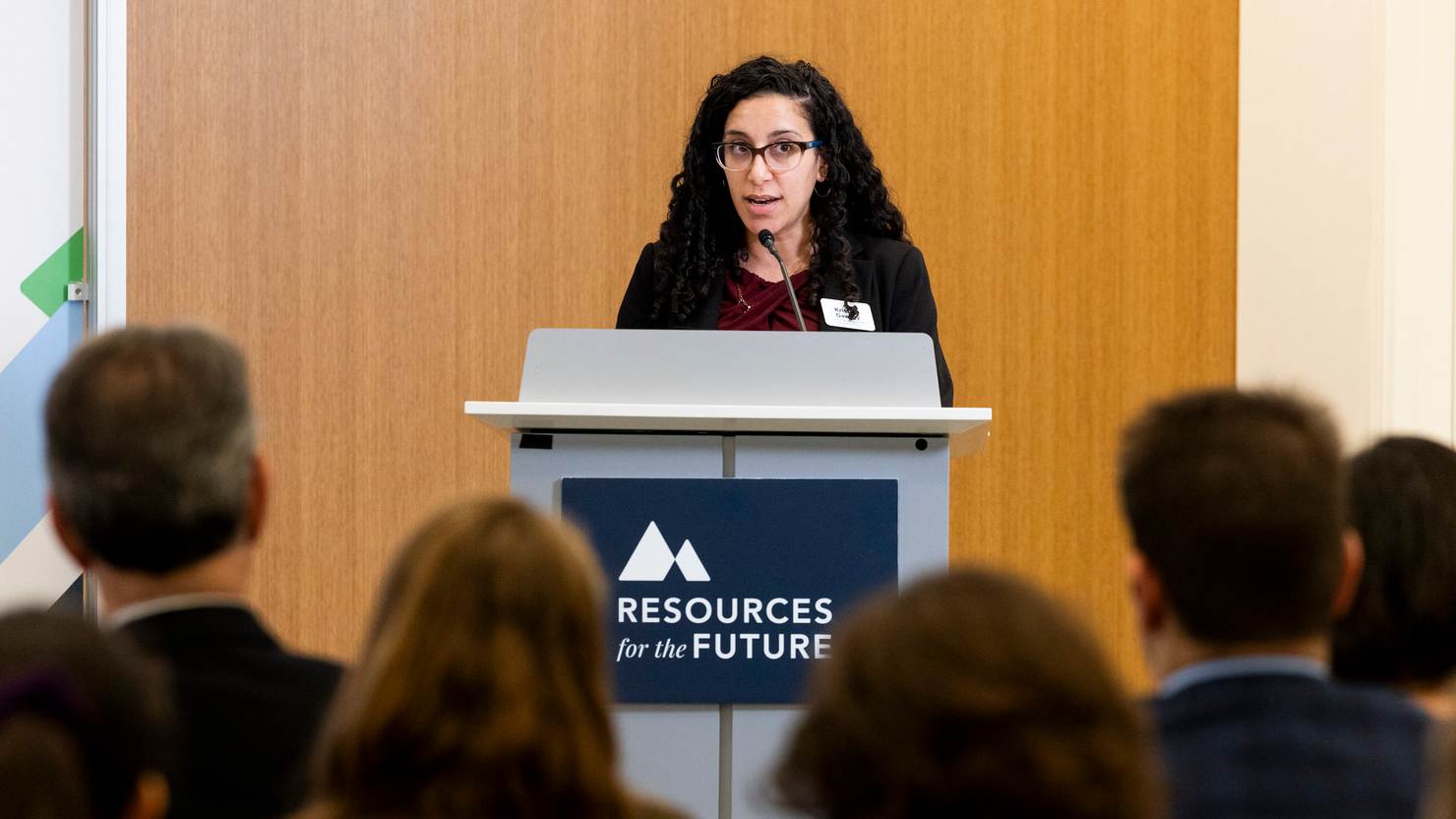
RFF Vice President for External Affairs Kristina Gawrgy speaks to attendees of RFF’s Big Decisions 2026 event on January 14, 2026.
RFF turned our focus to US states for carbon pricing policies like cap and trade, as state governments became the new laboratory for climate policy. In the past few years, our research has helped inform policy design for carbon pricing programs in California, Connecticut, Delaware, Maine, Maryland, Massachusetts, New Hampshire, New Jersey, New York, Rhode Island, Vermont, Washington, and other states. Today, RFF is helping policymakers in these states think about their carbon pricing policies in the context of affordability, as costs rise for everyday Americans.
Much of our state-level work is not done in a vacuum. Instead, as this year’s Earth Day theme beautifully illustrates, our research is done in concert with other groups that are working toward a healthier environment. RFF always looks to collaborate with local organizations that know their communities better than anyone else. For example, we partnered with the New York City Environmental Justice Alliance to analyze the effects of different proposals for the implementation of a cap-trade-and-invest policy as part of New York’s Climate Leadership and Community Protection Act. The New York–based organization provided us with invaluable information and guidance that helped RFF target our rigorous and independent research process toward solutions and policy ideas that were important to people on the ground.
At the federal level, RFF applies our rigorous, independent approach to policies that come up in bipartisan conversations. For example, RFF’s Obstacles to Energy Infrastructure Project brings together experts and policymakers to identify the best ways to remove barriers to clean energy development. With increased electricity demand from data centers and the rising cost of electricity, we are seeing growing interest in RFF’s trusted voice on power-sector issues. Another area of bipartisan interest is the intersection of climate and trade. Both Democrats and Republicans have used RFF research to inform their proposals on a carbon border adjustment—which would place a tariff on imports with high emissions intensities.
The future is very uncertain. But RFF’s mission is never done. We are confident that our approach will empower us to make positive change for another 75 years.
We're All in This Together
The severe challenges facing our country and our planet make it clearer than ever that it’s going to take a village to tackle climate change. That’s why we think this year’s Earth Day theme is so important. We are going to need all institutions, especially in civil society, to solve the world’s most pressing problems and create a healthy environment and thriving economy for all people. RFF is proud to work alongside leaders from so many other organizations and missions, across many differences, to take care of this Earth we all call home.