Wetlands play a vital role in reducing flood risk, yet they are vanishing from the American landscape at a growing rate. A new peer-reviewed paper finds that wetland loss has significantly increased insurance payouts that help communities recover after floods.
Wetlands provide several ecosystem services that support human well-being and improve resilience to climate impacts. During flood events, wetlands have the capacity to store floodwaters, reduce rainfall runoff, and resist the flow of water over the landscape, potentially reducing flood losses. As the frequency and severity of flooding increases under climate change in much of the United States, these functions are expected to become increasingly valuable to households and communities that are exposed to flood risk.
Despite these benefits, there has been widespread conversion of wetlands for development and agricultural production across the United States (Figure 1). Since 1700, the United States is estimated to have lost 40 percent of its wetlands. While state and federal governments have implemented several land use regulations that aim to curb wetland conversion, the rate of loss only continues to accelerate. This persistent loss of wetlands threatens to increase exposure to flood risk and undermines households’ and communities’ ability to adapt to climate impacts.
Figure 1. Change in Wetland Area (Hectares) between 1985 and 2023
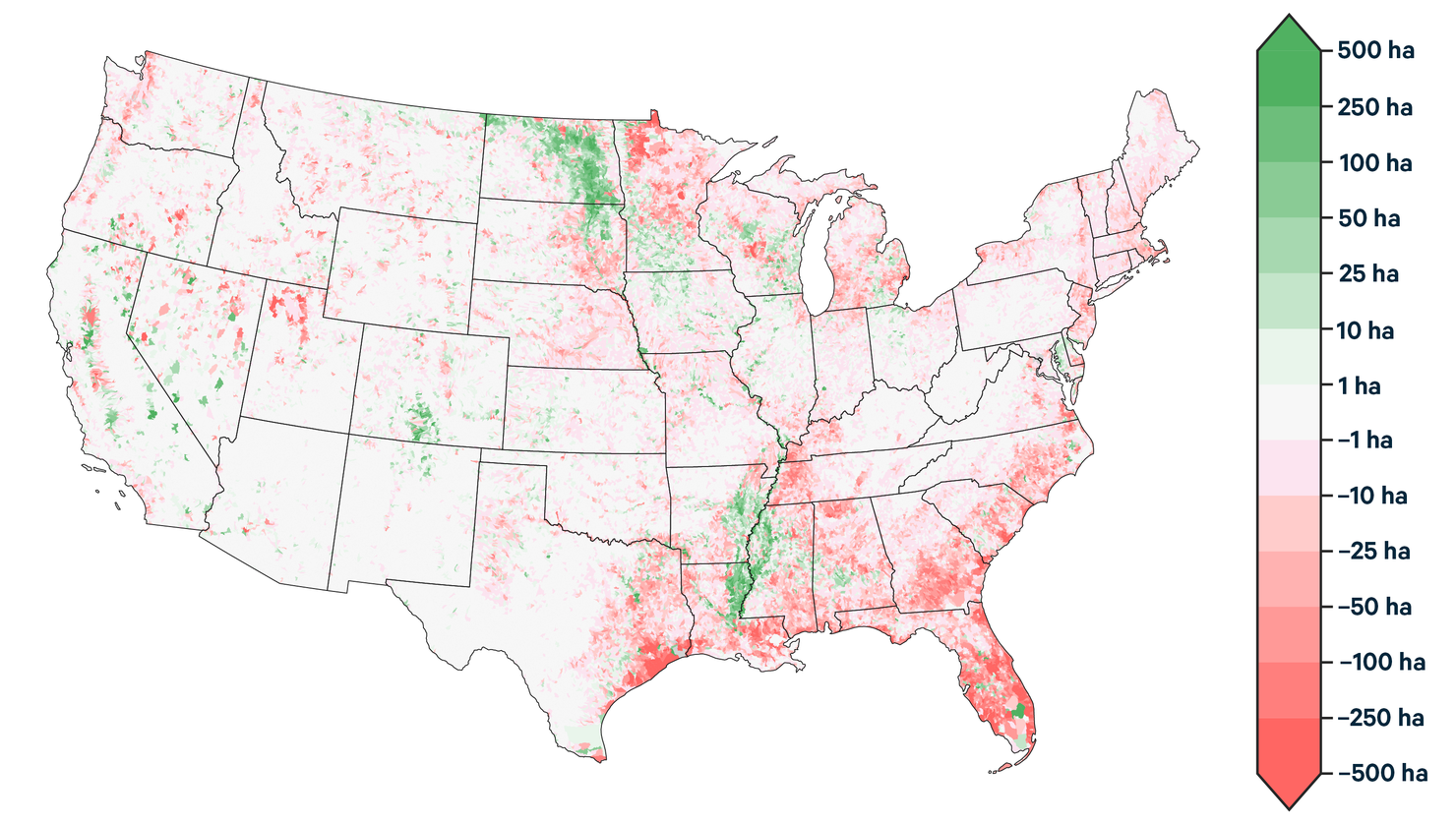
Data accessed from the National Land Cover Database; summarized by Hydrologic Unit Code–12 sub-watershed.
Private landowners often have limited financial incentive to preserve wetlands, since many of the benefits of wetland conservation go to people living elsewhere in the watershed. To correct this market failure, government interventions can facilitate pricing mechanisms that internalize the value of wetlands in market prices, thus creating a financial signal for conservation. At the federal level, the National Flood Insurance Program (NFIP) provides a clear opportunity for pricing the flood-mitigation benefits provided by wetlands. By incorporating the risk-reduction benefits provided by wetlands into its pricing methodology, the NFIP has the potential to improve actuarial soundness and create financial and political incentives for increasing investment in wetland conservation. However, implementing this type of pricing mechanism requires precise and accurate information about how incremental changes in wetlands translate into flood mitigation benefits.
In a recent study published in Nature Water, my coauthors Adam Gold and Helena Garcia and I address this challenge by quantifying the value of wetlands in reducing property losses from riverine flooding across the United States. (This research did not look at green infrastructure used to manage stormwater flooding in urban areas, nor did it look at coastal flooding.) To estimate the value of wetlands, we identify the effects of changes in wetland area across the conterminous United States between 1985 and 2023 on riverine flood insurance claims to individual properties.
Estimated Effects of Changes in Wetland Area
We find that wetland loss significantly increases the claim payment amounts through flood insurance. In the sub-watershed where a property is located, we estimate that one additional hectare of lost wetlands increases claim payment amounts by an average of 0.033 percent. For example, 50 hectares of wetlands lost since 1985 would have increased a $100,000 claim by an average of $1,650. Wetland loss in sub-watersheds located upstream of a property also increases claim payment amounts, but the effect sizes diminish as the distance between wetlands and claims increases.
By contrast, gains in wetland area do not have a statistically significant effect on claim payment amounts. Our null result is consistent with other recent findings; however, this result may be due to the limited sample of claims that experience gains in upstream wetland area, resulting in insufficient statistical power to detect an effect. More broadly, though, these null results do align with other research on the ecological effects of wetland restoration, which have shown that historical efforts to restore wetlands have been generally ineffective in recovering the original level of wetland ecosystem functions. This difficulty of restoring the natural environment suggests that the loss of intact wetlands may pose relatively larger costs compared to the benefits from newly restored wetlands.
Taken together, these results may imply that the loss of ecosystem services from wetland conversion is unlikely to be directly offset by restoration elsewhere. Thus, if wetland degradation is being justified based on the promise that restoration will be fully compensatory, then the flood-mitigation benefits provided by wetlands may continue to decline.
Cumulative Effects of Wetland Loss over Time
Based on our empirically estimated effects, we calculate that wetland loss since 1985 has increased flood insurance payments by an average of $5,915 per claim, and a total of $10.1 billion—equal to roughly 9 percent of all payments made on riverine losses. As shown in Figure 2, these costs are concentrated in the Houston metropolitan area, southeastern Louisiana, and coastal Florida—sites of high wetland loss, high flood risk, and high flood insurance uptake. We also find that historical wetland loss has disproportionately increased flood losses in Census tracts with lower household incomes and a higher percentage of nonwhite population.
Figure 2. Total Cost of Additional Claims Payments Caused by Wetland Loss Since 1985
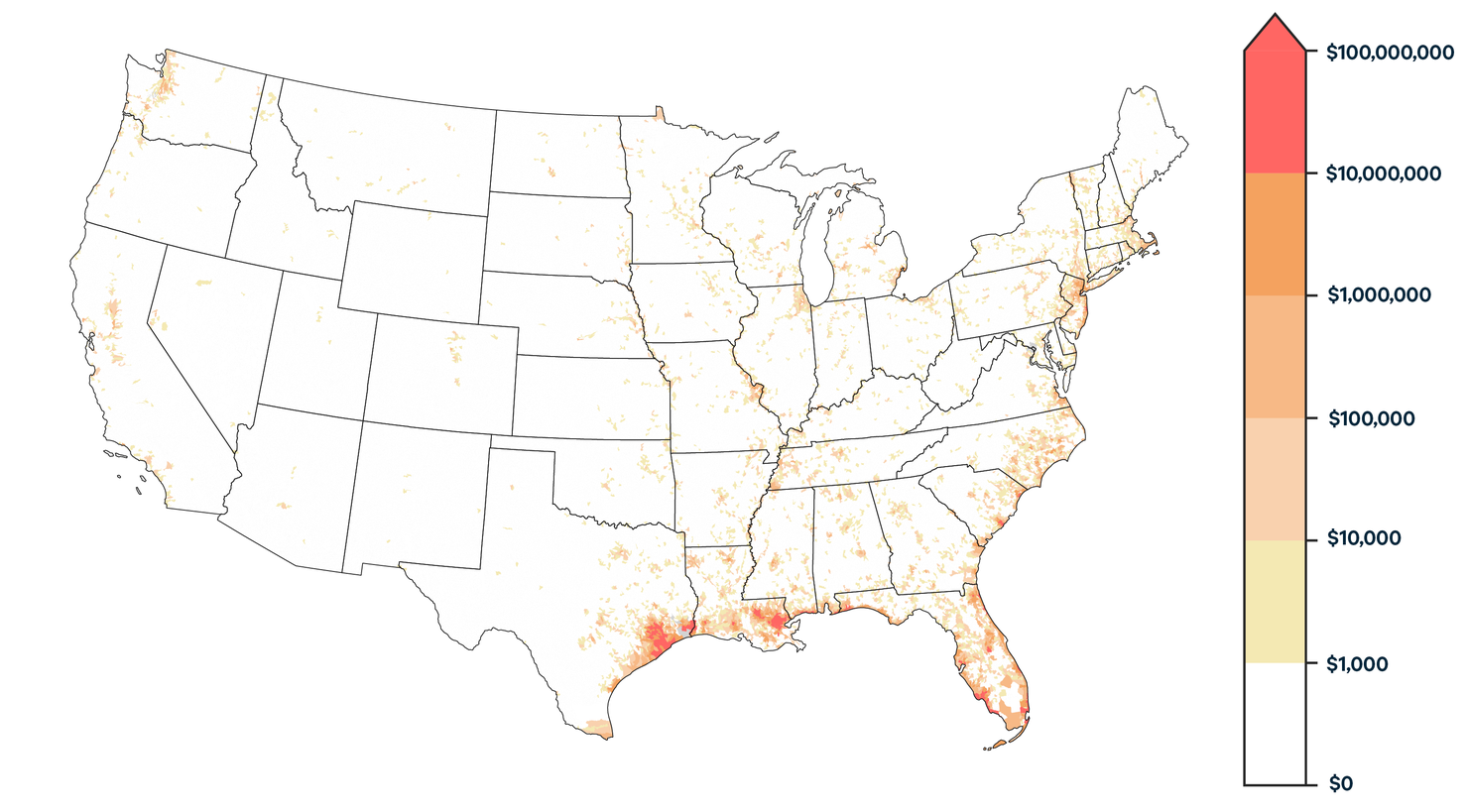
Summarized by Hydrologic Unit Code–12 sub-watershed.
However, it is important to note that only 30 percent of expected annual flood losses are insured by the NFIP. When considering the other 70 percent of uninsured (or privately insured) flood losses, which are less easily observed, the total costs of historical wetland loss since 1985 could exceed $33 billion. Lower-income, Black, and Hispanic households are also less likely to be insured, which may also lead us to underestimate disparities across demographic groups.
Implications for Flood Insurance Pricing
The information from this analysis can be used to support decisionmaking among a range of actors in local, state, and federal governments, and in the private sector. Flood insurance underwriting models in particular could be a potential tool for pricing the flood-mitigation benefits provided by wetlands.
Currently, it is not clear if or how wetlands are incorporated or represented in the proprietary flood-hazard models underlying the NFIP’s pricing methodology. Even if wetlands are well represented, these models are updated infrequently, such that a change in wetland area is unlikely to be reflected in NFIP rates. This lag may therefore mute the price signal that could otherwise help to incentivize wetlands protection.
Apart from the flood-hazard models, wetlands are partially accounted for as part of the NFIP’s Community Rating System. The Community Rating System awards points to communities that engage in specific activities to manage flood risk, such as preservation of open space, which then translate to community-wide premium discounts ranging from 5 to 45 percent. While the Community Rating System technically values the flood-mitigation benefits of wetlands via these discounts, this approach is actuarially imprecise and not empirically grounded.
As an alternative, the NFIP could use our estimates to adopt a simple pricing structure that adjusts insurance rates for individual properties based on annual losses in upstream wetland area observed by the National Land Cover Database. While our study focuses specifically on the role of wetlands in reducing flood losses, our approach could easily be applied to estimate the effects of other types of nature-based solutions (e.g., mangroves, coral reefs), which then could be similarly incorporated into NFIP pricing.

This blog post is a lightly edited version of an article originally published by Insurance for Good.